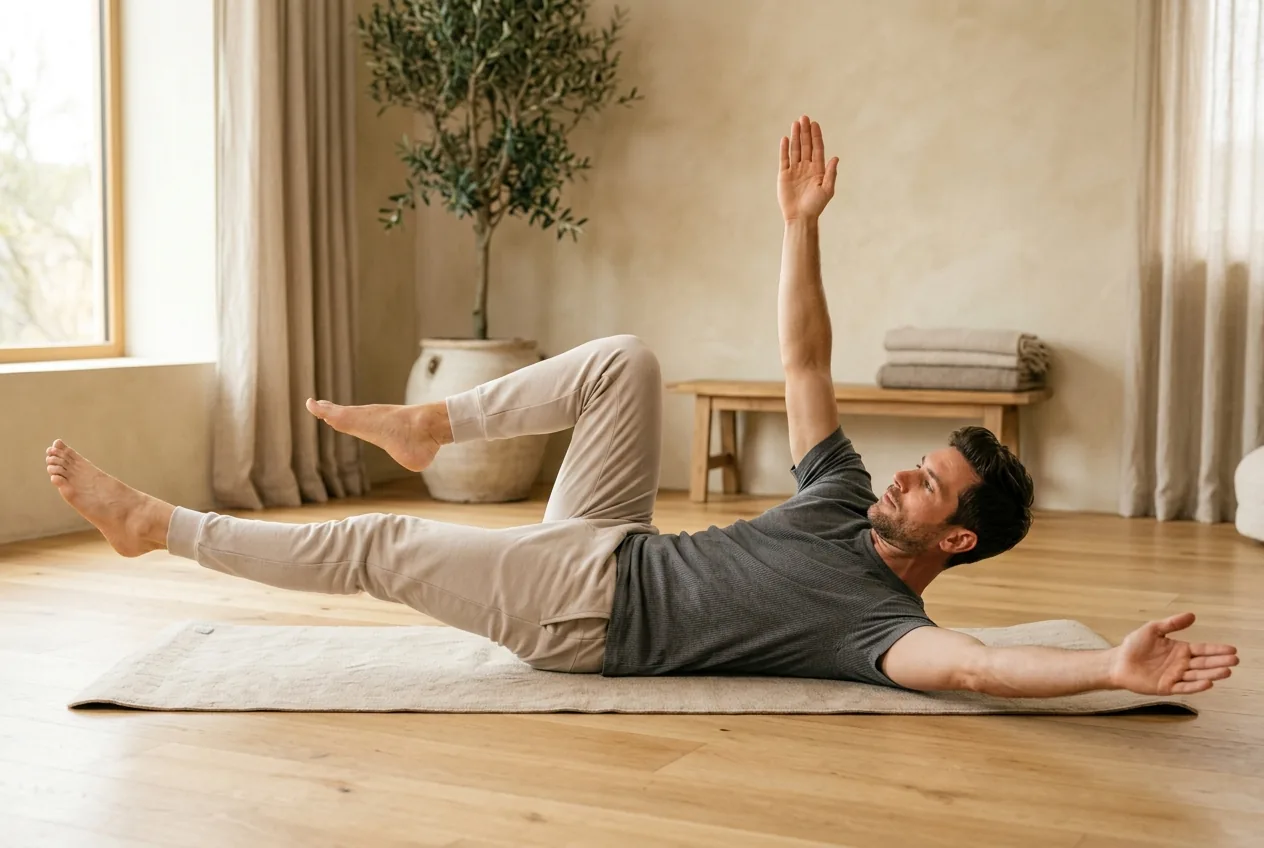

If you've started bracing a hand on the wall to put your socks on, or your back complains the first few steps out of a chair, you don't need a punishing workout — you need movement that's gentle, steady, and yours to control. Gentle back exercises for seniors aren't a watered-down version of younger training. They're aimed at the things that actually matter after 50: getting out of a chair without thinking about it, turning to back the car out, sleeping through the night, carrying the groceries in one trip.
This is a practical routine. You'll get a short set of safe moves with clear how-to, the things worth skipping, and the signs that mean check with a doctor before you start.
What changes with age — and what doesn't
Some stiffness with age is normal. Joints move a little less freely, muscles take longer to wake up, and a back that's spent decades in chairs and cars has settled into certain patterns. That's the part people assume is permanent. Much of it isn't.
Here's the encouraging part: the muscles that support your spine respond to gentle work at any age. A glute that's gone quiet from years of sitting can be woken up at 70 the same way it can at 40 — just more gradually. The goal isn't to turn back the clock. It's to give your back the support and movement it's been missing, so daily life stops feeling like a negotiation.
The principle is the same one behind weak glutes and back pain at any age: when the right muscles do their job, the spine stops overworking to cover for them.
The aim isn't to get strong like you were at 30. It's to move through your own day without bracing for it.
A gentle daily routine
Do these slowly, breathing normally. Stop any move that causes sharp or shooting pain — a gentle stretch or mild effort is fine, sharp pain is not. Use a sturdy chair or wall for balance whenever you need it.
Seated marching. Sit tall toward the front of a firm chair. Slowly lift one knee a few inches, lower it, then the other. This wakes up the hips and core without any strain. 10 lifts per side.
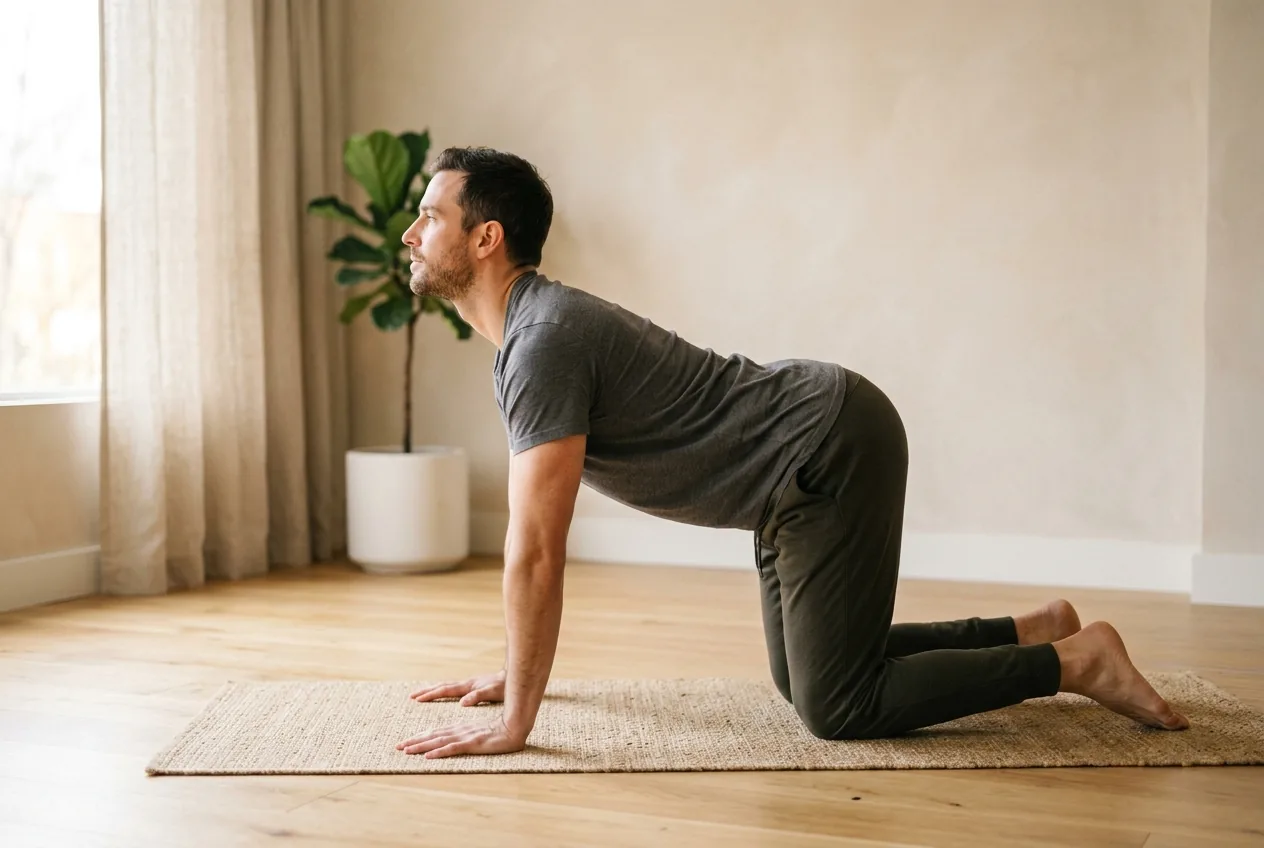
Cat-cow, seated or on all fours. If the floor is comfortable, do the cat-cow stretch on hands and knees. If not, do it seated: hands on knees, gently round your back on an out-breath, then arch and open your chest on an in-breath. This restores spinal movement. 8 slow cycles.
Supported glute bridge. Lie on your back, knees bent, feet flat. Gently squeeze your backside and lift your hips just an inch or two, then lower slowly. Keep it small. This is a gentle version of the glute bridge for back pain. 2 sets of 8.
Wall chin tucks. Standing or sitting tall, gently glide your head straight back to make a light double chin, eyes level, hold five seconds, release. This eases the forward-head slump that builds with reading and screens. 8 reps.
Sit-to-stand. From a firm chair, stand up and sit down slowly, using your legs and backside rather than pushing off your hands when you can. This is the single most useful real-life movement to keep strong. 2 sets of 6–8. Keep a hand on the chair arm for safety.
Run through the set once a day. A calm ten minutes beats an exhausting half-hour, and consistency is what changes how your back feels.
A note on warming up: you don't need anything elaborate, but a couple of minutes of easy walking or marching on the spot before the routine lets stiff muscles loosen so the moves feel smoother and safer. After 50, going from cold and still straight into exercise is the most common way people give themselves a tweak. Ease in.
What to skip or modify
- Don't push into sharp pain. Mild effort and gentle stretch are the targets. Sharp, shooting, or sudden pain is a signal to stop, not push through.
- Go easy on deep forward bends and heavy twisting, especially if you have a known disc issue or osteoporosis. Keep movements within a comfortable, controlled range.
- Skip breath-holding and straining. If a move makes you hold your breath or grit your teeth, it's too much — make it smaller.
- Use support without shame. A wall, a chair, or a counter for balance lets you do the move safely, which matters far more than doing it unaided.
When to check with a doctor first
This part matters more after 50, so check with your doctor before starting if any of the following apply, and seek care promptly if they appear:
- Numbness, tingling, or weakness spreading into a leg or arm
- Any loss of bladder or bowel control
- Back pain after a fall or injury
- Fever alongside back pain, or unexplained weight loss
- A diagnosis of osteoporosis, a recent fracture, or recent spine surgery
- Pain that is severe, or steadily getting worse rather than easing
None of this is meant to scare you off moving. It's to make sure the movement you do is the right kind for your situation. A quick conversation with your clinician clears the path — and for most people, the answer is a green light to start gently, which is exactly what this routine is built for. Staying still because you're worried about your back tends to make a back stiffer and weaker, not safer. Gentle, regular movement is usually the more protective choice once a doctor has ruled out the red flags above.
Why a routine matched to you works better
A gentle general routine helps most older adults, and it's a fine place to start. But the reason your back aches — a forward-tipped pelvis, switched-off glutes, a rounded upper back, or some mix — is specific to you, and it shapes which moves should get the emphasis. The same set that eases one person's back can do little for another's, because their pattern lives somewhere else.
That's the limit of any one-size-fits-all list. Knowing your own pattern is what turns gentle exercise into a routine that holds and keeps you steady. A posture assessment measures where your body actually deviates — gently, from a couple of photos — and builds a program around it, scaled to where you are now.
Start with the routine above, keep it gentle, keep it daily, and let it earn back the small movements that make a day easier. Then match it to your body, and let it do the quiet work over time.
Common questions
Is it safe to exercise my back after 50 if it already hurts?
For ordinary mechanical aches, gentle and regular movement is usually the more protective choice, since staying still tends to leave a back stiffer and weaker. The exceptions are the red flags below — numbness or weakness, loss of bladder or bowel control, pain after a fall, osteoporosis, recent fracture or surgery — which mean check with your doctor before starting.
How often should an older adult do these exercises?
Once a day is enough. A calm ten minutes done consistently changes how your back feels more than an exhausting half-hour you can only manage now and then.
Do I need to warm up before gentle back exercises?
A couple of minutes of easy walking or marching on the spot is plenty. After 50, going from cold and still straight into exercise is one of the most common ways people tweak something, so easing in matters more than any elaborate warm-up.
Which exercise matters most for daily life?
The sit-to-stand. Standing up and sitting down slowly using your legs and backside is the movement you repeat all day, so keeping it strong does the most to make getting out of a chair feel automatic again.