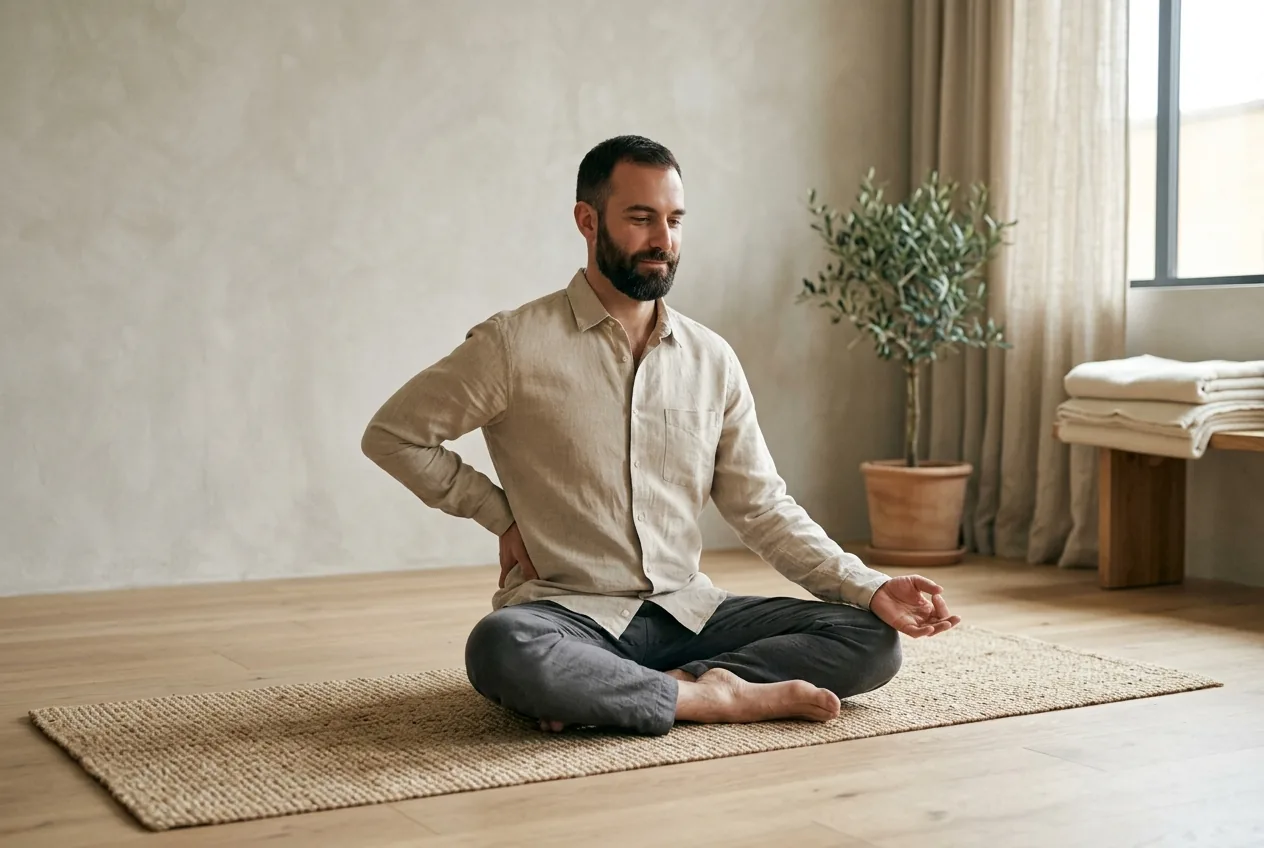
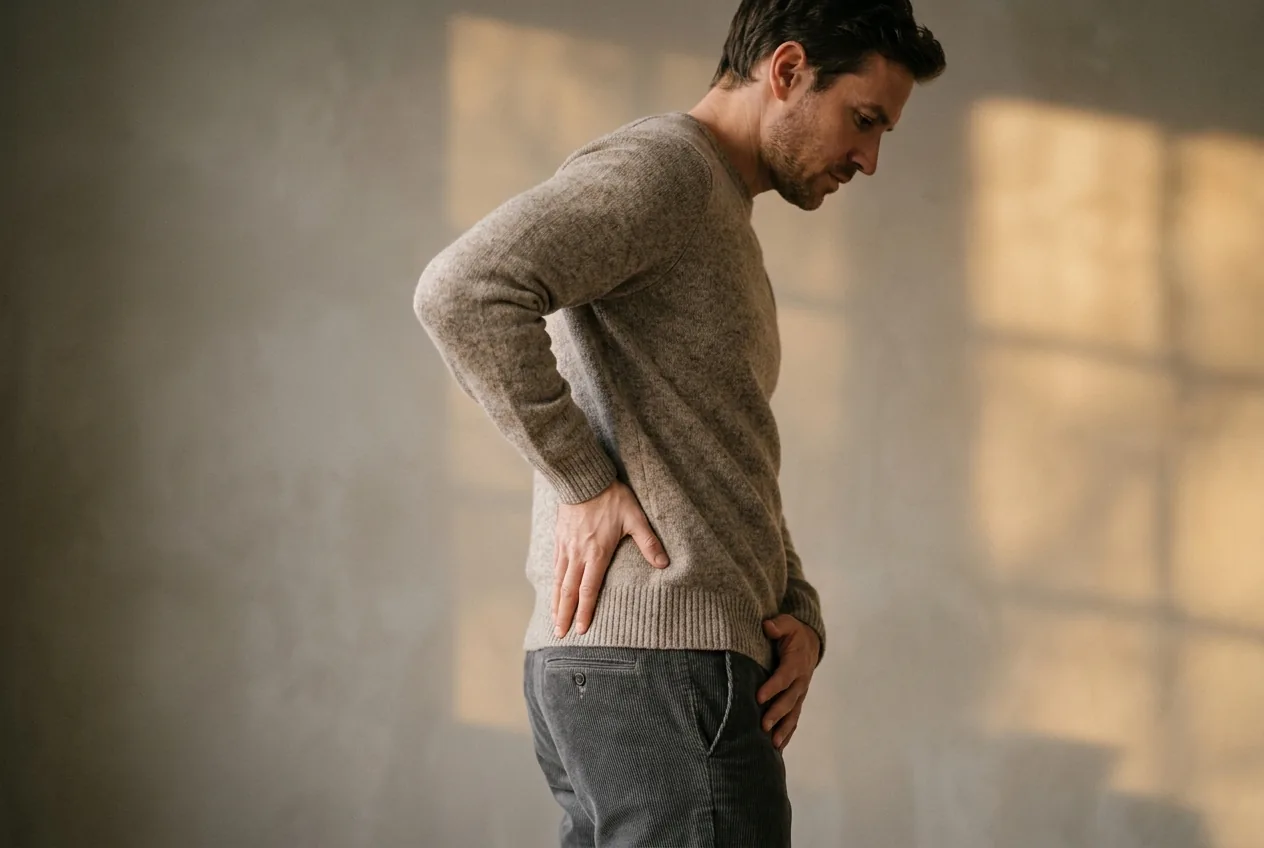
It starts as a low ache in the back, then you notice it wrapping around to the front — a deep, dragging pull in the crease of the hip or the groin. Standing up after sitting makes it announce itself. So does the first few steps of a walk. When lower back and groin pain show up together like this, it's confusing, because the two spots feel so far apart that it seems like two separate problems.
Often it's one. The lower back, the pelvis, and the hip all share the same neighborhood of muscles and joints, and a problem in one frequently refers pain into the others.
Why back pain travels to the front
Pain doesn't always announce itself where the trouble actually sits. Nerves and muscles from the lower spine and pelvis feed into the front of the hip and the groin, so an irritated structure in the back can be felt in the front. This is why lower back pain that radiates to the front is so common and so disorienting.
A few mechanical patterns produce this back-to-groin wrap:
- Tight hip flexors. The main hip flexor runs from your lower spine, through the pelvis, to the front of your thigh. When it's short and tight from long sitting, it can pull on the lower back at one end and ache deep in the groin and front of the hip at the other. This single muscle explains a large share of combined back-and-groin pain.
- The SI joint. The joint where your pelvis meets your sacrum can refer pain into the groin as well as the low back when it's irritated. The SI joint pain article covers it.
- The hip joint itself. The ball-and-socket hip joint typically refers its pain straight into the groin. If your "back" pain is really hip pain, the groin is often the giveaway.
- A tipped pelvis. An anterior pelvic tilt shortens the front of the hips and over-arches the back, loading both the lower back and the front of the pelvis at once.
When the lower back and groin ache together, the hip flexor and pelvis are usually the link between them.
What tends to help
The aim is to release the tight front of the hips, calm the pelvis, and stop feeding the imbalance — gently.
Kneeling hip flexor stretch. Kneel in a lunge, tuck your tailbone slightly under, squeeze the down-side glute, and ease your hips forward until you feel a stretch across the front of the back hip and into the groin. Hold 30 seconds each side. This directly targets the muscle most likely linking your back and groin. The hip flexor stretch for back pain breaks it down.
Knee-to-chest. Lie on your back and draw one knee gently toward your chest, hold 20 to 30 seconds, switch. This eases tension low in the back and the front of the hip.
Glute bridge. Lie on your back, knees bent, feet flat. Lift your hips by squeezing your glutes, hold two seconds, lower slowly. Do 10 to 12. Waking the glutes takes the pelvis out of its forward tip, which unloads both the back and the front.
Stop feeding it. Break up long sitting, which is what shortens the hip flexors in the first place. Alternate the side you carry loads on. Don't push into deep back-arching stretches when the back is already over-arched.
Keep all of these pain-free. If a move sharpens the groin pain rather than easing it, stop and reread the section below.
When to see a doctor
This is where groin pain needs more care than ordinary back pain, because the lower abdomen, pelvis, and groin sit near several organs that can refer pain — and a few of these are not muscle problems at all.
See a clinician promptly if you have numbness, tingling, or weakness spreading down a leg, any loss of bladder or bowel control, pain after a fall or accident, fever with back pain, or unexplained weight loss. Beyond the standard flags, groin pain warrants specific attention. Get checked soon for: a visible bulge or lump in the groin, which can signal a hernia; back-and-flank pain with groin pain plus burning urination, blood in the urine, or fever, which can point to a kidney stone or urinary infection; testicular pain or swelling in men; and pelvic pain with abnormal bleeding or, in pregnancy, intense or one-sided pain in women. Sudden, severe lower-abdominal-and-groin pain with nausea or fever should be treated as urgent, not stretched. When in doubt with groin pain, get it looked at rather than assuming it's muscular.
Why a generic routine often misses it
Here's what most advice skips. Back-and-groin pain has several possible drivers — a tight hip flexor, an irritated SI joint, the hip joint, a tipped pelvis — and the right moves for one can do little for another. A stretch that frees a tight hip flexor won't help much if the real source is the hip joint, and pushing the wrong direction can aggravate things.
Once anything serious is ruled out, lasting relief comes from knowing which pattern is actually yours: how your pelvis sits, which hip muscles are short, where the load lands. That's the idea behind a posture assessment that measures your real deviations and builds the routine around them, instead of guessing. If you've tried generic stretches without it sticking, see how a posture-based method approaches chronic back pain.
When the back and groin ache as a pair, treat them as connected — through the hips and pelvis — rather than as two separate fires to put out.
Common questions
Why do I have lower back and groin pain at the same time?
The lower back, pelvis, and hip share muscles and joints, and pain often refers between them. A tight hip flexor that runs from the lower spine to the front of the thigh is the most common link, along with an irritated SI joint, the hip joint, or a forward-tipped pelvis.
Can a tight hip flexor cause groin pain?
Yes. The main hip flexor attaches near the lower spine and runs to the front of the thigh, so when it's short and tight it can pull on the back at one end and ache deep in the groin and front of the hip at the other. Releasing it often eases both.
When should lower back and groin pain be checked by a doctor?
Get it checked promptly for spreading numbness or weakness, loss of bladder or bowel control, pain after a fall, fever, or weight loss. Groin-specific flags include a visible bulge (possible hernia), flank and groin pain with burning or bloody urine (possible kidney stone or infection), testicular pain in men, or pelvic pain with abnormal bleeding in women.
Is lower back and groin pain a muscle problem or something internal?
It's often muscular, tracing to the hip flexor, SI joint, or pelvis. But the groin sits near organs that can refer pain, so internal causes like hernias, kidney stones, or pelvic issues are possible. If the pain comes with a bulge, urinary symptoms, fever, or abnormal bleeding, treat it as a medical question, not a stretching one.