
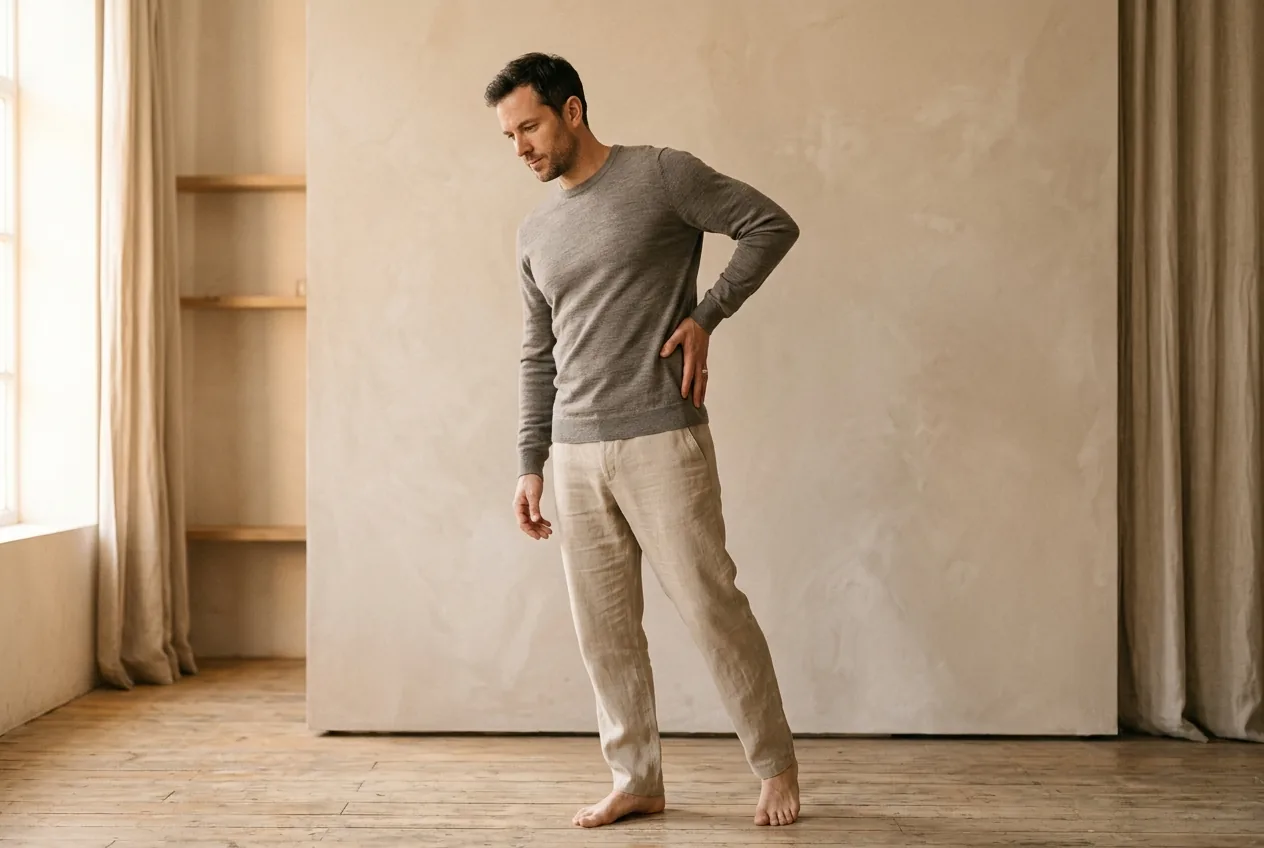
You reach across the desk for a mug with your right hand, and a sharp pull lights up the left side of your lower back. Or you roll over in bed and only the left side complains. The pain has picked a side, and you keep wondering why it's there and not somewhere central.
Lower back pain on the left side is incredibly common, and most of the time it's mechanical — muscles, joints, and soft tissue, not anything sinister. The side it lands on is rarely random. It usually tells you which part of your body has been doing more than its share.
Why pain picks the left side
Your spine sits in the middle, but you don't live symmetrically. You carry a bag on one shoulder, sit twisted toward a second monitor, drive with one foot on the pedals, sleep curled the same way every night, and hold a toddler on the same hip. Over months and years, one side ends up working harder than the other.
When the left side of your lower back carries more load — or has to brace because something else switched off — the muscles there fatigue, tighten, and start to ache. That's the simplest version of left-sided back pain: an asymmetry your body has quietly adapted to.
The pattern often isn't really "the left side is the problem." It's that the left side is compensating for something. A hip that sits higher on one side, a pelvis that's rotated, a weak glute on the right that leaves the left to overwork — these imbalances send the strain to one side. The ache is the symptom; the lopsided loading is the cause. This is the same logic behind one-sided lower back pain in general, and it's worth reading if your pain switches sides or moves around.
The usual mechanical causes
A few specific things tend to produce left-sided lower back pain.
A muscle strain or spasm. The most common cause by far. You lifted awkwardly, twisted under load, or simply held a tense posture too long, and a muscle on the left went into protective guarding. It feels tight, sore to press, and worse with certain movements. If your muscle has fully locked up, lower back spasm relief walks through how to calm it down.
The SI joint. The sacroiliac joint connects your spine to your pelvis, one on each side. When the left one gets irritated or moves poorly, you feel a deep ache just to the side of the spine, often near the dimple above the buttock. It frequently flares with standing on one leg, climbing stairs, or rolling over in bed.
A facet joint. The small joints at the back of the spine can get irritated on one side, giving a localized ache that's worse when you lean back or twist toward the sore side.
Referred pain from the hip or pelvis. A tight hip, a cranky piriformis, or an uneven pelvis can all refer ache into the left lower back without the spine being the real culprit.
What about the things that aren't muscular
This is where left-sided pain earns a little extra attention. Organs on the left side of your torso can occasionally refer pain to the back. The left kidney can cause pain higher up and more to the side, usually with urinary symptoms or fever. These are less common than muscle and joint causes, but they're the reason you shouldn't ignore left-sided pain that comes with symptoms unrelated to movement — fever, blood in your urine, or stomach upset.
The quick test most people use: mechanical pain changes with movement and position. If leaning, twisting, or pressing the spot clearly changes the pain, it's almost certainly musculoskeletal. If the pain is steady, deep, and unrelated to how you move, that's a reason to get it checked.
What actually helps
For the common mechanical version, the goal is to settle the irritated side and rebalance the load.
Keep moving, gently. Lying still for days stiffens everything and slows recovery. Short, easy walks usually help more than bed rest.
Use heat once the acute phase passes. For a fresh, angry strain, ice in the first day or two can calm it; after that, heat relaxes the guarding muscle. If you're unsure which to reach for, heat or ice for back pain breaks down the timing.
Stretch the tight side, but don't force it. Gentle knee-to-chest pulls, a slow figure-four for the hip, and easy rotations can release the left side. Stop short of any sharp pain.
Stop feeding the asymmetry. Notice the daily habits loading your left side and break them. Swap your bag to the other shoulder. Sit square to your screen. Stop standing with all your weight cocked onto one hip. Alternate the side you carry your kid on.
Wake up the side that quit. Often the left overworks because something on the other side isn't pulling its weight. Glute and core work that restores balance takes pressure off the side that's complaining. For more immediate strategies when you need relief today, how to relieve lower back pain fast covers the steps that calm a flare quickest.
Left side versus right side
People often assume left-sided and right-sided back pain are different problems. Mechanically, they're usually the same kind of issue landing on opposite sides — the same muscles, the same joints, just mirrored. What differs is which everyday habits and which imbalance are driving it. If your pain has settled on the other side instead, right-sided lower back pain covers the same ground from that angle. The thing worth knowing is that the side it picks is a clue to your particular loading pattern, not a separate diagnosis.
The side your back pain picks is rarely an accident — it's usually the side that's been carrying more than its share.
When to see a doctor
Most left-sided lower back pain is mechanical and eases within a few weeks. Some signs mean you should be seen promptly rather than wait it out: weakness in the leg or foot, numbness spreading into the saddle area between your legs, or any loss of bladder or bowel control — those can signal nerve compression and need same-day attention. Also get checked if the pain follows a fall or accident, comes with fever, blood in your urine, or unexplained weight loss, or is severe and steadily worsening rather than settling. Pain that's constant, doesn't change at all with movement, and is paired with feeling unwell deserves a clinician's look to rule out a non-muscular cause.
Why the same fix doesn't work for everyone
Here's the honest limit of general advice: the reason your pain landed on the left in the first place is specific to how your body is built and how it's adapted. A pelvis tilted one way, a hip sitting higher, a glute that switched off — each sends load to a different place. Generic stretches can't see which imbalance is driving your left-sided ache, which is why people stretch for months without it sticking.
That's the thinking behind a posture assessment: instead of guessing, you measure your actual deviations and build a daily routine around the imbalance that's overloading one side. If the steps here help a little but the ache keeps returning to the same spot, knowing your own pattern is usually the missing piece — and the posture therapy approach is built to find the cause under the symptom.
Common questions
Why does my lower back hurt only on the left side?
Most often because one side of your body has been carrying more load — from a habit like a one-shoulder bag, sitting twisted, or a pelvis and hip imbalance that leaves the left muscles overworking. A muscle strain, an irritated SI or facet joint on that side, or referred pain from a tight hip are the usual culprits.
Should I worry about left-side back pain?
Usually no — mechanical pain that changes with movement and position is the common case. Be more cautious if the pain is steady regardless of how you move and comes with fever, blood in your urine, stomach upset, or unexplained weight loss, since the left side also houses organs that can occasionally refer pain to the back.
How long does left-sided lower back pain last?
A simple muscle strain or joint irritation usually eases over one to three weeks with gentle movement and sensible loading. If it's lingering past six weeks or keeps coming back to the same spot, the underlying imbalance probably hasn't been addressed yet.
Is left-side back pain a kidney problem?
It can be, but that's the less common cause. Kidney pain tends to sit higher and more to the side, doesn't change much when you move, and usually comes with urinary symptoms or fever. If your pain clearly shifts when you bend, twist, or press the area, it's far more likely to be muscular or joint-related.