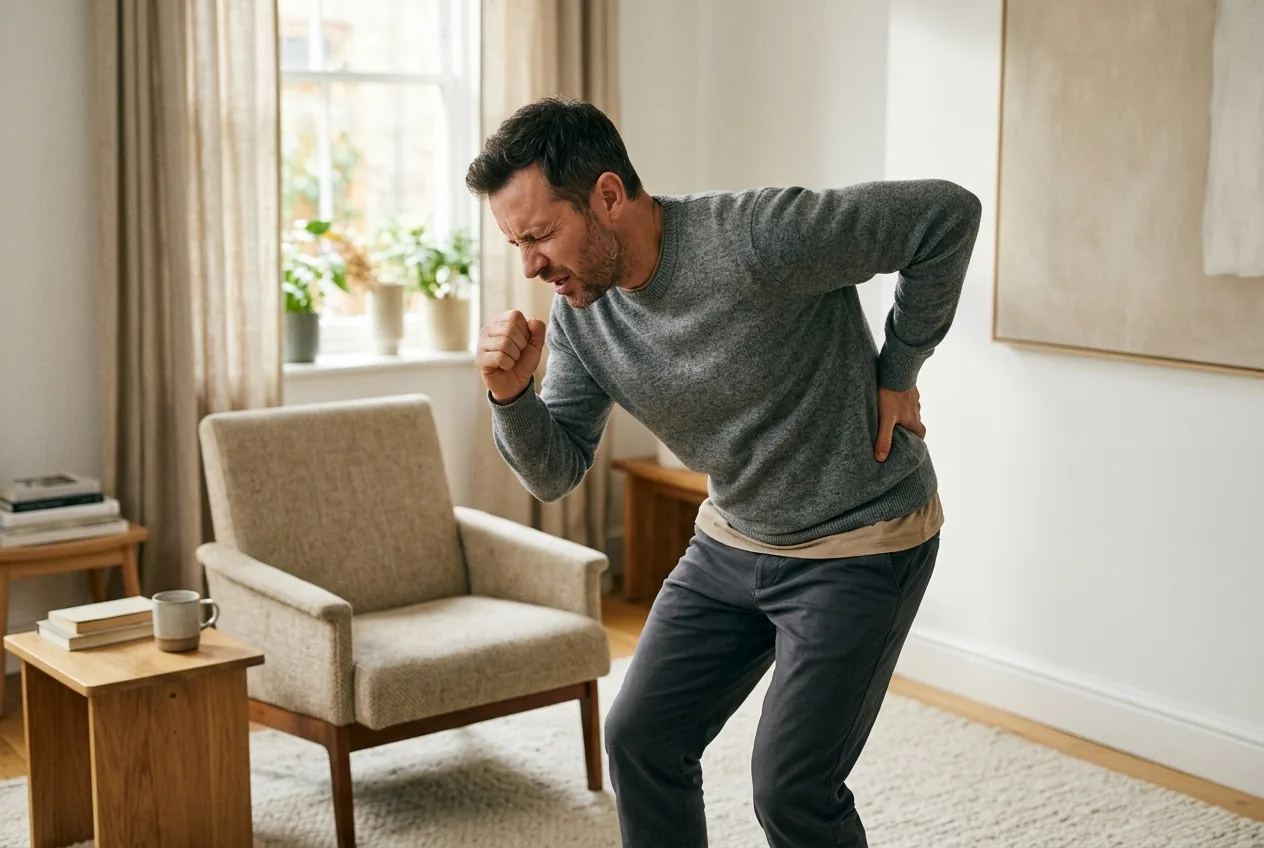
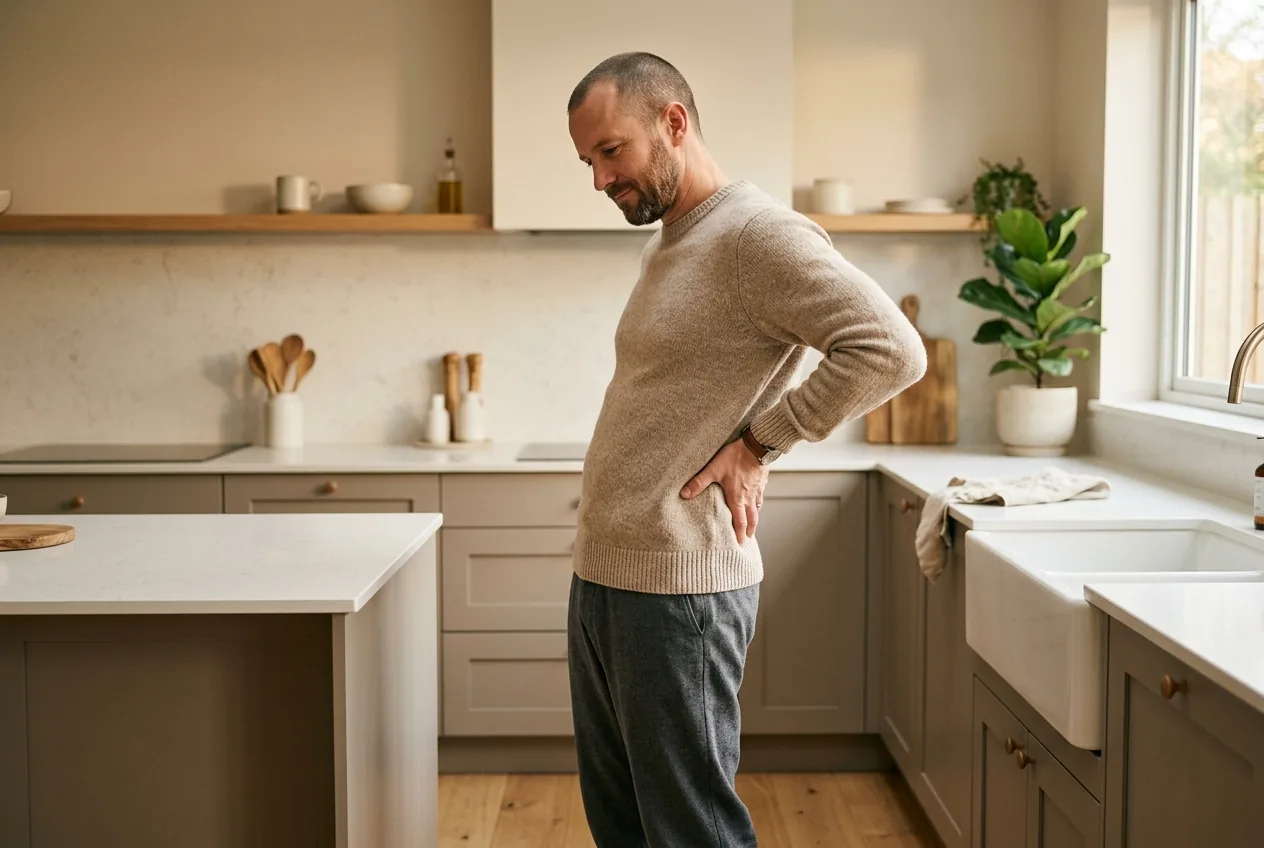
You can sit fine. You can walk for a bit. But stand still in a kitchen, a queue, or at a kids' birthday party for twenty minutes and your lower back starts to bark — and leaning on the counter or sitting down makes it stop. If that's you, this is the pattern worth understanding.
Standing pain that eases the instant you sit or fold forward is mechanical and postural far more often than it's anything alarming. It's about how you stack your body when there's nothing to support it.
Why standing still is harder than walking
Walking shares the load. Each step shifts weight, the muscles around your hips and spine take turns working, and circulation keeps moving. Standing still removes all of that. You're holding one posture with the same muscles for minutes on end, and your lower back becomes the prop that keeps you upright.
For a lot of people, that default standing posture is a quiet over-arch: belly forward, weight dumped into the lower back, knees locked. The small joints at the back of the spine press together and start to complain. Sit or lean and you open those joints up, which is why the relief is so fast.
The arch that's doing the work
The usual culprit is an exaggerated lower-back curve, often driven by anterior pelvic tilt — the pelvis tipped forward like a bowl spilling water out the front.
Years of sitting shorten the hip flexors at the front of the pelvis. They pull the pelvis down and forward. The glutes and deep core, which should hold the pelvis level, have gone quiet. So when you stand, nothing keeps the pelvis neutral, the back arches to compensate, and the load piles onto the very back of the spine.
This is the same imbalance that often makes sitting hurt too, just exposed by a different position. The body is compensating around a postural deviation, and standing still is where it shows.
It's worth being clear about why standing still is uniquely hard. When you walk, no single muscle has to hold a position — the work passes from one side to the other with each step, and blood keeps moving. Standing still removes all of that relief. The same few postural muscles grip continuously, the joints stay loaded in one spot, and there's no rhythm to flush things through. That's why people who can walk for half an hour comfortably can be in real discomfort after ten minutes of standing in a queue. The position isn't worse than walking — the stillness is.
What to do while you're standing
You can take pressure off in the moment without anyone noticing.
- Unlock your knees. Locked knees throw your pelvis forward into the arch. A soft micro-bend changes the whole stack.
- Tuck the tailbone slightly. Think of gently drawing your belt buckle up an inch. This flattens the excess arch and lets the joints breathe.
- Shift your weight. If there's a low step or rail, rest one foot on it for a minute, then switch. Bartenders and chefs do this for a reason — it tilts the pelvis back toward neutral.
- Stand with weight through your heels and mid-foot, not pushed onto the balls of your feet, which tips you forward into the arch.
Moves that change the cause
Hip flexor stretch. Half-kneel with one knee down. Squeeze the down-side glute and tuck your tailbone before you lean forward. Feel it across the front of the hip. Hold 30 seconds each side. Tight hip flexors are usually the engine of this whole pattern.
Glute bridges. Lie on your back, knees bent, feet flat. Press through your heels and lift your hips until your body makes a straight line from knees to shoulders. Squeeze the glutes at the top, lower slowly. Two sets of twelve. This wakes up the muscles that should hold your pelvis level so your lower back stops doing their job.
Standing wall lean for the core. Stand with your back to a wall, heels a few inches out. Gently press your lower back toward the wall using your stomach, hold five seconds, release. This teaches the neutral position you want when standing. For a full progression, core exercises for lower back pain build the deep support you're missing.
Do these consistently rather than intensely. Ten minutes most days does more than an hour once a week, because you're retraining a default position your body holds for hours at a time. The hip flexor stretch and the glute bridge are the two to keep if you only keep two — they attack opposite ends of the same problem, releasing the tight front of the hip and switching on the lazy back of it. Within a few weeks of standing, most people notice the queue or the kitchen counter stops being a countdown.
If leaning on a counter fixes the pain in two seconds, the problem isn't your spine wearing out. It's the position it's stuck in.
What to stop doing
- Stop locking your knees when you stand for a while. It's the single most common trigger.
- Stop the hip-forward "tired teenager" lean with weight hanging on the lower back.
- Stop standing barefoot on hard floors for long stretches if it flares you — a cushioned mat or supportive shoe changes how the load travels up.
When to see a doctor
Standing pain that eases when you sit or bend forward, and that has no leg symptoms, is usually mechanical. See a clinician promptly, though, if standing or walking brings on numbness, tingling, heaviness, or weakness in one or both legs that forces you to stop and sit (this needs a proper look), or if you have pain after a fall, fever with back pain, unexplained weight loss, any loss of bladder or bowel control, or pain that keeps worsening no matter what you do.
Finding your actual pattern
Unlocking your knees and stretching your hip flexors will help, and for some people it's enough. But if standing pain keeps coming back, the imbalance underneath hasn't changed. Generic stretches can even backfire here, because the move that helps an over-arched back can aggravate a flat one — and you can't tell which you have by feel alone. A posture assessment measures your specific deviations and builds the daily routine around them, which is the thinking behind this posture therapy method.
You should be able to stand through a school assembly without scanning the room for somewhere to lean. That's the goal.
Common questions
Why does my lower back hurt when I stand but not when I walk?
Walking shares the load across both sides and keeps blood moving, so no single muscle has to hold a position. Standing still removes that relief, so the same postural muscles grip continuously and the joints stay loaded in one spot, which is why a queue can hurt more than a half-hour walk.
Why does leaning forward or sitting take away standing back pain so fast?
If your lower back tends to over-arch when you stand, the small joints at the back of the spine press together. Leaning on a counter or sitting opens those joints back up, which is why the relief feels almost instant.
Does locking my knees make standing back pain worse?
For many people, yes. Locked knees push the pelvis forward into a deeper arch and dump weight into the lower back. A soft micro-bend in the knees changes how your whole body stacks and often eases the ache.
Will better shoes or a standing mat help?
They can, if hard floors flare you. A cushioned mat or supportive shoe changes how load travels up your legs, but they address the surface rather than the posture pattern underneath, so treat them as one piece of the answer.