If your back keeps flaring up — fine for a week, then floored by something as small as picking up a sock — and crunches and sit-ups only seem to make it angrier, there's a smarter way to train your core. The McGill big 3 exercises are three moves designed by spine researcher Stuart McGill to build endurance in the muscles that brace and protect your spine, without the repeated bending that aggravates a sore back. They're a staple in rehab for good reason: they're gentle on the spine, they target the right muscles, and they teach your core to do the job it's actually meant to do — hold your spine steady while the rest of you moves.
This guide covers the step-by-step for all three moves, what good form feels like, the common mistakes, and how to set the reps so it builds endurance instead of fatigue.
Why these three, and why not sit-ups
A common mistake with a bad back is to train the core by repeatedly flexing it — crunches, sit-ups, leg raises. For an already irritated spine, that repeated bending is often part of the problem, not the cure. The job that actually protects your back is different: it's holding your spine still and neutral while your hips and shoulders move. McGill calls it building a stiff, stable core, and he built three moves to train it across the front, side, and back of your trunk without grinding the spine.
Done as a set, the big 3 train endurance rather than max strength — because a back that gives out usually isn't weak, it's one whose stabilising muscles fatigue and stop bracing partway through the day. That's the same anti-movement skill the bird dog trains, and it's why the big 3 belong alongside the other core exercises for lower back pain that train stability over crunching.
A back that gives out picking up a sock isn't weak. Its stabilisers got tired and stopped holding the line.
Move 1: the curl-up
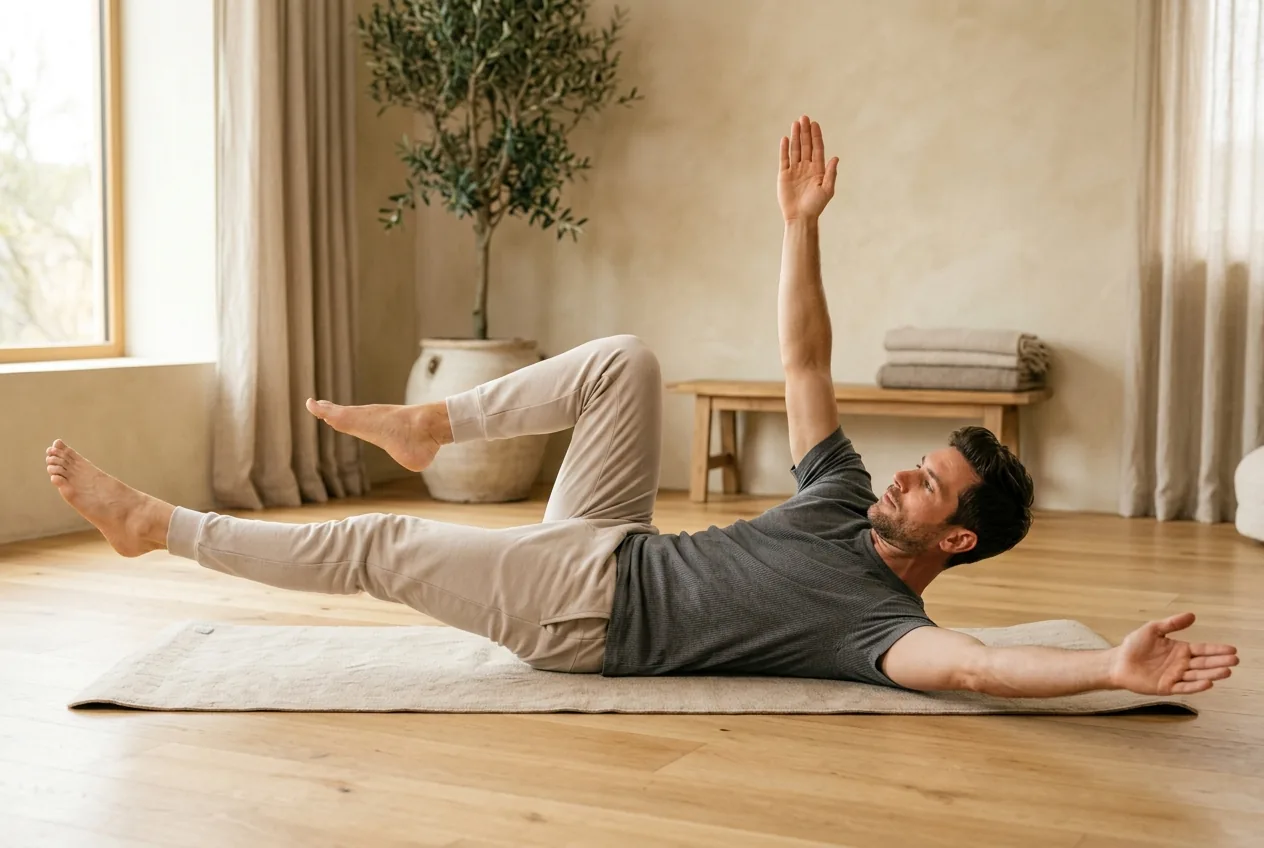
This trains the front of your trunk without rounding your spine like a crunch does.
- Lie on your back. Bend one knee with that foot flat on the floor; keep the other leg straight.
- Slide both hands, palms down, under the small of your lower back to keep its natural arch — don't flatten it.
- Brace your stomach gently, then lift only your head and shoulders a small amount off the floor — an inch or two. Your neck and upper back stay in one rigid line; you're not curling up.
- Hold for about 10 seconds, breathing the whole time, then lower slowly.
- Do your reps, then swap which leg is bent.
The key is that almost nothing moves. You're bracing and holding, not crunching.
Move 2: the side plank
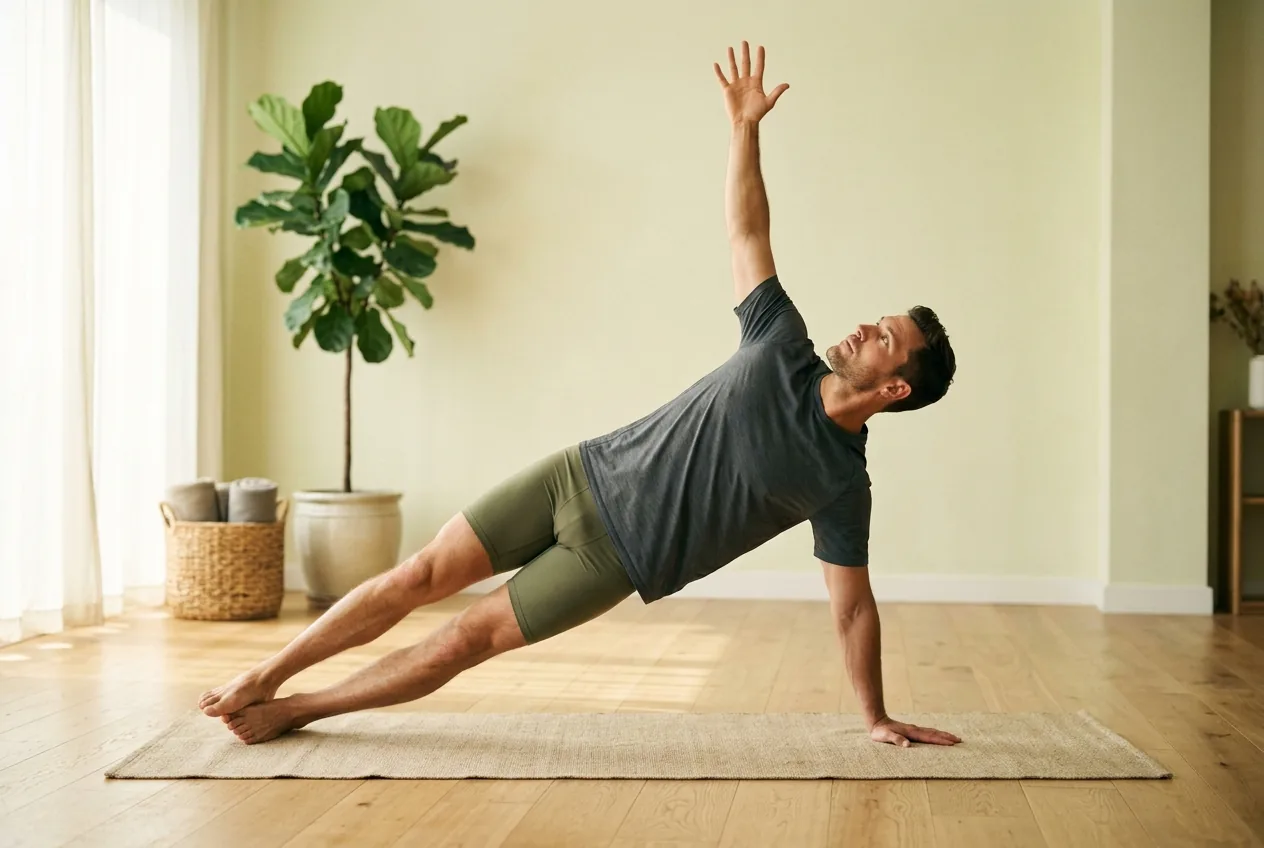
This trains the muscles down the side of your trunk that resist sideways collapse.
- Lie on your side, propped up on your forearm, elbow under your shoulder, knees bent for the beginner version (or legs straight for the harder one).
- Brace your core and lift your hips so your body makes a straight line from knees (or feet) to head.
- Keep your hips stacked and forward-facing — don't let them sag or rotate.
- Hold for about 10 seconds, breathing steadily, then lower with control. Repeat, then switch sides.
Start with the knees-bent version. Progress to straight legs only when the bent version is solid.
Move 3: the bird dog
This trains the back of your trunk and the anti-twist control that protects your spine when you reach and lift.
- Start on hands and knees, wrists under shoulders, knees under hips, spine in a neutral flat-table position.
- Brace your stomach gently, as if bracing to be poked.
- Slowly reach your right arm forward and your left leg back until both are roughly level with your torso — reach *long*, not high.
- Keep your hips and shoulders square to the floor; don't let your back arch or your hips twist.
- Hold about 10 seconds, return with control, then switch to the opposite arm and leg.
There's a full bird dog walkthrough with scaling options if you want to drill that one on its own.
The form errors that undo the big 3
Flattening or arching the lower back in the curl-up. Keep the natural arch under your hands and lift only a couple of inches. Cranking high turns it back into a crunch.
Letting the hips sag or rotate in the side plank. A drooping or twisting hip means the side muscles have stopped working. Hold a straight, stacked line and shorten the hold if you can't.
Lifting the arm and leg too high in the bird dog. Reaching toward the ceiling arches the low back and hands the work to the spine. Stay level with your torso.
Holding your breath. Bracing isn't clenching and freezing. Keep breathing steadily through every hold — endurance training needs oxygen.
Chasing long single holds. McGill's method deliberately uses short holds in descending sets, not one grinding marathon hold. Long holds build fatigue, not the endurance pattern you want.
Sets and reps: the descending pyramid
McGill recommends short holds — about 10 seconds each — in a descending "pyramid" of repetitions rather than one long hold. A typical scheme:
- First set: 6 reps (each a ~10-second hold)
- Second set: 4 reps
- Third set: 2 reps
Run each of the three moves through that pyramid. Done daily or most days, it builds the stabilising endurance that holds up across a whole day. It works well as a morning routine to "switch on" your core before you load it, and it pairs naturally with the glute bridge so the hips drive movement while the core keeps the spine still.
When to see a doctor
The big 3 are gentle and spine-sparing, but symptoms have limits. See a clinician promptly if you have numbness, tingling, or weakness spreading down a leg, any loss of bladder or bowel control, back pain after a fall or accident, fever with back pain, unexplained weight loss, or pain that's severe or steadily worsening. Stop any move that produces sharp or shooting pain rather than steady muscular effort, and get the routine cleared after recent spinal surgery.
Why core endurance is half the equation
The big 3 build a genuinely useful skill, and a more stable core helps almost any back. But how much it helps *you* depends on what's pulling your spine out of neutral in the first place. If a forward-tipped pelvis or weak glutes keep dragging your back into an arch, your core is bracing against a stacked deck — working harder to hold a position your posture keeps undoing.
That's the limit of any exercise set. It builds the skill but can't see the pattern you're bracing against. Knowing your own deviations is what tells you which moves to prioritise and in what order — and whether your back even wants the same emphasis as the next person's. A posture assessment measures where your alignment actually drifts and builds the routine around it, so your core work has a fair fight.
Drill the big 3 with clean form and short holds, and let your core endurance build. Then set them inside the routine your body actually needs.
Common questions
What are the McGill big 3 exercises?
They're three spine-sparing core moves — the curl-up, the side plank, and the bird dog — designed by spine researcher Stuart McGill to build endurance in the muscles that brace and protect your back without the repeated bending that irritates a sore spine.
How often should I do the McGill big 3?
Daily or most days works well, especially in the morning to switch your core on before you load it. Use short ~10-second holds in a descending pyramid — 6 reps, then 4, then 2 — for each move rather than one long hold.
Are the McGill big 3 good for a herniated disc?
They're widely used in rehab because they train stability without flexing the spine repeatedly, which suits many irritated backs. But individual cases vary — clear it with your clinician first and stop any move that sends pain down a leg.
Why short holds instead of long planks?
The goal is endurance in the stabilising muscles, not a max-effort grind. Short ~10-second holds repeated in descending sets build that endurance while keeping fatigue and spine load low. Long single holds tend to build fatigue and poor form instead.