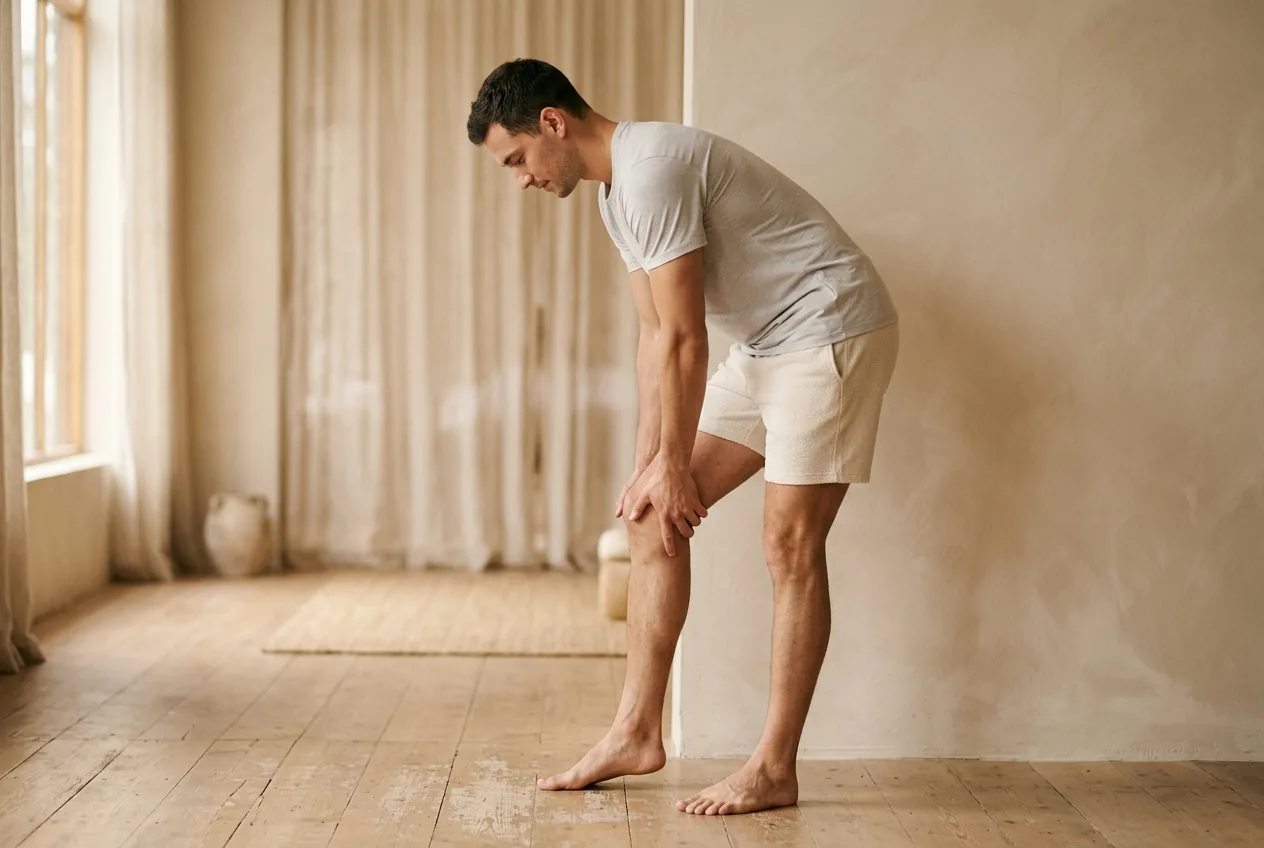
It's the spot you can't quite reach. Pain at the back of the knee shows up when you straighten your leg fully, when you've been walking a while, or when you stretch in the morning and feel a tight, pulling ache behind the joint. It rarely announces itself with a single injury. More often it builds quietly until you notice you're not extending the leg all the way anymore.
Behind-the-knee pain has a wide range of causes, and a few of them are genuinely urgent. So before the fixes, one important note up front.
Read this first: the urgent red flag
This is posture education, not medical advice — and the back of the knee is one place where a couple of signs need a doctor straight away, not a stretch.
If the back of your knee or your calf is swollen, warm to the touch, red, or tender along the calf, and especially if that came on without an obvious cause, get it checked urgently. Those can be signs of a blood clot in the leg (a deep vein thrombosis), which is a medical emergency. The same goes for sudden, severe swelling behind the knee, or a knee that swelled up fast after the pain began. Don't massage or stretch a hot, swollen calf — see a clinician.
With that said, most ordinary back-of-knee pain is mechanical, and the rest of this article is about that kind.
What's usually going on
The back of the knee is a crossroads. Your hamstrings come down from the back of the thigh, your calf muscles run up from below, and they meet right behind the joint. When any of them is tight or overworked, the tension lands in that hollow.
The most common cause is tight hamstrings and calves. Long days of sitting leave the hamstrings short and the calves stiff, so when you finally straighten the leg fully, the tissue at the back gets pulled taut and aches. This is the morning-stretch pull and the after-walking tightness many people describe.
The next cause is upstream. If your hips don't extend properly — usually because the hip flexors are tight and the glutes are quiet — your hamstrings end up doing the glutes' job on every step. Overworked hamstrings get irritated where they attach near the back of the knee. It's the same chain behind a lot of hamstring tightness and back pain: the hip sets the terms, the back of the knee complains.
The back of the knee is where the thigh and calf meet — so tightness above or below tends to land right in that hollow.
The moves that ease it
Work the tissue around the knee gently, and address the hips that load it.
Calf stretch against a wall. Hands on the wall, one leg back with the heel down and knee straight, lean in until you feel a stretch through the calf. Hold 30 seconds each side. A straight-knee version targets the upper calf where it crosses the back of the knee.
Gentle hamstring stretch — no bouncing. Sit on the floor with one leg straight, the other tucked in, and hinge forward from the hips (not the lower back) until you feel a mild pull along the back of the thigh. Ease in slowly. Aggressive, bouncing hamstring stretches irritate an already-tight back of the knee.
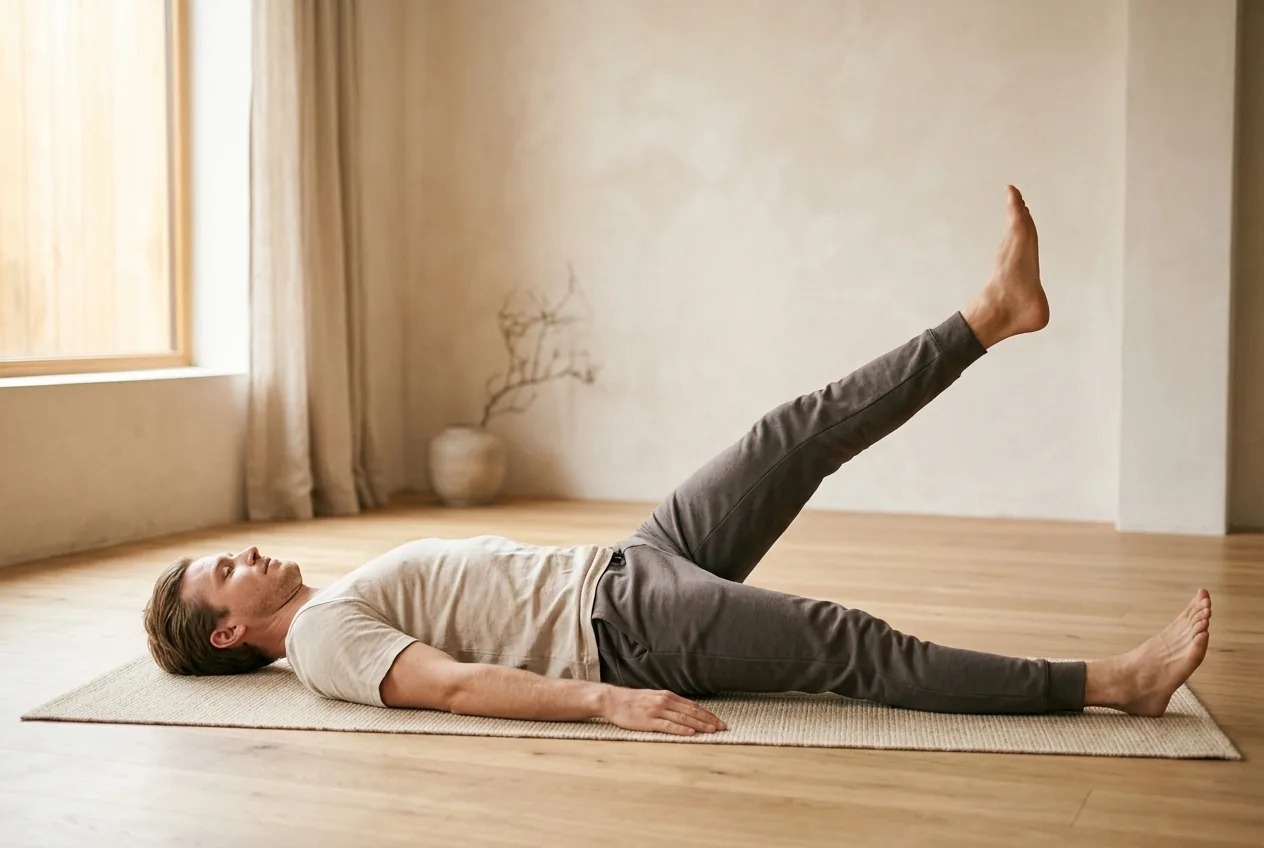
Heel slides to restore full straightening. Lying down, slowly straighten the leg all the way and gently press the back of the knee toward the floor, then relax. A few slow reps coax back the last bit of extension without forcing it.
Wake the glutes. If overworked hamstrings are the problem, the real fix is upstream. A glute bridge for back pain gets the glutes carrying their share, which takes the constant pull off the hamstrings.
What to stop doing
- Don't force a deep, painful hamstring stretch. Pulling hard into pain behind the knee makes irritated tissue worse, not looser.
- Don't sit with your knee locked under the chair for hours. A held bent position keeps the back of the knee stiff and the hamstrings short.
- Don't ignore one-sided swelling, warmth, or redness in the calf. Re-read the red-flag section — that one isn't a stretch problem.
- Don't only chase the knee. Tight hip flexors keep the hamstrings overloaded, so a daily hip flexor stretch for back pain often does more than knee work alone.
When to see a doctor
Beyond the urgent calf-clot signs above, see a clinician promptly if the knee locks, catches, or gives way, if you feel a tender lump or fullness behind the knee, if you can't bear weight or fully straighten the leg, if there's a fever with the pain, or if it followed a fall or twist. Numbness or weakness spreading down the leg, and pain that's severe or steadily worsening, also deserve a proper look.
Why knowing your own pattern matters
The stretches above help most ordinary cases. But why your hamstrings were overloaded in the first place — tight hips, a tipped pelvis, quiet glutes on one side — is specific to you, and the wrong emphasis can keep the ache circling back.
That's the case for a proper posture assessment rather than guessing: measure your real alignment, then train the muscles that quit so your hips carry their load and the back of the knee stops doing someone else's job.
Common questions
What causes pain behind the knee?
Most often it's tight hamstrings and calves that meet behind the joint, or hamstrings overworking because the hips and glutes aren't pulling their weight. Less common causes include a fluid-filled cyst behind the knee or a joint problem. Sudden swelling, warmth, or redness in the calf needs urgent medical attention, as it can signal a blood clot.
When should I worry about pain behind my knee?
Get urgent care if your calf or the back of your knee is swollen, warm, red, or tender — especially without an obvious cause — as that can be a blood clot. Also see a doctor for sudden severe swelling, a knee that locks or gives way, inability to bear weight, fever, or pain that followed a fall.
Why does the back of my knee hurt when I straighten my leg?
Full extension pulls the hamstrings and upper calf taut where they cross the back of the knee. If they're tight from sitting or overworked from doing the glutes' job, that pull turns into an ache. Gentle calf and hamstring stretching, plus restoring full straightening with slow heel slides, usually eases it.
Can tight hamstrings cause pain behind the knee?
Yes. The hamstrings attach near the back of the knee, so when they're short or overloaded the tension lands right there. Easing them with gentle stretching helps, but the lasting fix is often upstream — loosening tight hips and waking the glutes so the hamstrings stop overworking.