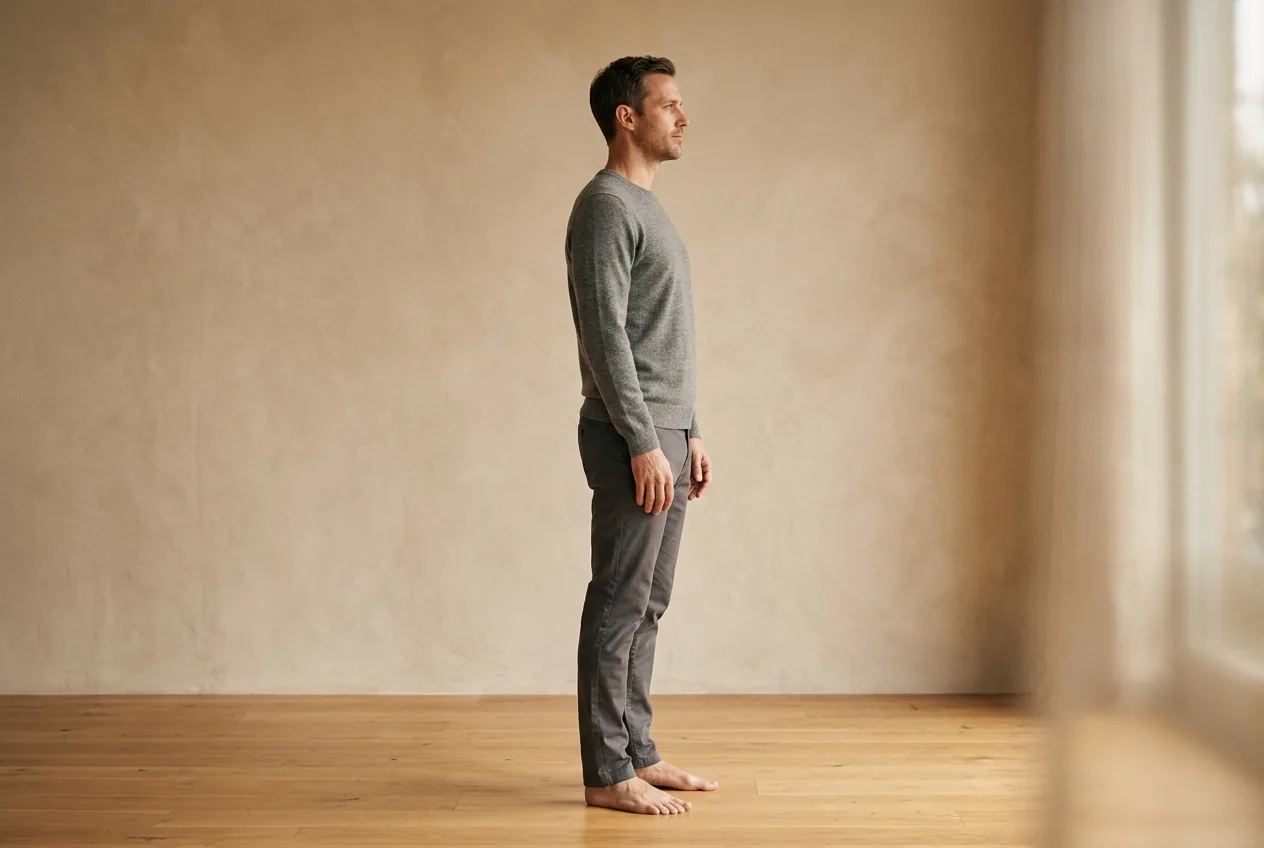
You've tried the stretches. They feel good for an hour, and then your shoulders roll right back in. That's the thing nobody tells you about fixing posture: stretching alone almost never holds. The muscles you stretch loose just tighten back up by mid-afternoon, because the real reason you're slumping is that the muscles meant to hold you upright have gone quiet. Posture-correcting workouts work where stretching stalls, because they wake those muscles up.
The aim of workouts to fix posture isn't to build big muscles or burn calories. It's to retrain the specific postural muscles that switched off — the deep core, the glutes, the muscles between and below your shoulder blades, the ones at the front of your neck — so they start holding you in line without you thinking about it. Strength that holds is the whole game. Here's how to build it.
Why strength holds when stretching doesn't
A slump is a muscle-balance problem. Some muscles have shortened and tightened; their opposites have lengthened and gone weak. Stretching addresses the tight half, which feels great, but it does nothing for the weak half — and it's the weak half that's supposed to hold you upright. So you stretch loose, sit back down, and within hours the tight muscles win again because nothing on the other side is pulling back.
Strengthen the weak side and the picture changes. The muscles that hold your shoulders back, your pelvis level, and your head stacked start doing their job on their own. Good posture stops being something you force and becomes your default. That's why the lasting fix is strength, with stretching as the warm-up rather than the whole plan. The same logic runs through exercises for better posture generally.
Stretching loosens what's tight. Strengthening fixes what let go. Only one of them changes your default.
The muscles posture workouts need to hit
Four groups do most of the work of holding you upright. A good routine wakes up the ones that match your slump.
- The deep neck flexors at the front of the neck, which hold your head back over your shoulders instead of poking forward.
- The mid- and lower-trapezius and rhomboids between and below your shoulder blades, which pull your shoulders back and down out of a round.
- The deep core — the muscles that brace your trunk and keep your spine stacked.
- The glutes, which level the pelvis and give your spine a stable base.
You don't train all four equally. A forward-head, rounded-shoulder pattern leans on the first two; a pelvis-and-lower-back pattern leans on the last two. Matching the work to your pattern is the difference between progress and spinning your wheels.
The core posture workout
These are the moves that reliably build posture-holding strength. Start with the two or three that fit your slump, keep the reps clean, and do them most days — frequency beats intensity here.
Chin tucks — for the forward head
Sitting or standing tall, draw your head straight back so your ears stack over your shoulders, making a gentle double chin. Hold five seconds, release, repeat ten times. This wakes the deep neck muscles that hold your head back. The full how-to is in the chin tucks exercise.
Wall angels — for rounded shoulders
Stand with your back against a wall, arms up in a goalpost, backs of the hands toward the wall. Slowly slide your arms up and down while keeping your lower back, shoulders, and wrists in contact. It's harder than it looks and it fires the upper-back muscles that pull your shoulders back. See wall angels.
Band pull-aparts — for shoulder set
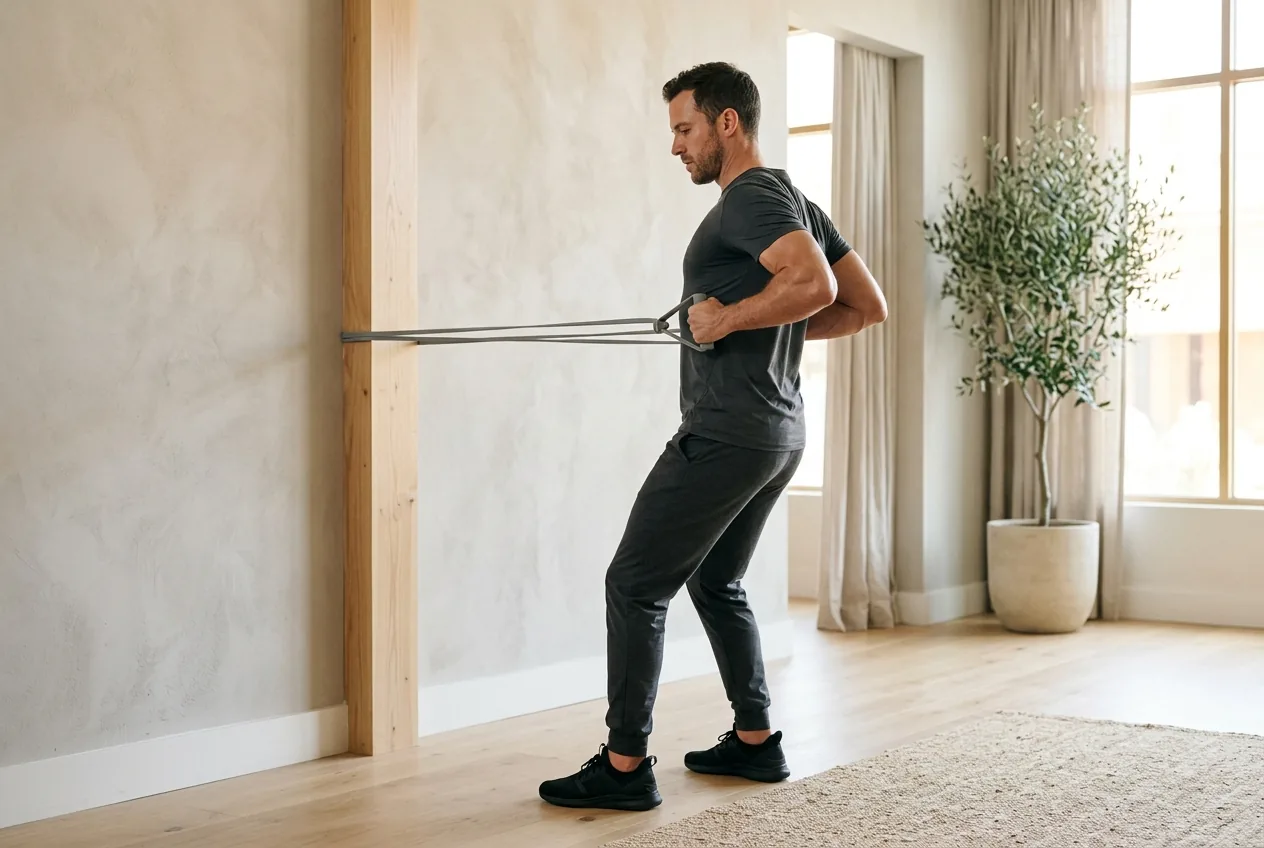
Hold a light resistance band at chest height, arms straight, and pull it apart by squeezing your shoulder blades together, then return slowly. Two sets of fifteen. This builds the endurance the upper-back muscles need to hold your shoulders set through a long day. The band pull-aparts guide has the detail.
Glute bridges — for the pelvis
Lie on your back, knees bent, feet flat. Drive through your heels and lift your hips into a straight line from knees to shoulders, squeeze the glutes at the top, lower slowly. Ten to twelve reps. This fires the glutes that level the pelvis, the foundation of a stacked spine. See the glute bridge.
Bird dog — for the whole chain
On all fours, extend one arm and the opposite leg until both are level with your back, hold, return, alternate. This teaches the deep core to keep your trunk stable while your limbs move — the exact skill upright posture needs. The bird dog exercise walks through keeping it clean.
How to program it so it sticks
The routine only works if it survives a busy week. A few rules that make it hold.
- Short and daily beats long and occasional. Ten focused minutes most days retrains your default faster than a long session once a week. Your nervous system learns the new position through reps.
- Quality over quantity. Clean reps that actually fire the target muscle do more than rushed ones. If you're swinging or cheating, drop the reps or the resistance.
- Anchor it to a habit. Glute bridges before your shower, chin tucks at red lights, pull-aparts when you walk past the band on the door. Stacked onto things you already do, it survives.
- Warm up with the stretches, then strengthen. Loosen the tight side first — a doorway chest stretch opens the chest before you train the upper back — then do the strength work that holds it.
When to see a doctor
This is posture education, not medical advice. Stop and see a clinician promptly if any exercise brings numbness, tingling, or weakness into the arms or legs, sharp or radiating pain, or pain that lingers and worsens rather than settling. Also seek care first if you have a known spinal condition, recent injury, fever with back pain, unexplained weight loss, or any loss of bladder or bowel control. Build slowly and stop anything that hurts beyond ordinary muscle effort.
Why the routine has to match your pattern
Here's the catch that decides whether any of this works: the right workout depends on which way you're actually pulled. Strengthen a muscle that's already overworking, or skip the one that's truly switched off, and you can reinforce the very imbalance you're trying to undo. A forward-head person and an over-arched-back person need genuinely different routines, even though both call it "bad posture."
That's the case for knowing your own pattern before you pick your moves. A short posture assessment measures your real deviations and orders a daily program around them — the right strength work, in the right emphasis. The exercises above are a solid, safe starting point. Aimed at your actual pattern, they become strength that holds.
The fix for a slump isn't more stretching. It's waking up the muscles that quit, every day, until upright is automatic.
Common questions
Do posture exercises actually work?
Yes, when they strengthen the muscles that hold you upright rather than only stretching the tight ones. A slump is a muscle-balance problem, and stretching addresses just the tight half. Strengthening the weak, switched-off half is what changes your default so good posture holds on its own — that's where stretching-only routines fall short.
What are the best workouts to fix posture?
Chin tucks for a forward head, wall angels and band pull-aparts for rounded shoulders, glute bridges for the pelvis, and bird dogs for the core-and-trunk connection. Pick the two or three that match your slump, do clean reps most days, and warm up with stretches first. Matching the work to your pattern matters more than the exact list.
How long until posture workouts make a difference?
Most people feel looser within a week or two and notice their posture holding on its own after several weeks of steady daily work. Resetting a long-standing default usually takes a few months. Short daily sessions retrain your posture faster than long, infrequent ones.
Should I stretch or strengthen to fix posture?
Both, in that order, but strengthening is what makes it last. Stretch the tight muscles to loosen the pull, then strengthen the weak muscles that are meant to hold you upright. Stretching alone feels good but fades within hours, because nothing is built on the other side to hold the new position.