If you've been lying on the floor pulling your knee to your chest because a video told you to, and the leg pain only got louder, this article is for you. Sciatica is touchy. The right sciatica stretches at home can settle it down in a few days. The wrong ones keep the fire going.
So before you stretch anything, it helps to know what you're actually stretching, and why one person's miracle move is another person's worst night.
What sciatica actually is
Sciatica isn't a diagnosis so much as a description: pain that travels along the path of the sciatic nerve, from your lower back or buttock down the back of the leg, sometimes past the knee into the calf or foot. The nerve itself is fine. Something along its route is crowding or irritating it.
That "something" is usually mechanical. A disc in the lower spine bulges and leans on the nerve root. Or the piriformis muscle deep in the buttock tightens and clamps down on the nerve as it passes underneath. Often there's a postural reason behind both: a pelvis that tilts and rotates, a lower back stuck in too much curve or too little, hips that no longer sit level. The nerve is the messenger. The posture is the address the message keeps coming from.
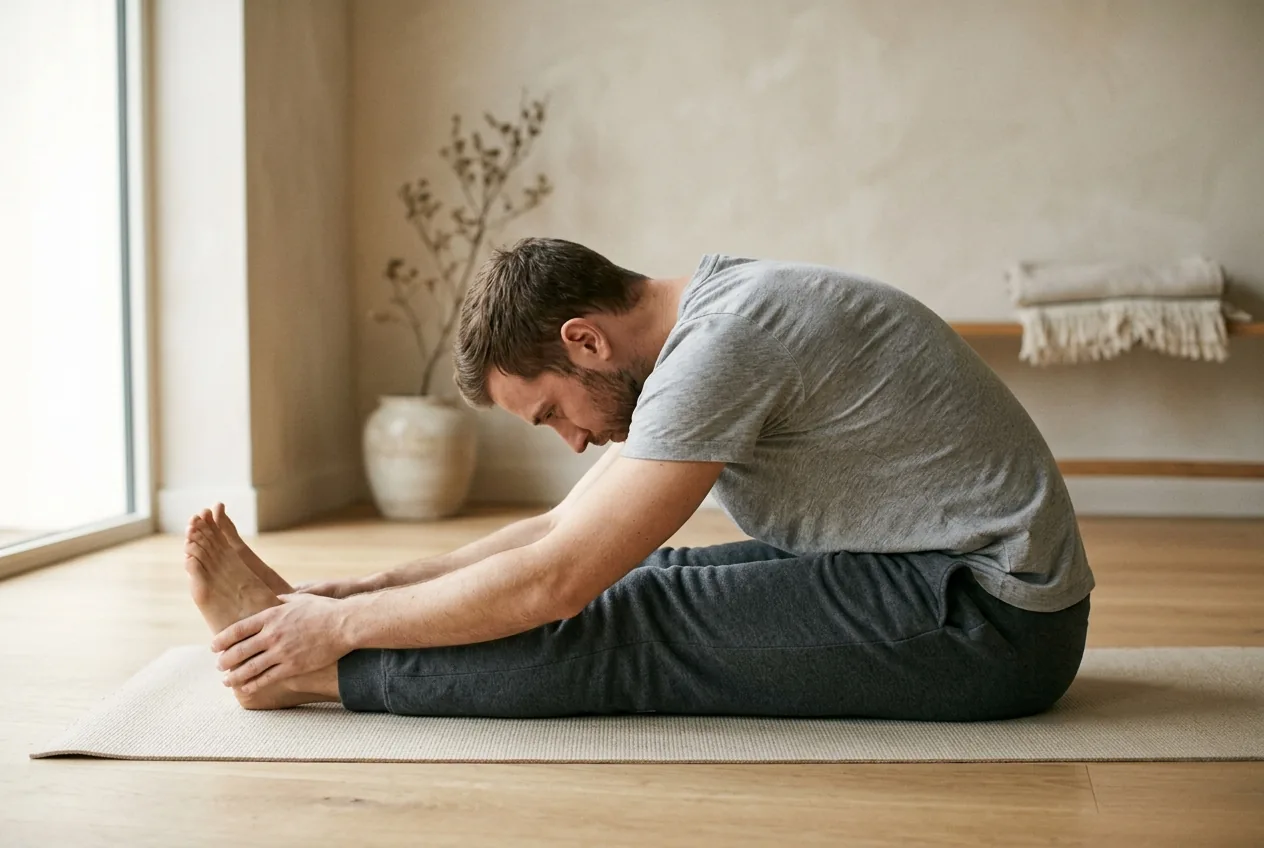
This is why generic stretching is a gamble. A forward fold that decompresses one person's nerve will compress another's, depending on whether the disc or the muscle is the culprit and which way their spine is biased. The stretches below are chosen because they're gentle and tend to calm the nerve rather than provoke it. Move slowly, and let pain be the referee.
The rule before any stretch
One principle saves a lot of grief: never stretch into the shooting leg pain. A mild pull in the muscle belly is fine. Pain that zings down the leg, or numbness that spreads, means stop and back off. You want the leg symptoms to pull back toward the spine over the session, not march further down the leg. That's the difference between calming the nerve and aggravating it.
Four gentle stretches to start with
Do these on a soft surface, breathe, and hold each position rather than bouncing.
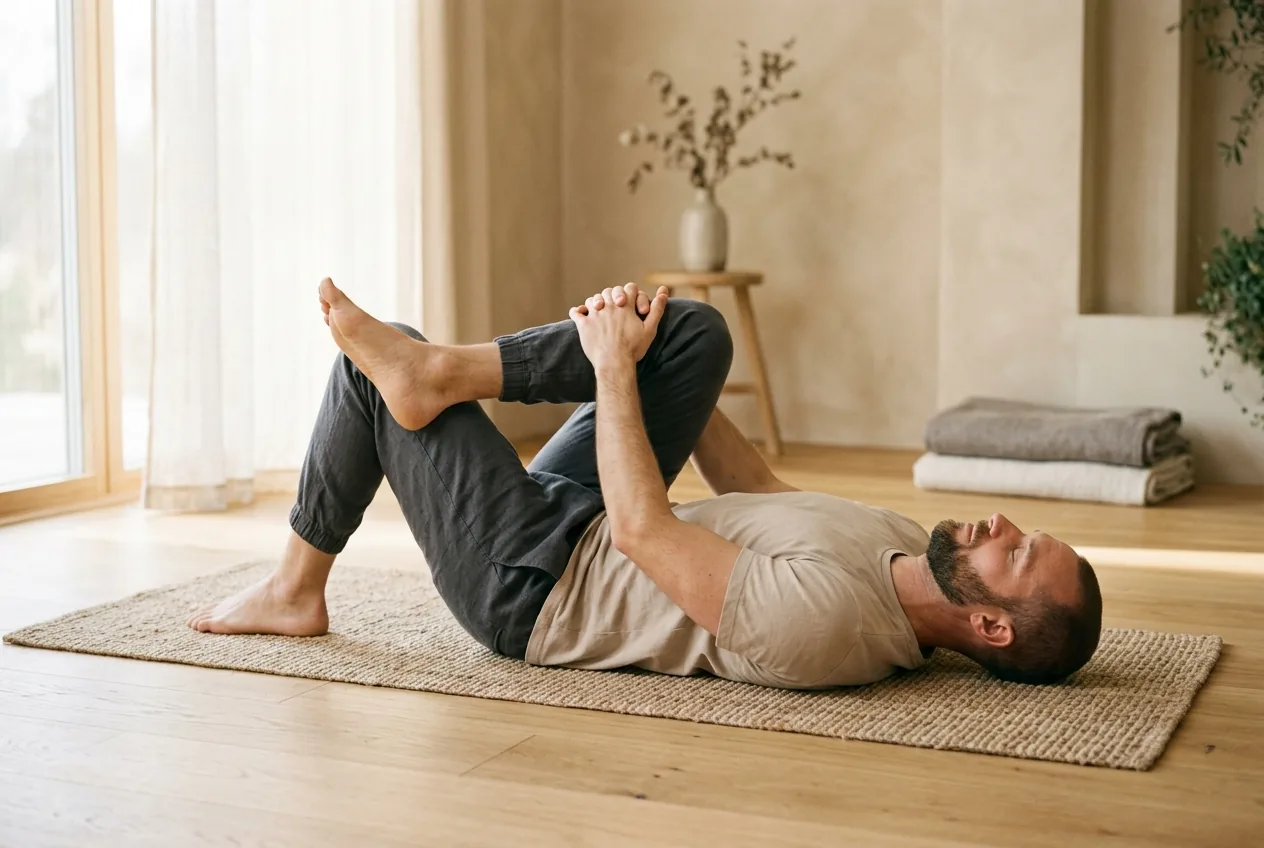
Knee-to-chest, one leg at a time
Lie on your back, both knees bent. Bring one knee gently toward your chest with your hands behind the thigh, not over the kneecap. Stop where you feel a mild stretch in the buttock or low back, not where the leg lights up. Hold 20 to 30 seconds, lower, switch sides. Three rounds each. This opens the lower back and buttock without loading the disc much.
Supine figure-four
Still on your back, cross one ankle over the opposite thigh so your legs make a "4." Reach through and gently pull the bottom thigh toward you. You should feel this deep in the buttock of the crossed leg. This targets the piriformis and the deep hip rotators, the usual suspects when the pain sits more in the cheek than the back. Hold 30 seconds each side.
Standing hamstring on a step
Tight hamstrings drag on the pelvis and feed sciatic tension. Put one heel on a low step or stair, keep that leg straight but soft, and hinge forward from the hips with a flat back until you feel a stretch behind the thigh. Gentle. If it shoots down past the knee, you've gone too far. Hold 20 to 30 seconds each side.
Cat-cow for the spine
On hands and knees, slowly round your back toward the ceiling, then let it sag and lift your head. Move with your breath, five to ten slow cycles. This isn't a deep stretch; it's a way to gently mobilize the spine and find the range that doesn't bother the nerve. The cat-cow stretch is a good daily warm-up for a cranky lower back.
If a stretch sends pain further down the leg, it's the wrong stretch for your pattern that day. Skip it and move on.
How to build it into a routine
A stretch done once does almost nothing. The nerve responds to gentle, repeated input over days. A simple way to structure it: run through the four moves once in the morning to loosen up after sleep, and once in the evening to undo a day of sitting. Five to ten minutes each time is plenty — this isn't a workout, and longer or harder is not better here.
Breathe through each hold rather than holding your breath and bracing. The muscles you're trying to lengthen relax on the exhale. And track how the leg behaves across the week, not minute to minute. The win you're looking for is the symptoms slowly pulling up toward your spine and the painful range getting a little bigger each day. If a particular move never settles after several tries, drop it — your pattern may not like that one, and that's useful information rather than a failure.
What to do besides stretching
Stretching only buys you so much if you sit eight hours folded over a keyboard. Sciatica often spikes the moment you sit, because sitting loads the lumbar discs and shortens the hip. If that's you, the way you set up your chair matters as much as any floor exercise, and sciatica pain when sitting is worth reading next.
A few habits that help:
- Get up every 30 to 40 minutes. A short walk often calms the nerve more than a long stretch.
- Sleep in a position that takes pressure off the nerve. The best positions for sleeping with sciatica can be the difference between waking up loose or locked.
- Be choosy about which moves you do. Some popular exercises make a disc-related case worse, and the sciatica exercises to avoid are worth knowing before you load up a routine.
When to see a doctor
Most sciatica is mechanical and settles with time and the right movement. Some of it isn't. See a clinician promptly if you have progressive weakness in the leg or foot (it keeps getting harder to lift your toes or push off), foot drop, numbness in the saddle area between the legs, or any loss of bladder or bowel control. Those last two can signal cauda equina compression, which is a medical emergency. Also get checked if the pain follows a fall or injury, comes with fever, or is severe and steadily worsening rather than easing.
Why the same stretch helps your friend and hurts you
Here's the honest limit of any stretch list: it's a starting point, not a program. The reason one person calms their sciatica with figure-fours while another flares is that their underlying postures differ — a tilted pelvis, a rotated hip, a flattened lumbar curve all change which moves help. Generic advice can't see your particular pattern.
That's the idea behind a posture assessment: instead of guessing, you measure your own deviations and build a routine around them. If the stretches here help a little but the pain keeps circling back, knowing your specific alignment is usually the missing piece — that's what the posture therapy approach is built to find.
Start gentle, respect the leg pain, and give it a week of daily, careful work before you judge it.
Common questions
How often should I do sciatica stretches?
Once or twice a day is usually enough, in gentle sets rather than long holds. Daily consistency matters more than pushing hard in a single session.
Should I stretch through the leg pain or stop?
Stop if a stretch sharpens the pain shooting down your leg. A mild pull in the muscle is fine, but pain that travels further down the limb is a sign to back off that move.
How long before stretching helps my sciatica?
Many people notice a little easing within a week or two of careful daily work. If nothing has shifted after several weeks, the stretches probably aren't matched to what's actually crowding the nerve.
Can I make sciatica worse by stretching wrong?
Yes. A stretch that suits one posture can aggravate another, which is why a move that helps a friend might flare you. Ease off anything that increases the leg symptoms rather than calming them.