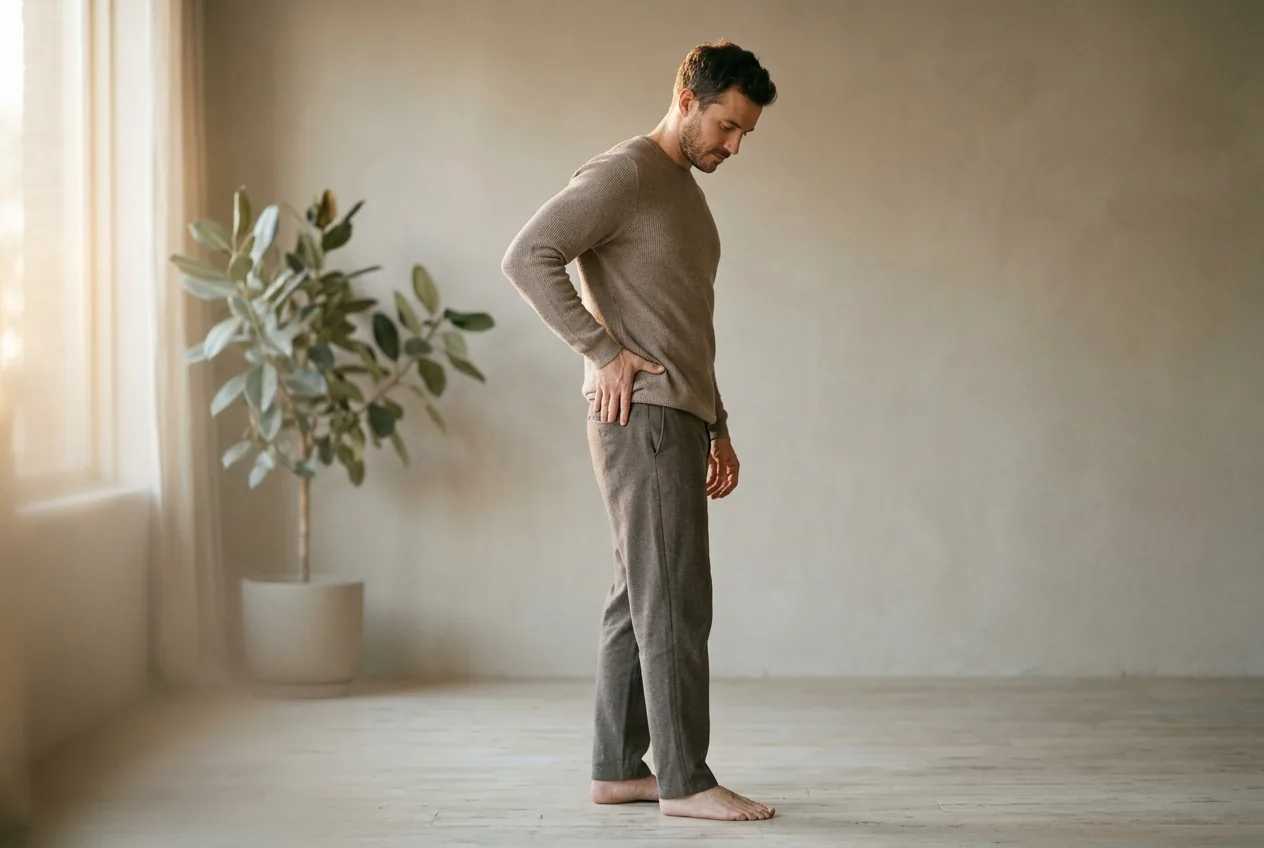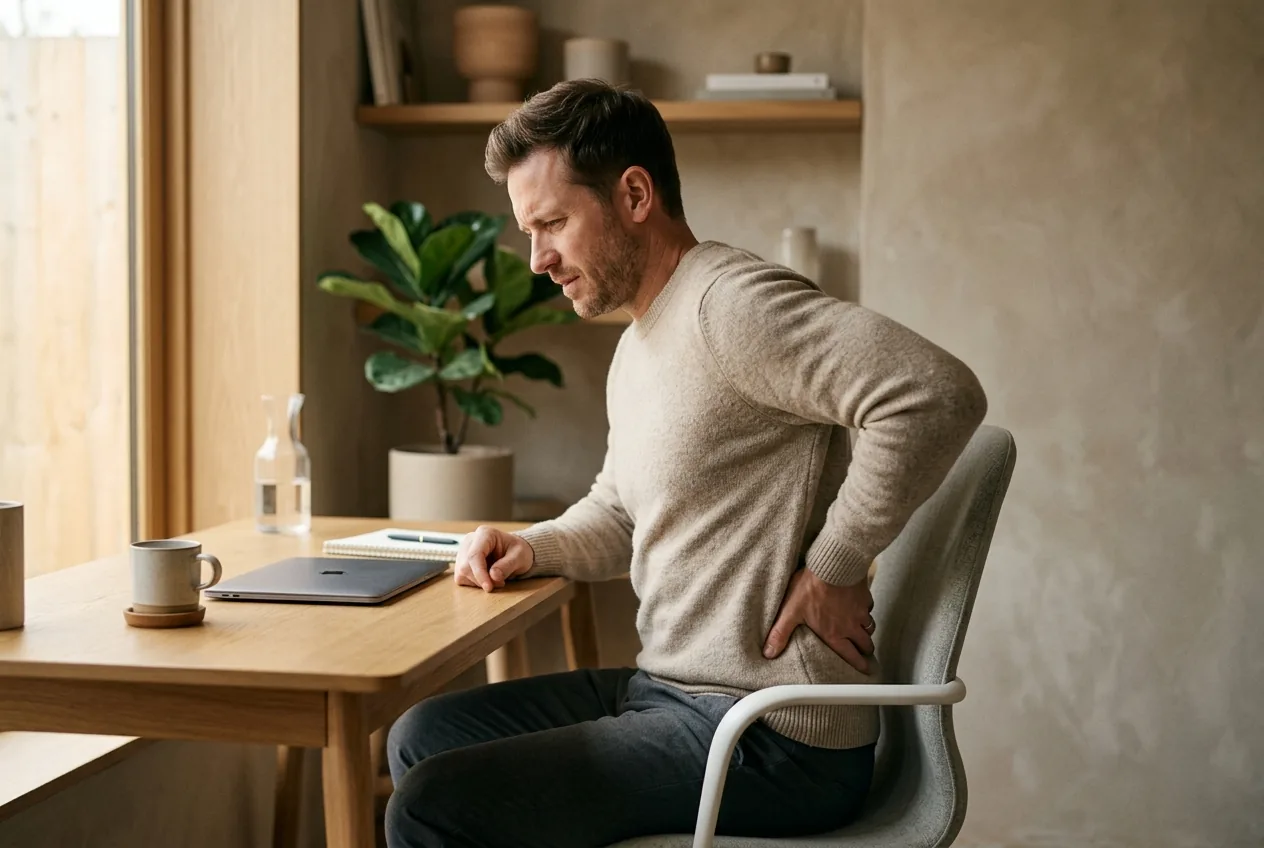
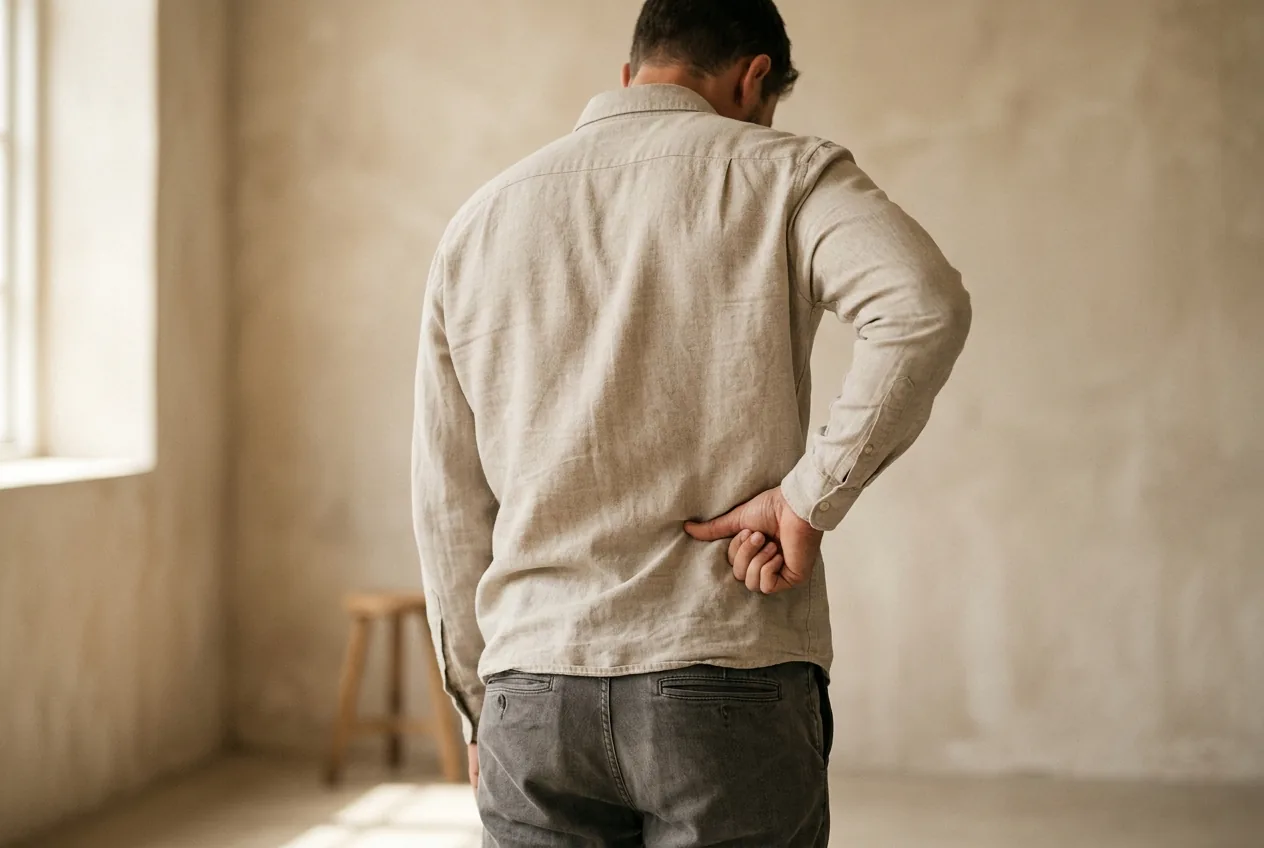
There's a deep, dull ache low on one side of your back, right where a back dimple would be. It flares when you roll over in bed, climb stairs, or stand on one leg to pull on your socks. You've stretched your lower back, you've foam-rolled, and it doesn't quite land on the spot. That's because the spot isn't your spine. It's your SI joint.
The sacroiliac joint gets overlooked because it barely moves and it hides between the spine and the pelvis. But when it's irritated, it produces some of the most stubborn one-sided lower back pain there is. The good news: it usually responds well to the right SI joint pain exercises and a few changes to how you load your body.
What the SI joint is and why it complains
You have two SI joints, one on each side, where the triangular sacrum at the base of your spine meets the broad bones of your pelvis. Their job is to transfer the weight of your upper body down into your legs and to absorb the forces of walking. They're built for stability, not motion — strong ligaments hold them tight.
Pain shows up when the load crossing the joint becomes uneven or excessive. If your pelvis is tilted or rotated, one SI joint gets compressed and tugged differently than the other. If the muscles meant to stabilize it — the glutes, the deep core, the pelvic floor — aren't doing their job, the joint takes strain it wasn't designed to absorb alone. The ligaments and joint surfaces get irritated, and you feel it as a deep ache low on one side.
So SI joint pain is rarely the joint failing on its own. It's the joint caught in the middle of an imbalance happening around it.
How to tell it's the SI joint
A few signs point toward the SI joint rather than the spine or a disc:
- The pain is low and to one side, often pinpointed near a dimple above the buttock.
- It can refer into the buttock, groin, or back of the thigh, but usually not far down the leg.
- It flares with single-leg loading — stairs, getting out of a car, standing on one leg.
- Rolling over in bed or standing up after sitting sets it off.
If your pain shoots well past the knee, or comes with numbness and tingling down the leg, you may be dealing with a nerve issue instead — leg numbness and tingling from the back and piriformis problems can mimic this, so it's worth knowing the difference.
The SI joint rarely breaks on its own. It hurts because the pelvis around it isn't sharing load evenly.
SI joint pain exercises that help
The aim is to stabilize the joint and even out the pull of the muscles around it. Move gently and stop short of anything that sharply reproduces the pain.
Stabilize
- Glute bridges. Lie on your back, knees bent, feet flat and hip-width. Press evenly through both heels and lift your hips, squeezing your glutes. Lower slowly. Do 8–12. Strong glutes are the SI joint's main support — this is the single most useful move.
- Bird dog. On hands and knees, slowly extend the opposite arm and leg until level, hold a breath, return, switch sides. 6–8 each side. This trains the deep core to stabilize the pelvis without yanking the joint.
Open and balance
- Single-knee-to-chest on the painful side, drawing the knee gently toward your chest and holding 20–30 seconds. This eases the muscles that tug the joint.
- Figure-four stretch. Lying on your back, cross the sore-side ankle over the opposite knee and draw both legs toward you. This releases the deep hip muscles that, when tight, twist the pelvis and load one SI joint. Tight glutes and rotators here are also behind many cases of piriformis-driven pain.
What to stop doing
- Standing with all your weight on one leg, hip jutted out.
- Crossing the same leg every time you sit.
- Sitting slumped for hours, which switches off the glutes the joint depends on — see lower back pain when sitting.
Do a short set most days. The joint stabilizes through repetition, not through one hard session.
Day-to-day habits that help
The exercises do their work between sessions only if your daily loading stops re-irritating the joint. A few practical changes:
- Get in and out of the car with control. Swing both legs together rather than twisting out one at a time, which jams the joint.
- Climb stairs deliberately. Lead with the stronger side and use the rail when it's sore, so you're not loading the painful SI joint with your full weight on one leg.
- Sit with even weight. Both sit bones planted, both feet flat, no leg crossed. An uneven seat tilts the pelvis and tugs one joint all day.
- Don't sleep twisted. A pillow between your knees when you're on your side keeps the pelvis stacked and the joint neutral overnight.
None of these is a cure on its own. They stop you undoing the stabilizing work every time you stand, sit, or roll over, which is what lets the joint actually calm down.
When to see a doctor
Most SI joint pain is mechanical and settles with stabilizing work. Some signs need a clinician first.
Get checked promptly if you have numbness or weakness spreading down a leg, any loss of bladder or bowel control, pain after a fall or accident, fever with back pain, or unexplained weight loss. A specific flag worth naming: pain set higher and to one side near your flank, especially with burning urination, blood in the urine, or fever, can be kidney-related rather than joint-related — call your doctor that week. Pain that's severe or steadily worsening also warrants a professional assessment.
Why it keeps flaring on the same side
If your SI joint keeps acting up on the same side, the joint isn't the real story — the pelvis around it is. A pelvis that sits tilted or rotated will keep loading one joint unevenly no matter how much you stretch the spot. That's why borrowed stretches help for a day and then it's back: the pattern feeding the joint hasn't changed. And a move that helps one posture can worsen another, so a generic routine can even add to the twist.
Lasting relief comes from seeing your own pattern — how your pelvis actually sits, which side is tight, which glute has gone quiet — and matching the work to it, repeated daily. That's what a posture assessment measures. If you've been chasing this ache around your lower back without it sticking, see how a posture-based method approaches chronic back pain at the source.
Stabilize the joint, balance the pelvis, and that deep one-sided ache usually loosens its grip.
Common questions
How do I know if my pain is the SI joint and not my spine?
SI joint pain tends to sit low and to one side, near a dimple above the buttock, and flares with single-leg loading like stairs or getting out of a car. It can refer into the buttock or groin but usually doesn't shoot far down the leg. Pain that travels past the knee with numbness points more toward a nerve.
What's the single most useful exercise for the SI joint?
Glute bridges. Strong glutes are the joint's main support, so rebuilding them takes strain off a joint that's been left to stabilize on its own.
Why does my SI joint keep flaring on the same side?
The joint isn't usually the real story — the pelvis around it is. A pelvis that sits tilted or rotated keeps loading one joint unevenly no matter how much you stretch the spot, so the flares return until that pattern changes.
When should SI joint pain be checked by a doctor?
Get checked promptly for numbness or weakness spreading down a leg, loss of bladder or bowel control, pain after a fall, fever, or unexplained weight loss. Pain set higher near your flank with burning urination or blood in the urine can be kidney-related rather than joint-related.