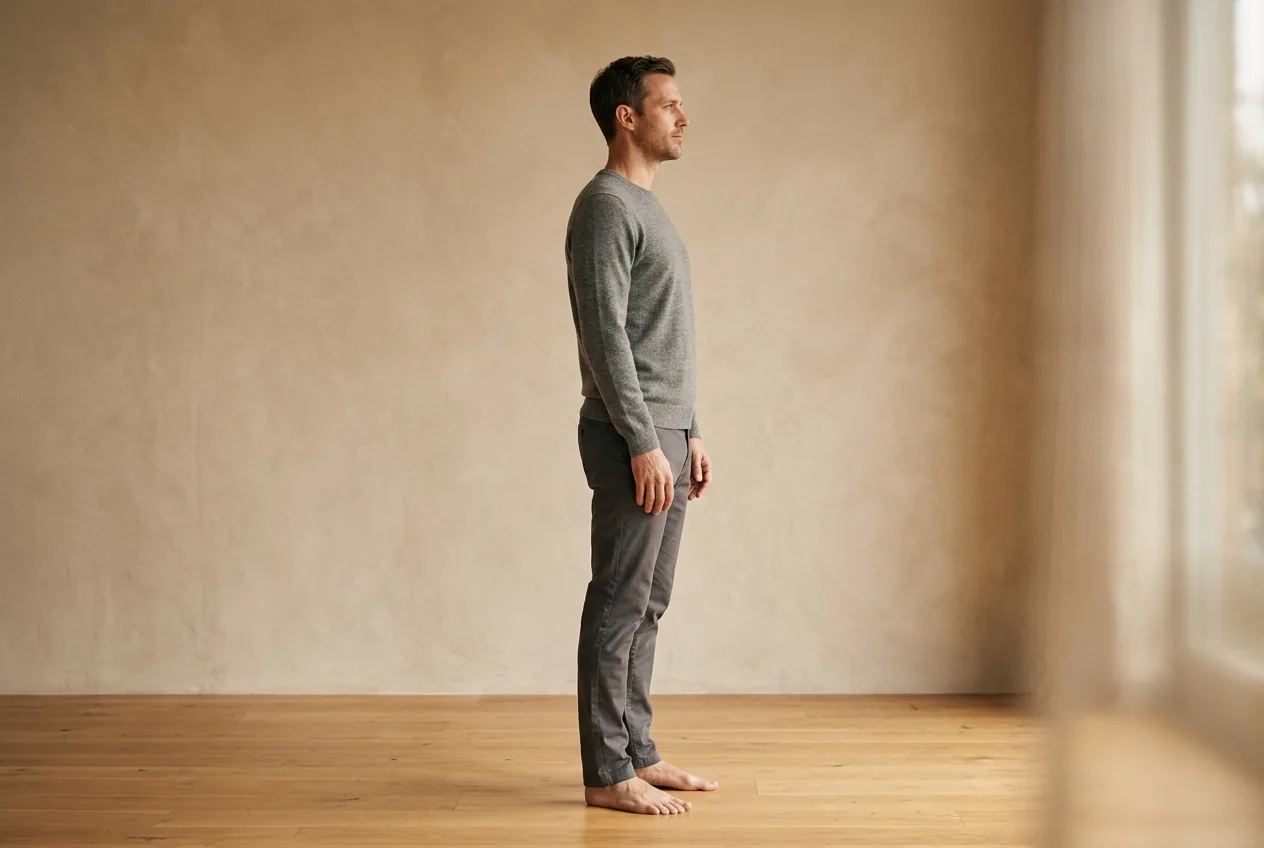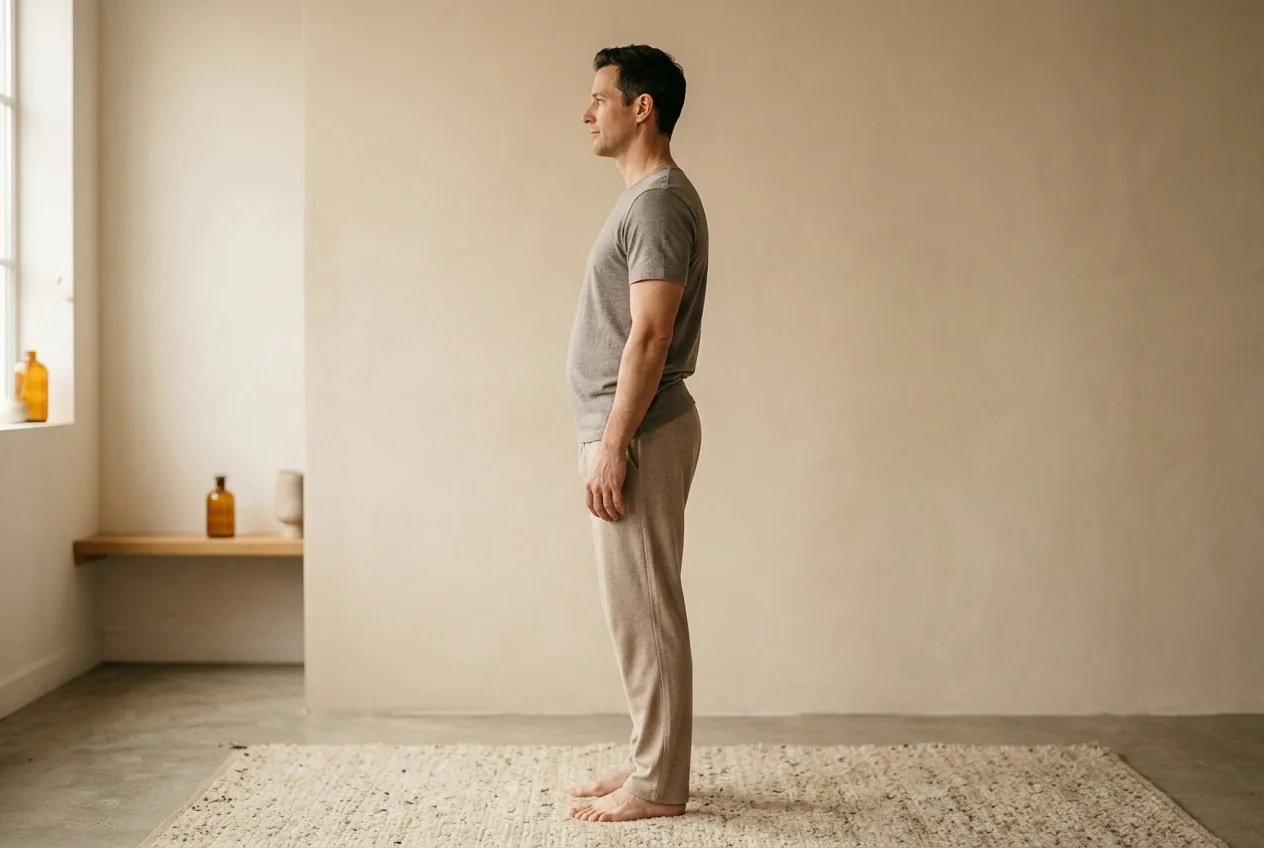
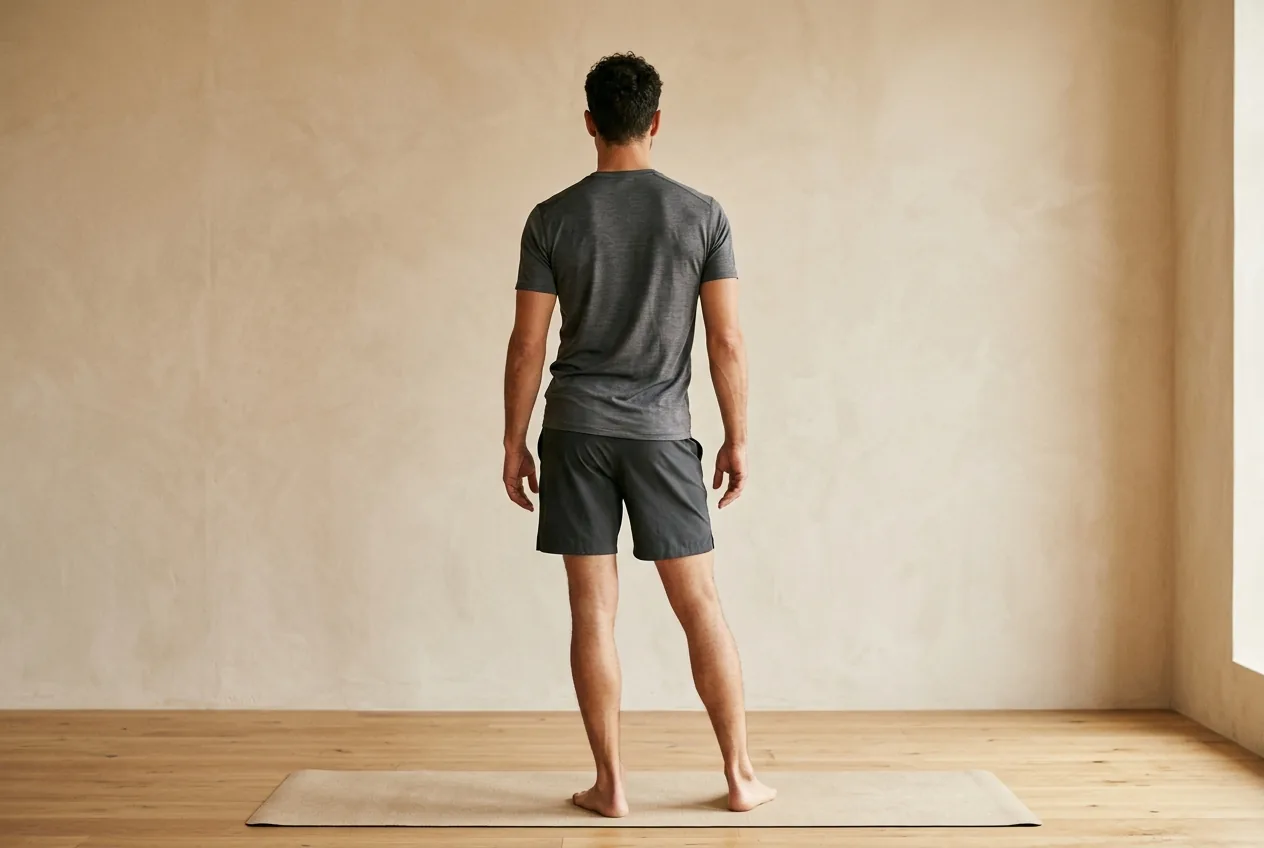
You're standing at the kitchen counter, weight parked on one leg, and you notice your belt sits crooked — one hip clearly higher than the other. Or jeans always feel longer on one side. Or your lower back nags on the same side at the end of every day. These small clues usually point to the same thing: your pelvis isn't level.
A tilted pelvis is one of the most common posture patterns, and one of the most consequential, because the pelvis is the foundation everything above it sits on. When one hip rides high, the spine bends a little to compensate, the shoulders tilt to keep your eyes level, and the load through your back and legs goes uneven. The reassuring part: for most people this is a learned pattern in the muscles, not a fixed defect in the bones.
Two very different kinds of "uneven"
Before you do anything, it helps to know there are two distinct situations that both look like one hip higher than the other.
The first is a functional tilt — the common kind. Here the bones are fine, but the muscles around the pelvis pull unevenly, hiking one side up. Tight muscles on one side, switched-off muscles on the other. This is the type that responds well to corrective work, because you're changing muscle balance, not anatomy.
The second is a structural difference — an actual difference in leg length, or a fixed change in the bones or spine. This is less common, and it doesn't fully resolve with stretching because the bones themselves aren't even. It still benefits from balance work, but it's worth knowing about, and sometimes a small shoe adjustment from a clinician helps.
Most people reading this have the functional kind. The way to get a sense of which you're dealing with is whether the tilt changes — if your pelvis looks more level after you've moved, stretched, or lain down, the muscles are driving it.
Why the pelvis tilts
A functional tilt is built by the same thing that builds most posture patterns: repeated, one-sided load and long hours in the same position.
- Standing on one leg. Parking your weight on the same hip while you cook, queue, or hold a child teaches that side to stay hiked.
- Sitting crooked. Tucking one leg under you, sitting on a wallet, or leaning into one armrest tilts the pelvis for hours a day.
- One-sided carrying. A bag or a toddler always on the same hip pulls the pelvis up on that side.
- Tight or weak hip muscles. The muscles on the side of the hip — the ones that keep the pelvis level when you stand on one leg — are common culprits when one is tight and the other has gone quiet.
The pelvis rarely tilts in just one plane. Often a side-to-side hike comes bundled with a front-to-back tilt — an anterior pelvic tilt where the pelvis dumps forward, or a posterior tilt where it tucks under. And whatever the pelvis does, the structures above it follow, which is why uneven hips so often travel with uneven shoulders.
What to do about it
The aim is to release the tight, hiked side, wake up the muscles holding the level, and break the one-sided habits feeding the tilt. Start gently and consistently rather than forcefully.
- Stretch the side that hikes up. Standing tall, cross the high-hip leg behind the other and let that hip ease outward, feeling a stretch along the outer hip. Hold easy, breathe. Favor the tight side.
- Wake up the side hip muscles. Lie on your side, legs stacked and slightly bent, and lift the top knee while keeping your feet together — like a clamshell opening. This switches on the muscles that keep the pelvis level when you stand.
- Rebuild even hip extension. A controlled glute bridge, lifting through both glutes evenly, retrains balanced support from behind. Notice if one side wants to do more — that's the pattern showing itself.
- Lengthen tight hip flexors. A gentle kneeling lunge on each side lets the front of the hip release, which helps the pelvis settle level rather than tilted.
The pelvis is the floor your spine stands on. Get it level and a surprising amount above it quietly falls back into line.
What to stop is half the work. Quit standing on one leg — distribute your weight. Sit square with both feet on the floor. Switch carrying sides or use a backpack. These habit changes are what make the stretches hold instead of fading by lunchtime.
Why a tilted pelvis is worth taking seriously
It's tempting to file uneven hips under "cosmetic" and move on, especially if they don't hurt yet. The reason to address the tilt anyway is what sits above it. When the pelvis isn't level, the spine curves slightly to keep your torso upright, and that curve loads one side of your lower back, one hip, and one knee more than the other, hour after hour. Over years, that uneven loading is the kind of thing that quietly sets up one-sided lower-back ache, hip discomfort, or nagging on the same side every time you stand too long.
So a tilt that's painless today is still worth levelling, not for the look but because the foundation being off means everything above it works a little harder on one side than it should. Catch it as a habit pattern now and the fix is gentle. Leave it for a decade and you're often unwinding the compensations it caused as well as the tilt itself.
When to see a doctor
This is posture education, not medical advice. Most uneven hips are functional patterns. But see a clinician promptly if the tilt came on suddenly or after an injury, if you have numbness, tingling, or weakness running down a leg, any loss of bladder or bowel control, or pain that's severe or steadily worsening. Fever with back pain or unexplained weight loss alongside it also warrants a prompt evaluation. If you suspect a genuine leg-length difference, a professional can measure it properly rather than you guessing.
Knowing which pattern is yours
Here's the rub. The moves above help a functional tilt, but only if you're working the right side and addressing the front-to-back tilt that often rides along with the side-to-side one. Stretch the wrong hip and you can deepen the imbalance instead of easing it. And if there's a structural leg-length difference underneath, you'll want to know that before you spend months stretching something that won't fully budge.
Generic advice gets you moving in roughly the right direction. Lasting relief comes from knowing your own pattern — which way the pelvis tilts, what's tight, what's switched off, and what to address first. A posture assessment measures your specific deviations from a few photos and builds the corrective order around them. For a quick first read on your own, the at-home posture check helps you see whether your hips, shoulders, or both are off level, and if you want the bigger map of where you sit, the main posture types lays them out.
A tilted pelvis took years of small one-sided habits to build. The right correction, repeated daily, is what brings it back to level — not willpower at the mirror.
Common questions
Why is one of my hips higher than the other?
Most often it's a functional tilt: the muscles around the pelvis pull unevenly from one-sided habits like standing on the same leg, sitting crooked, or carrying on one hip. Less commonly it's a structural difference, such as a true leg-length difference, which doesn't fully resolve with stretching.
How can I tell if my uneven hips are functional or structural?
A rough test is whether the tilt changes. If your pelvis looks more level after you move, stretch, or lie down, muscles are driving it, which is the functional kind. A difference that stays fixed regardless is worth having a clinician measure properly.
Are uneven hips worth fixing if they don't hurt?
Often yes. When the pelvis isn't level, the spine curves slightly to keep you upright, loading one side of the back, hip, and knee more hour after hour. Catching it as a habit now is gentler than unwinding years of compensations later.
Do uneven hips cause uneven shoulders?
They can. The pelvis is the foundation, so when one hip rides high the spine bends to compensate and the shoulders tilt to keep your eyes level. That's why the two patterns so often travel together.