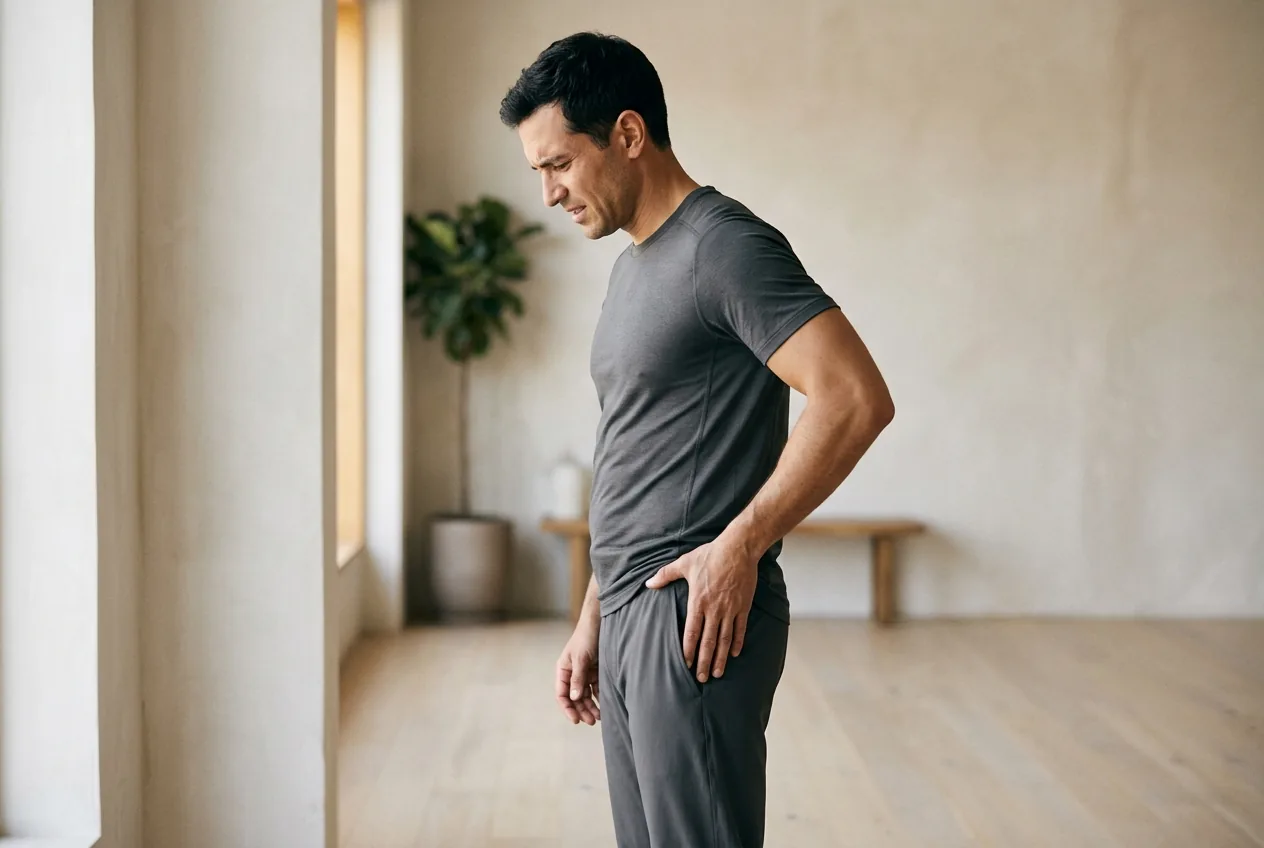

You set off fine, and somewhere in the first ten minutes the hip starts to talk — a deep ache in the side or the front, a catch with each stride, a feeling that one hip isn't carrying you the way the other does. By the time you're walking back it's worse, and the next morning the first few steps to the bathroom remind you it's still there. If your hip turns a normal walk into something you have to think about, this is the pattern to fix.
Walking is the one thing a sore hip can't avoid, which is why hip pain when walking is so wearing. But it's also a clue. The hip only hurts on certain steps, in a certain place, and that tells you a lot about what's actually going on — because walking is a one-leg-at-a-time test of whether your pelvis stays level.
Why walking is the moment it flares
Here's the part most people never picture. Every time you take a step, for a split second your whole body weight is balanced on one leg. In that instant, a set of muscles on the outside of that hip — the side glutes — has to fire to keep your pelvis from dropping toward the swinging leg.
Do that well and walking is smooth and even. Do it poorly — because those side glutes are weak or switched off from years of sitting — and the pelvis drops a little on each step. That drop yanks the band of tissue on the outside of the hip across the bone, overworks the muscles trying to stabilise, and grinds whatever's already irritated. So walking flares the hip precisely because walking is hundreds of single-leg balance tests in a row, and a weak side hip fails the test every step.
A smooth walk is your side glutes quietly doing their job. A painful one is the pelvis dropping and something else paying for it.
Where it hurts tells you what's going on
Pain on the outside of the hip
A point-tender ache on the bony bump on the outside, worse with each step and impossible to lie on at night, points to the outer-hip structures — often an inflamed bursa or an overworked band of tissue, driven by that dropping pelvis. This is the hip bursitis pattern, and walking is one of its loudest triggers.
Pain deep in the groin
A deep ache in the front, in the crease of the groin, that worsens with walking and weight-bearing more than with pressing, tends to come from the hip joint itself. It's the joint surfaces taking uneven load, often because the pelvis and leg aren't lining up cleanly.
Pain in the buttock that travels
A deep ache in the backside that starts referring down the back of the leg as you walk can be the deep rotator muscles, or the nerve they sit beside, rather than the hip joint at all.
How to settle it
The order matters: calm the flare, then fix why the pelvis isn't staying level.
Calm the flare
- Shorten your walks for a week or two and break them into smaller bouts rather than one long, aggravating march.
- Stop standing slumped on one hip. Hip-cocked standing all day keeps one outer hip under strain before you even start walking. Keep your weight even on both feet. And watch how you sit between walks, since hip pain when sitting often shares the same dropped-pelvis cause.
- Ice a hot, point-tender outer hip for 10 to 15 minutes after a walk that stirred it up.
- Mind your sleep position — a pillow between the knees keeps the top leg from dragging across an irritated hip overnight.
Rebuild the muscle that holds the pelvis level
This is the part that lasts. The side glutes are what fail in the most common walking-pain pattern, so wake them up.
- Side-lying leg raises — lie on the good side, top leg straight and slightly behind you, lift it a foot or so under control, leading with the heel. 8 to 10 reps, pain-free.
- Glute bridges — on your back, knees bent, lift the hips by squeezing the glutes, hold two seconds, lower slowly. 10 to 12 reps.
- Standing stance reset — practise standing tall with weight even on both feet, so the side glutes learn to hold the pelvis level by default.
Check how you're walking
Long-striding and slamming the heel down can amplify the pelvic drop. A slightly shorter, more even stride with the foot landing under you, not way out in front, gives the side glutes a fairer chance to stabilise — the same principles that matter in proper running form apply at walking pace.
When to see a doctor
This is posture education, not medical advice. See a clinician promptly if the hip pain came after a fall or you can't bear weight, if the area is red, hot, and swollen or you have a fever, if there's numbness, tingling, or weakness spreading down the leg, any loss of bladder or bowel control, unexplained weight loss, or pain that's severe or steadily worsening. A hip that locks, gives way, or won't move through its normal range also deserves assessment.
Why your own pattern decides what helps
Hip pain when walking is rarely a problem with the hip alone — it's usually a pelvis that won't stay level, and the reason it won't varies from person to person. One hip drops because the side glute on that side is weak; another because the pelvis is tipped or rotated; another because an old habit of standing on one leg has worn a groove. Generic glute exercises help the first person and barely touch the others.
A posture assessment that measures your own deviations reads how your pelvis actually sits and which muscles are letting it drop, so the work targets why your hip isn't carrying you evenly. Settle that, and walking goes back to being something you don't have to think about.
Common questions
Why does my hip hurt when I walk?
Usually because the side-hip muscles that should keep your pelvis level on each step are weak or switched off, so the pelvis drops slightly with every stride. That drop grinds the band of tissue and structures on the outside of the hip, which is why walking — hundreds of single-leg balance moments in a row — is what flares it.
Why does my hip hurt after walking but not during?
A hip that's borderline can hold up during the walk and complain afterward, once the overworked outer-hip muscles and any irritated bursa stiffen and inflame. It often shows up as soreness later that evening or as a stiff, painful first few steps the next morning.
Should I keep walking with hip pain or rest it?
Don't stop moving entirely, but shorten and break up your walks while it settles, and avoid the things that grind it — long marches, hilly descents, standing slumped on one hip. At the same time, strengthen the side glutes so the pelvis stops dropping, which is what lets you build back to normal walking without the flare returning.
Is hip pain when walking a sign of arthritis?
It can be, especially if the ache sits deep in the groin and worsens with weight-bearing. But outer-hip pain from a dropping pelvis and weak side glutes is far more common and very treatable. Where the pain sits, and whether it hurts more to press or to bear weight, helps tell them apart — and a proper assessment can confirm it.