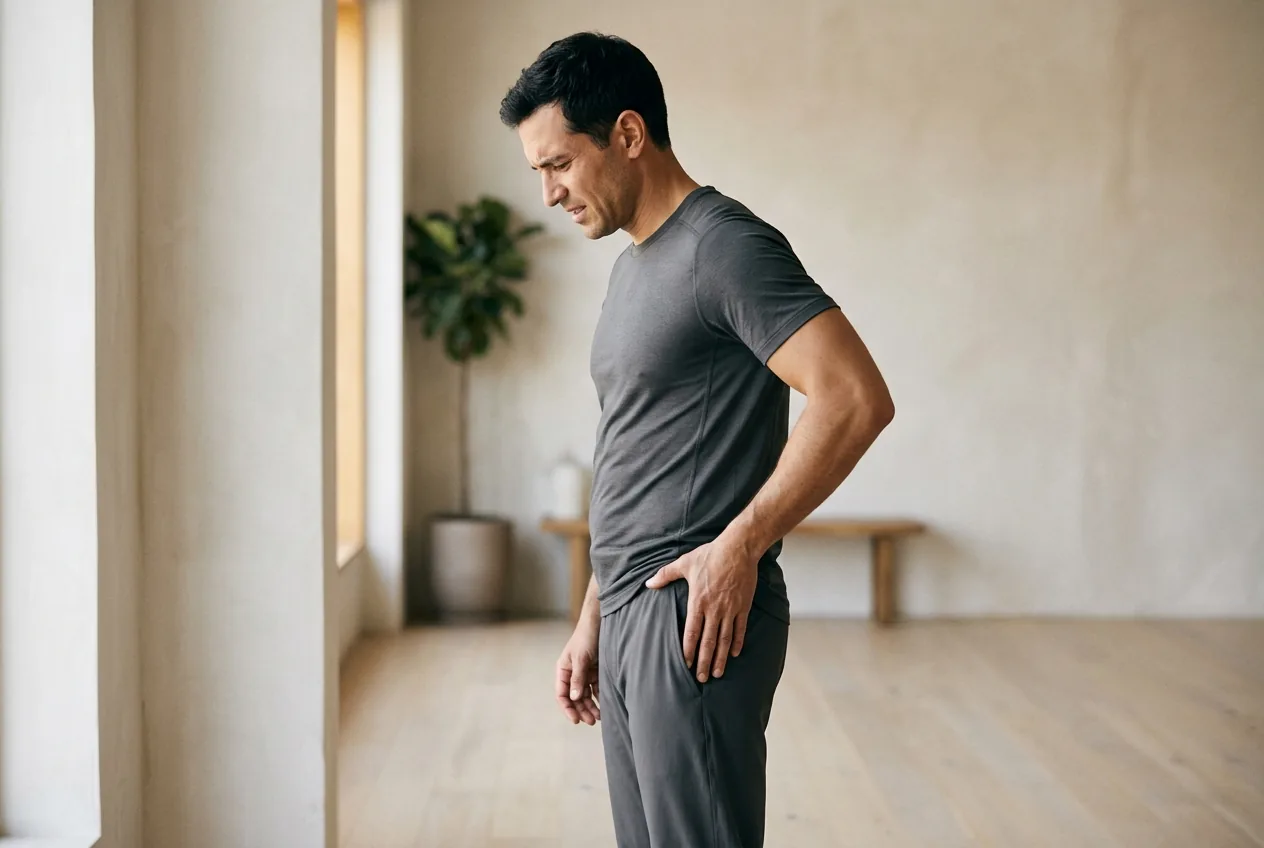
The pain isn't on the outside of your hip, and it isn't in your back. It's deep in the front — in the crease where your thigh meets your pelvis — and it bites when you lift your knee to climb into the car, march up a stair, or stand up out of a low chair. Sometimes there's a click or a snap with it. That deep front hip pain is the calling card of iliopsoas bursitis, and it's tied tightly to the hip flexor that runs right over it.
It's a less famous cause of hip pain than the bursitis on the outside of the hip, partly because it sits so deep that it's easy to mistake for a groin strain or a joint problem. But the pattern is recognizable, and once you understand the hip-flexor link, the way to calm it makes sense.
What the iliopsoas bursa is
Deep in the front of your hip, the iliopsoas muscle — your main hip flexor, the one that lifts your thigh toward your chest — runs down across the front of the pelvis and the hip joint to attach near the top of your thigh bone. Between that muscle-tendon and the bone underneath sits the iliopsoas bursa, the cushion that lets the tendon glide as the hip bends and straightens.
When the tendon rubs or presses on that sac too much, the bursa fills and turns sore. Now every time you flex the hip — every step's swing-through, every stair, every time you lift your knee — the irritated tendon drags across the inflamed sac. That's the deep front-of-hip ache, and it's why a snapping or clicking sometimes comes with it as the tendon flicks over the structure beneath.
If your hip hurts deep in the front crease when you lift your knee, and it eases when the leg is still, look at the hip flexor running over that spot — not your lower back.
The hip-flexor link
Here's where the iliopsoas bursa is different from the one on the outside of the hip: it sits directly under a muscle that, for most desk-bound adults, is chronically short and overworked. Sitting for hours keeps the hip flexor in a shortened position all day. Over months and years it adapts to that length and stays tight even when you stand.
A tight, overworked iliopsoas pulls harder across the bursa with every contraction. So the same hours of sitting that quietly shorten the hip flexor also load the sac underneath it. This is the same mechanism behind a hip flexor strain — an overloaded, shortened muscle that gets pushed past what it can handle — except here the irritation lands on the bursa rather than the muscle fibers.
That tight hip flexor doesn't sit in isolation, either. When it stays short, it tugs the front of the pelvis down and forward, which is the engine behind an anterior pelvic tilt and a lot of the trouble that comes from tight hip flexors from sitting. The posture and the bursa pain share a root.
How to settle it
Calm the irritation, then deal with the tight, overworked hip flexor that keeps pressing on it.
Settle the flare
- Back off deep hip flexion for a week or two — sprinting, high knees, deep leg-press reps, fast stairs taken two at a time, sitting folded up in low soft chairs.
- Ice the front of the hip after activity if it's sore and angry.
- Sit less, or break it up. Stand and move every half hour. Every hour folded at the hip keeps the muscle short and the sac loaded.
Loosen the hip flexor — gently
This is the part that addresses the cause. A short, tight iliopsoas keeps pulling across the bursa, so giving it length takes pressure off.
Kneeling hip-flexor stretch. Kneel on the sore side, other foot flat in front, and gently push your hips forward until you feel a stretch across the front of the kneeling-side hip. Keep your tailbone tucked under so you stretch the muscle rather than crank the lower back. Hold 20 to 30 seconds, a few times a day, well short of sharp pain. The full cues are in the hip-flexor stretch for back pain.
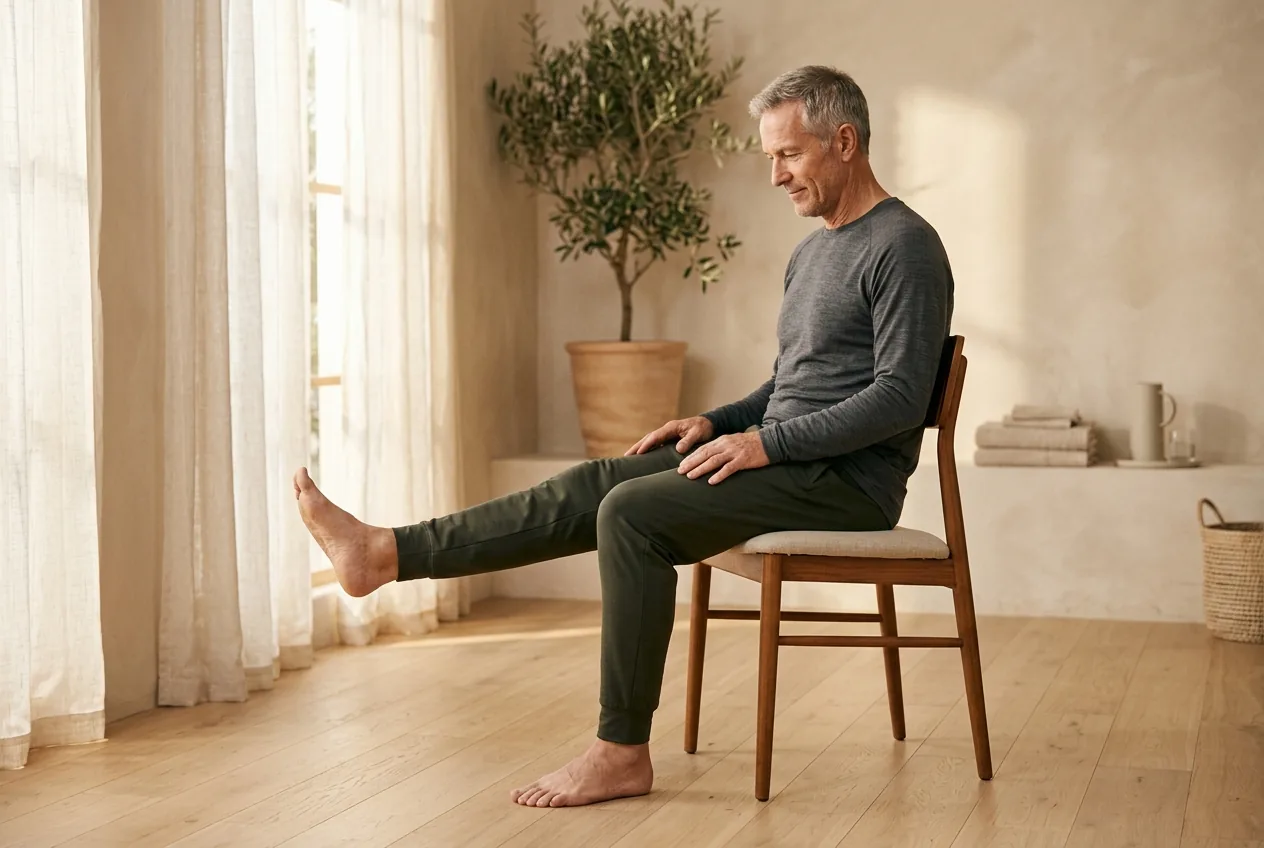
Easy, pain-free knee lifts. Once the sharp flare settles, gentle controlled knee raises keep the tendon gliding without slamming it.
Rebuild the balance
A hip flexor that's doing too much is often covering for a glute that's doing too little.
Glute bridge. Lie on your back, knees bent, feet flat, squeeze the glutes to lift the hips, hold two seconds, lower slowly. 10 to 12 reps. Waking the glutes up takes some of the workload off the overworked hip flexor.
When to see a doctor
This is posture education, not medical advice. See a clinician promptly if the hip pain came after a fall or trauma, if you can't bear weight on the leg, if the area is red, hot, and swollen or you have a fever (which can point to infection rather than simple bursitis), if there's numbness or weakness spreading down the leg, unexplained weight loss, or pain that's severe or steadily worsening. Deep front-hip pain that won't settle after a few weeks of sensible care is worth having assessed, since the groin region can refer pain from several structures.
Why the pattern is the part that lasts
You can rest and ice an iliopsoas flare quiet. But if you go straight back to eight hours of sitting with a short, overworked hip flexor and a glute that isn't pulling its weight, the tendon keeps grinding the bursa and the pain keeps returning. Stretching the spot helps for a day. It doesn't change why the muscle was overloaded.
That's the case for knowing your own pattern. A posture assessment looks at whether your pelvis is tipped forward, whether your hip flexors are doing the work your glutes should be doing, and builds the routine around that — so the muscle stops pressing the bursa flat in the first place.
Common questions
What does iliopsoas bursitis feel like?
Deep pain in the front crease of the hip, where the thigh meets the pelvis. It bites when you lift your knee — climbing into a car, going up stairs, standing from a low chair — and eases when the leg is still. Some people feel a click or snap with it.
What is the difference between iliopsoas bursitis and a hip flexor strain?
They share a cause — an overloaded, tight hip flexor — but the irritation lands in different places. A strain is damage to the muscle or tendon fibers, often after a specific overload. Bursitis is inflammation of the sac the tendon glides over, with deeper, more persistent front-hip pain and sometimes a click.
How do you treat iliopsoas bursitis?
Back off deep hip flexion for a week or two, ice it after activity, and sit less so the hip flexor isn't held short all day. Then gently stretch the hip flexor and strengthen the glutes so the muscle stops overworking across the bursa.
Is it OK to stretch with iliopsoas bursitis?
Gentle hip-flexor stretching usually helps, since a short, tight muscle is part of the problem. Keep it slow and well short of sharp pain. If a stretch produces a sharp bite deep in the front of the hip, ease off rather than pushing through.