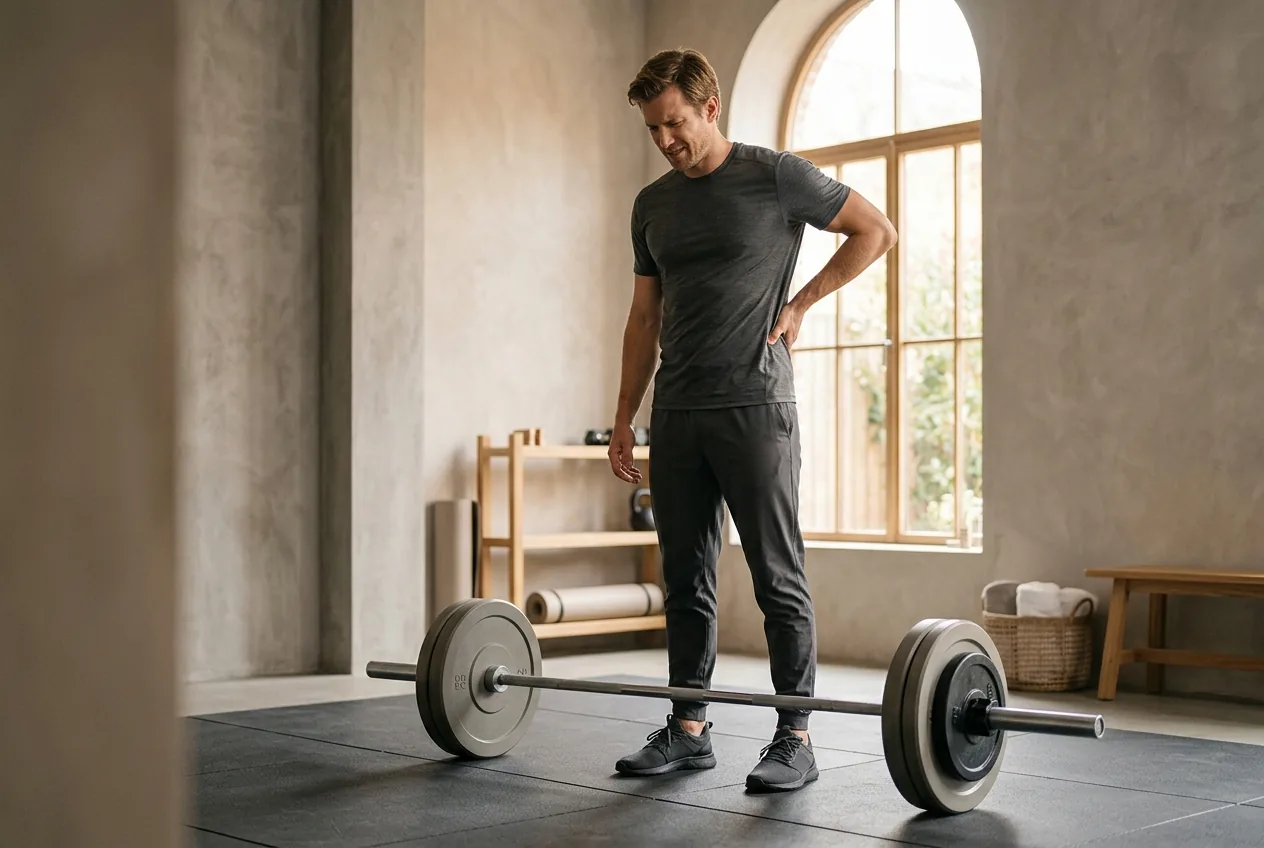
You finish the last set of deadlifts, rack the bar, and your lower back has that deep, tired, slightly-too-sore feeling that you know isn't normal muscle fatigue. Or you wake up the morning after squats and your back is locked. You've watched the form videos, you brace, you keep the bar close — and it still happens. Lower back pain after deadlifts and squats is frustrating because you're doing the homework.
Here's the part the form videos skip: your lifting posture starts before you touch the bar. It starts with the posture you carry all day.
Form and posture are two different things
Form is what you do during the lift — brace, hinge, bar path, depth. Posture is the resting alignment your body defaults to. You can have textbook form cues in your head and still load a bar onto a spine that's already sitting in a compromised position.
If your pelvis is tipped forward and your lower back over-arches in standing — a setup like anterior pelvic tilt, very common in people who sit all day — then your "neutral spine" at the bottom of a squat or the start of a deadlift isn't actually neutral. It's already extended. You load hundreds of pounds onto joints that are jammed together before the rep even starts, and the lower back muscles do work the hips and glutes should be doing.
That's why two lifters with identical cues can have completely different results. The bar finds whatever imbalance you brought to the platform.
The posture problems that show up under a bar
- Over-arched lower back (overextension). The most common one in desk-bound lifters. The back compensates for stiff hips and lazy glutes by arching, so it absorbs load it shouldn't. Often the same engine behind pain from standing too long.
- The rounded "butt wink" at the bottom of a squat. Tight hips and a weak core let the pelvis tuck under at depth, rounding the lower back under load — the riskiest moment.
- One-sided dominance. If you load or brace harder on one side, the back twists slightly under the bar and one side takes more than its share.
There's a tell that points to posture rather than form. If your back is sore in a deep, achy, central way *after* the session — the next morning, walking around — that's usually the joints and muscles that were taking load they shouldn't have, the posture problem. If instead you got a sudden sharp catch *during* a specific rep, that's more likely a moment of broken position under load, the form problem. Both are worth fixing, but they point you in different directions: the achy aftermath says address the alignment you bring to the bar, the sharp catch says clean up the rep itself. Most lifters who can't shake the problem have the first kind and keep trying to fix it with the second kind's solutions.
What to check before you blame your form
- Find true neutral, not your habitual arch. Stand tall, gently tuck the tailbone an inch, brace the core. That braced, slightly-flatter position is closer to neutral for an over-arched lifter. Train from there.
- Own your hips before you add weight. Warm up with bodyweight hip hinges and goblet squats, feeling the hips fold and the glutes drive. If the movement comes from your hips, it comes off your lower back.
- Brace like you mean it. A 360-degree brace — air into the belly, tighten all the way around — before you break the floor or descend. A loose midsection dumps load on the spine.
- Drop the ego load. If your back fails before your legs, the weight is teaching your spine to compensate. Lighten it, fix the pattern, build back up.
To strengthen the deep support that protects every rep, work in dedicated core exercises for lower back pain on non-lifting days.
Pay attention to your warm-up, too. A lot of post-lift back pain in desk workers comes from walking into the gym with hips that have been bent and locked for eight hours, then loading a hinge before anything has loosened. A few minutes of hip flexor stretching, glute activation, and bodyweight hinges before you touch the bar isn't filler — it's the difference between starting the working sets from a neutral pelvis or from your all-day sitting posture. Treat the first light sets as part of the warm-up rather than something to rush through, and feel for the hips driving rather than the lower back doing the lifting.
Good cues on a misaligned posture is like a perfect bar path on a bent barbell. The setup decides the outcome.
What to stop doing
- Stop hyperextending at the top of the deadlift, snapping the hips through and arching back hard. Finish tall and neutral, glutes squeezed, not arched.
- Stop squatting past the depth where your lower back rounds. Build the mobility first, then earn the depth.
- Stop training through a back that's already flared. A reactive back under load reinforces the very compensation hurting you.
When to see a doctor
Post-lift muscle soreness that eases over a day or two is normal training fatigue. See a clinician promptly if a lift caused a sudden sharp pain with numbness, tingling, or weakness down a leg; any loss of bladder or bowel control or numbness around the groin (treat as an emergency); pain that won't settle over a couple of weeks; or back pain with fever, unexplained weight loss, or pain that's severe or steadily worsening. A genuine acute injury under load deserves a proper assessment before you load again.
Fix the posture, then the lift follows
Bracing harder and owning your hips help every lifter. But whether your back over-arches, rounds, or twists under the bar changes which mobility and which strengthening you need — and the wrong drill can reinforce the fault. A posture assessment measures your actual deviations off the platform, so your daily routine corrects the alignment you bring to every rep. That's the principle behind this posture therapy method.
The lifters who get past this rarely do it by chasing a perfect cue or buying a belt. They do it by fixing the posture they walk into the gym with, so that neutral on the platform is actually neutral and the hips, not the lower back, drive the lift. Once the alignment is right, the form cues you already know start working the way they're supposed to.
You don't have to choose between lifting and a back that works. You have to stop loading the bar onto a posture that was already compensating.
Common questions
Why does my lower back hurt after deadlifts even with good form?
Form is what you do during the lift; posture is the alignment your body defaults to before you touch the bar. If your pelvis tips forward and your lower back over-arches in standing, your "neutral" at the start of a deadlift is already extended, so the back takes load the hips and glutes should handle.
Is my back pain after lifting a form problem or a posture problem?
A useful tell: a deep, achy soreness the next morning usually points to the alignment you brought to the bar, the posture problem. A sudden sharp catch during a specific rep is more likely a moment of broken position, the form problem. Most lifters who can't shake it have the first kind.
Should I keep lifting through lower back pain?
Post-lift muscle soreness that eases over a day or two is normal training fatigue. Don't train through a back that's already flared, since loading a reactive back reinforces the compensation hurting you. A sudden sharp pain with numbness or weakness down a leg needs a proper assessment before you load again.
How do I warm up to protect my back before squats or deadlifts?
Walk in with hips that have been bent all day and they need loosening first. A few minutes of hip flexor stretching, glute activation, and bodyweight hinges before the bar lets you start your working sets from a neutral pelvis rather than your all-day sitting posture.