
You turn to check your blind spot and the neck doesn't quite go all the way, with a stiff, gritty resistance and maybe a faint crunch. Mornings are the worst — it takes a while to loosen up — and the ache creeps up into the base of your skull by mid-afternoon. When a scan or a doctor puts the word "arthritis" on it, it can feel like a verdict. It usually isn't.
Neck arthritis, or cervical osteoarthritis, is wear-and-tear change in the joints and discs of the neck. It's extremely common as people get older, and here's the part that surprises people: how much arthritis shows up on a scan often has little to do with how much pain someone feels. Plenty of people with clear arthritic changes have comfortable necks, and plenty with mild changes have stiff, sore ones. That gap is where the room to improve lives.
What's actually happening in an arthritic neck
The neck is a stack of small joints with cushioning discs between the bones. Over decades, those discs lose some height and water, and the joints develop a bit of roughening and sometimes small bony growths. That's the "osteoarthritis" the scan describes. It's a normal part of ageing tissue, more like grey hair for your spine than a disease eating away at it.
The stiffness and ache come less from the wear itself and more from how the surrounding muscles respond. When the joints are a bit stiff, the muscles around them tighten to guard the area. Held tight, those muscles ache and fatigue, and they pull your head and neck further out of line, which loads the joints more. It becomes a loop: stiff joint, guarding muscle, more load, more stiffness.
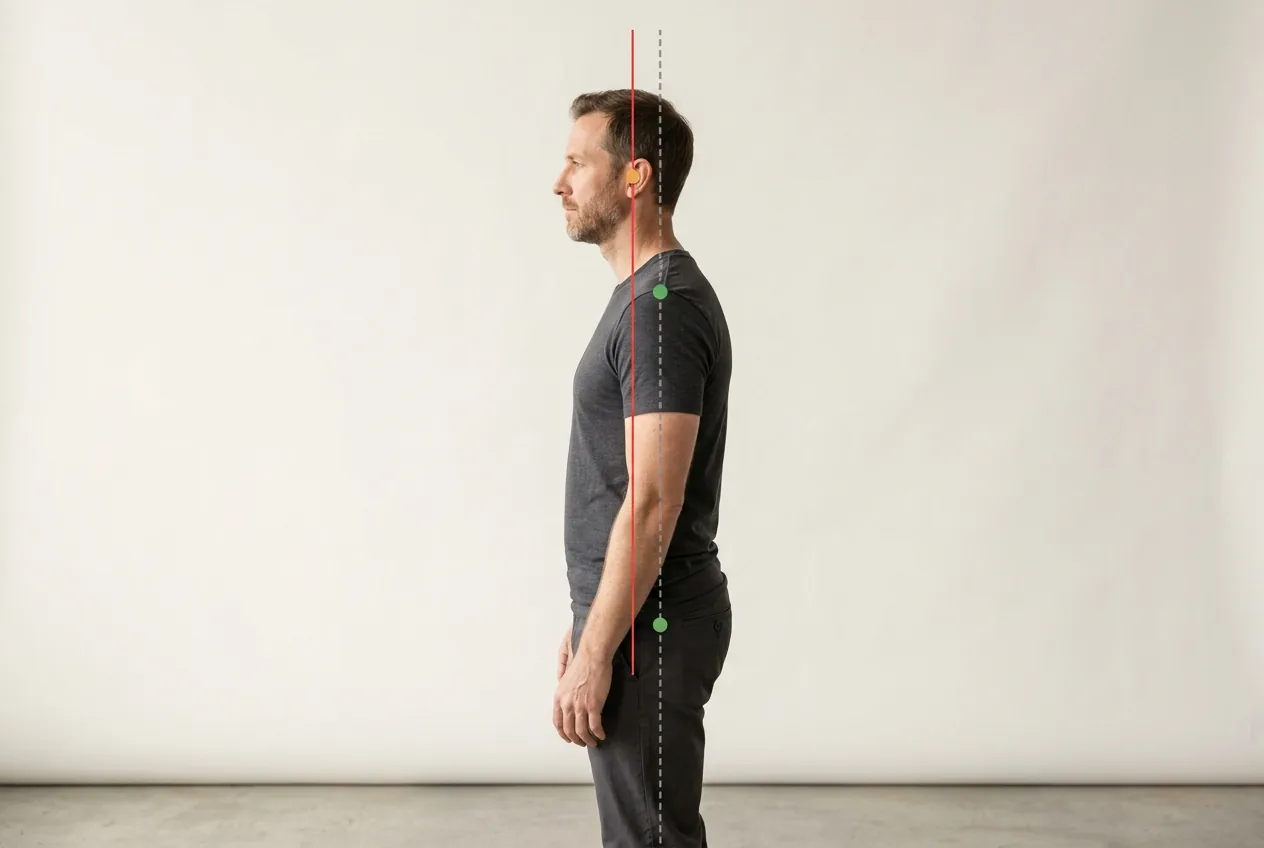
Posture feeds straight into that loop. If your head sits forward of your shoulders for hours over a screen, the joints at the back of your neck are compressed all day and the muscles at the base of your skull never get to switch off. An arthritic neck handles that sustained load far worse than a young one. This is the same mechanism behind forward head posture, just on a neck with less margin for error.
What actually helps
The useful news: the pieces you can change — movement, muscle balance, and load — are exactly the pieces that drive most of the symptoms.
- Keep the neck moving. Stiff joints get stiffer when guarded. Gentle range-of-motion through the day — slow turns side to side, small nods, easy tilts, within a comfortable range — keeps the joints lubricated and tells the guarding muscles to ease off. Frequent and gentle beats occasional and hard.
- Unload the joints with better head position. Bringing your head back over your shoulders takes the constant compression off the arthritic joints. A simple chin tuck — drawing the chin gently back to make a "double chin," holding a few seconds — is the cornerstone, and the routine in cervical posture exercises builds from there.
- Warmth for the morning stiffness. Heat relaxes the guarding muscles and eases the gritty morning start. A warm shower aimed at the neck, or a heat pack, before you move it helps.
- Set up your screen and desk. If your monitor is low and your head drops to read it, you're compressing the joints for eight hours. Raising the screen to eye level and getting your sitting sorted takes a huge chunk of the daily load off.
- Strengthen the deep neck muscles. The small muscles at the front of the neck that hold your head back over your shoulders tend to weaken, leaving the back-of-neck muscles to overwork. Gentle chin tucks and posture work build them back.
Arthritis on a scan isn't the same as pain in your neck. How the muscles around those joints behave matters more than the wear itself.
What tends to make it worse
- Long hours with the head forward over a phone or low screen.
- Sleeping with the neck cranked — too many pillows or a stomach-sleeping twist. The right pillow height for your position matters here.
- Holding still all day because moving feels stiff. That guards and tightens the muscles further.
- Aggressive cracking or forceful stretching into the stiff range. Gentle and within comfort is the rule.
When to see a doctor
Most arthritic neck stiffness and ache is manageable with movement, posture, and time. See a clinician promptly, though, if you have numbness, tingling, or weakness spreading into an arm or hand, clumsiness in the hands or trouble with fine tasks like buttons, problems with balance or walking, neck pain after a fall or accident, fever with neck pain, unexplained weight loss, or pain that's severe or steadily worsening. Those can signal a nerve or cord being compressed — which is the more serious end covered in cervical stenosis — and need a proper look rather than self-management.
Why a generic neck routine often misses
Here's the catch with arthritis advice. "Do neck exercises" is sound, but the move that helps one arthritic neck can aggravate another, because it depends on which way your neck is loaded — pulled forward, jammed into too much arch, or stiff to one side more than the other. The same chin tuck that unloads one person's joints is the wrong starting dose for another's. General mobility and posture work is a fair start, but the version that holds is matched to your actual pattern. A posture approach that measures how your head and neck sit can show which muscles switched off and which are overworking, so the daily routine targets the real driver of the compression rather than treating every arthritic neck the same.
The headline worth keeping: the wear is normal, the symptoms are largely about load and muscle balance, and those are the things you can actually change.
Common questions
Can neck arthritis be cured?
The wear-and-tear changes themselves don't reverse, so "cured" isn't the right frame. But the stiffness and pain often improve a lot, because most of the symptoms come from guarding muscles and poor head position rather than the wear itself. Keeping the neck moving, improving how your head sits over your shoulders, and unloading the joints can make an arthritic neck comfortable.
What is the best exercise for neck arthritis?
Gentle range-of-motion through the day plus the chin tuck — drawing your chin straight back to bring your head over your shoulders — is the most useful starting pair. The chin tuck unloads the arthritic joints at the back of the neck and strengthens the deep muscles that hold your head in line. Keep movements slow and within a comfortable range.
Does cervical arthritis get worse over time?
The structural changes tend to progress slowly with age, but symptoms don't track that progression closely — many people stay the same or feel better even as the scan shows more wear. How your neck feels depends heavily on posture, muscle balance, and movement, which you can keep working on at any age.
What makes neck arthritis flare up?
Long stretches with your head forward over a screen or phone, sleeping with the neck cranked or on too many pillows, holding the neck still all day, and forceful cracking or stretching into the stiff range. Cold, tense periods can stiffen the guarding muscles too. Movement, warmth, and a better head position usually settle a flare.