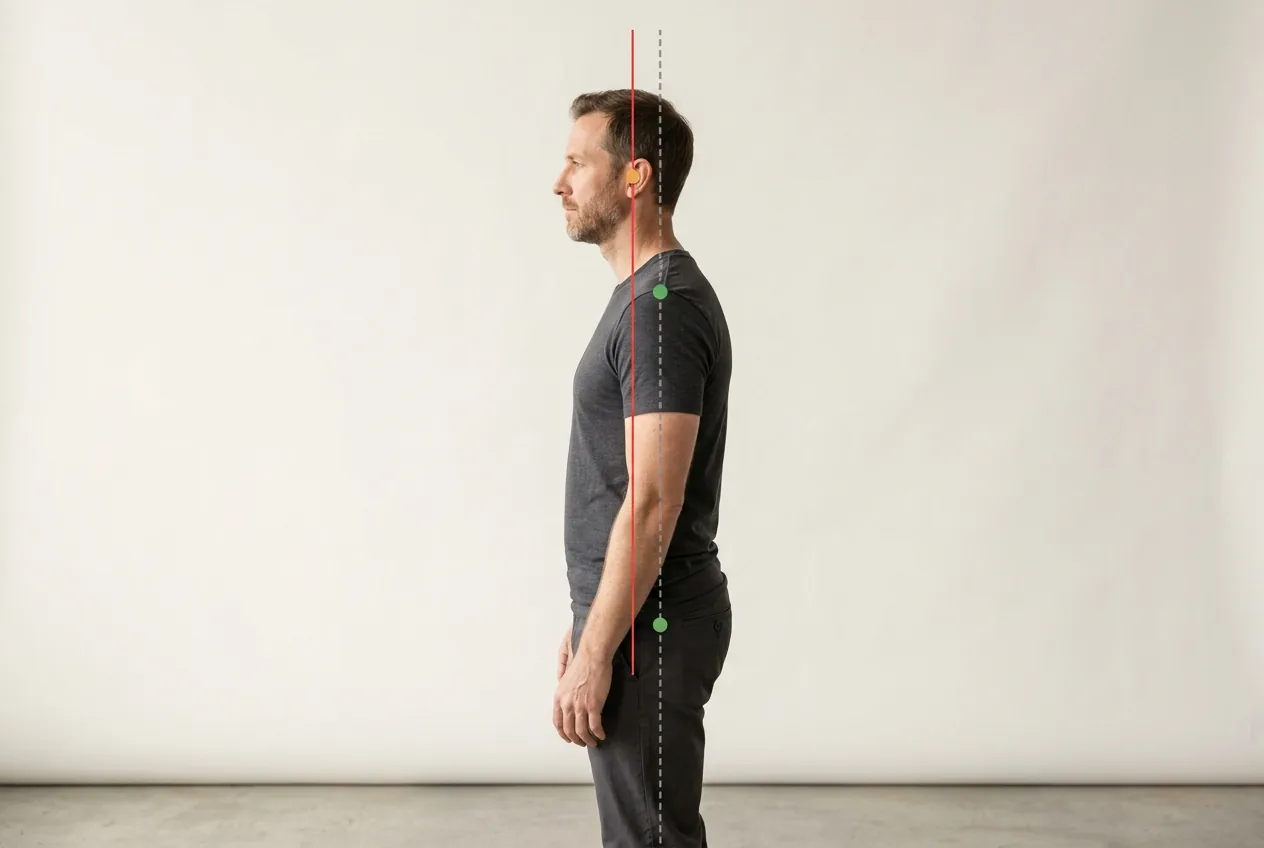

You're scrolling in bed, or hunched over your phone on the train, and there it is again — a tight, dull ache right where your skull meets your neck. By evening it has crept up into a low headache. You put the phone down, roll your neck, and it eases for a minute before settling back in.
That spot — the base of the skull — is one of the most common places phone users feel neck pain. It's not random. It's mechanical, and once you see why, the fix stops being a guessing game.
Why the base of your skull takes the hit
Your head weighs about five kilograms when it sits balanced over your spine. Held there, your neck barely notices it. But the head works like a weight on the end of a lever, and the moment it drifts forward — which is exactly what happens when you look down at a phone — the muscles at the back of your neck have to pull harder to stop it dropping toward your chest.
The small muscles right at the base of the skull, the suboccipitals, do a lot of that holding. They're tiny. They were never meant to brace a forward-tilted head for hours at a time. So they stay clenched, and a clenched muscle that never gets to rest aches and refers pain up into the back of the head.
This is the everyday version of forward head posture: the further forward your head sits, the more those base-of-skull muscles overwork. Phones just make the angle worse than almost anything else, because you tend to hold them low, in your lap or at your waist, and curl your whole neck down to meet them.
The ache isn't a weak neck. It's a tired one, holding a position it was never built to hold.
How to tell if your phone is the cause
A quick test. Notice where your phone usually sits when you use it. If it's down near your stomach and your chin drops to look at it, that's the angle doing the damage. Now check the timing of your pain — does it build through the day and ease overnight, then return? Is it worse after a long scroll or a stretch of texting?
Another tell: where exactly the pain sits. Phone-driven base-of-skull pain usually lands in a tight, low band right where you'd rest your hand if you cupped the back of your head, sometimes a little worse on one side if you favour one hand for scrolling. It tends to ease within minutes of putting the phone down and standing up, then return the next time you settle in to scroll. That on-off pattern, tied to the screen, is the clearest sign the angle is the driver rather than something structural.
If you want a fast read on whether the screen habit has already shaped your posture, the checklist in have text neck? find out quickly takes about a minute. Most phone-related base-of-skull pain fits the text-neck pattern closely.
What to do about it
The goal is to take the constant load off those base-of-skull muscles, give them a way to release, and retrain your head to sit back over your shoulders where it belongs.
Lift the phone, don't drop the head
This is the single biggest lever you have. Raise your phone toward your face instead of curling your neck down to it. Bring it up to eye level for anything longer than a quick glance. It feels slightly silly for a day or two. Then it feels normal, and the afternoon ache stops showing up.
Chin tucks to retrain the position
Chin tucks switch the deep neck muscles back on and glide your head back over your shoulders. Done right, they're the cornerstone move for this pain.
- Sit or stand tall, looking straight ahead.
- Without tilting your head down, draw it straight back — as if making a gentle double chin. You should feel the front of your neck working and a light stretch at the base of your skull.
- Hold five seconds, release. Do 8 to 10 reps.
Several short sets through the day beat one long one. The full how-to, including the mistake almost everyone makes, is in the chin tucks exercise guide.
Release the suboccipitals directly
Lie on your back and place two fingers, or a small rolled towel, right where your skull meets your neck. Let the weight of your head rest into the pressure. Tuck your chin a few millimetres to lengthen the muscles, then relax. Two minutes here can take the edge off a building headache. If you catch it early — the moment the pressure starts rather than once it's a full ache — it often heads the whole thing off.
A gentler version works at your desk: cup the back of your skull in both hands, fingers meeting at the base, and let your head's weight settle back into your hands for a few slow breaths. It gives those small muscles a brief rest they almost never get during a workday.
Reset the upper back too
Base-of-skull pain rarely travels alone. A rounded, stiff upper back pushes your head further forward, which makes the suboccipitals work harder still. Gentle upper-back movement through the day keeps the whole chain from locking up, and it pairs naturally with the chin tucks above.
What to stop doing
- Stop scrolling in bed with your head propped at a sharp angle on the pillow. It's one of the worst positions for these muscles.
- Stop cradling the phone between your ear and shoulder on calls. Use headphones or speaker.
- Stop the long, aggressive neck cracks and yanks. They give a second of relief and leave the underlying position unchanged.
When to see a doctor
Posture work is education, not medical care. See a clinician promptly if a headache comes on suddenly and severely, if neck stiffness arrives with a fever, if you have numbness, tingling, or weakness running down an arm, or if neck pain follows a fall or accident. Pain that's steadily worsening, won't settle, or comes with unexplained weight loss also deserves a proper look before you start any routine.
The part that's specific to you
Lifting your phone and doing chin tucks helps almost everyone with this pattern, because the mechanism is so consistent. But how far forward your head sits, how stiff your upper back has become, and which muscles to prioritize differ from person to person. Generic advice is a fine starting point — lasting relief comes from working your actual pattern rather than the average one.
That's the idea behind a proper posture assessment: measure your real deviations, then build a routine around them. The base-of-skull ache came from repetition. It leaves the same way.
Common questions
Why does the pain sit right where my skull meets my neck?
That's where the small suboccipital muscles attach, and they tighten when your head drifts forward and they have to hold it there for hours. The ache clusters at that spot because those muscles rarely get a real break during a desk day.
Can a pinched nerve cause pain at the base of the skull?
It can, and it usually brings other signs with it, like tingling or weakness running into an arm or hand. A purely muscular, posture-driven ache tends to stay local to the neck and head. If you have those nerve symptoms, get it looked at rather than guessing.
How long before chin tucks make a difference?
Many people feel some relief within a couple of weeks of doing them daily, because you're retraining muscles that have been switched off for a long time. Consistency matters more than intensity here.
Is it safe to massage the base of my skull myself?
Gentle, brief pressure with two fingers or a rolled towel is fine for most people and often helps. Avoid hard, prolonged digging that leaves the area sore, and stop if anything sharp shows up.