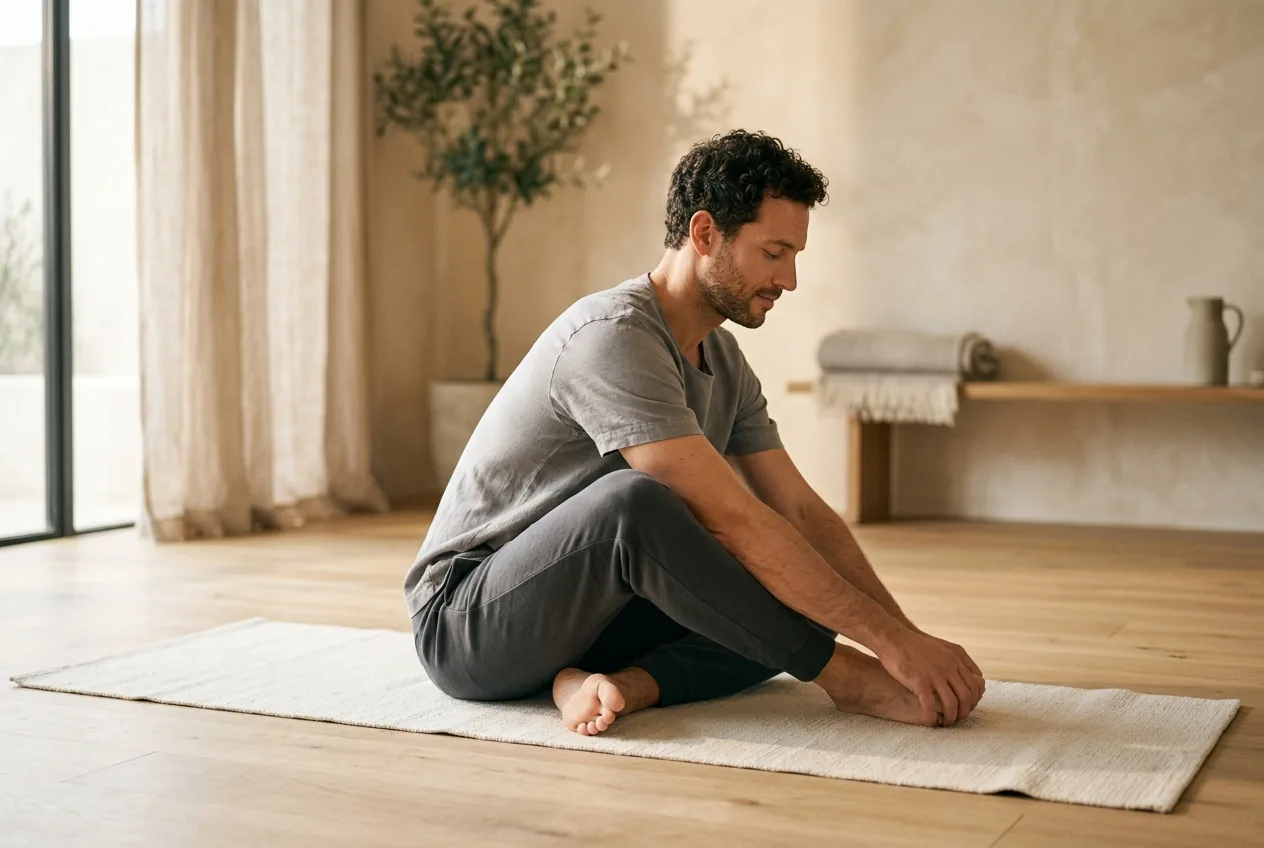
Sometimes the pain hits when getting on the floor is the last thing you want to do — mid-shift, standing in a queue, at the kitchen counter while the kettle boils, that hot line down the back of your leg flaring and no mat in sight. Standing sciatica stretches exist for exactly that moment: ways to take tension off the nerve without lying down, kneeling, or finding privacy.
These won't replace a proper routine, and they won't fix the reason your sciatica started. What they do is give you something useful to do in the moment, wherever you are, that can ease the pull without making things worse. That last part matters more than people think, because the wrong stretch can wind sciatica up rather than calm it.
A quick word on what sciatica is
Sciatica is a symptom, not a diagnosis — pain, tingling, or numbness travelling down the path of the sciatic nerve, from the lower back or buttock down the back of the thigh and sometimes into the calf and foot. It happens when something irritates or compresses that nerve, most often in the lower back where a disc or tight tissue presses on the nerve root, or in the buttock where a tight deep muscle leans on the nerve. The fuller picture is in sciatic nerve pain.
Why does this matter for stretching? Because the nerve doesn't like being yanked. A stretch that pulls hard on an already-irritated nerve can flare it. The standing stretches below are chosen to ease tension on the surrounding muscles and gently mobilise the nerve, not to crank on it.
An irritated nerve wants gentle, repeated movement, not a hard hold. If a stretch sharpens the shooting pain down your leg, that's your cue to back off, not push.
Standing stretches you can do anywhere
Standing figure-four
This opens the deep buttock muscles that often press on the nerve.
Stand near a wall or counter for balance. Cross one ankle over the opposite thigh, just above the knee, so the lifted leg makes a figure-four. Keeping your back fairly straight, sit back and down a little, as if lowering toward a chair, until you feel a stretch deep in the buttock of the crossed leg. Hold 20 to 30 seconds, breathe, and ease out. Two or three rounds a side. Stop short of any sharp leg pain.
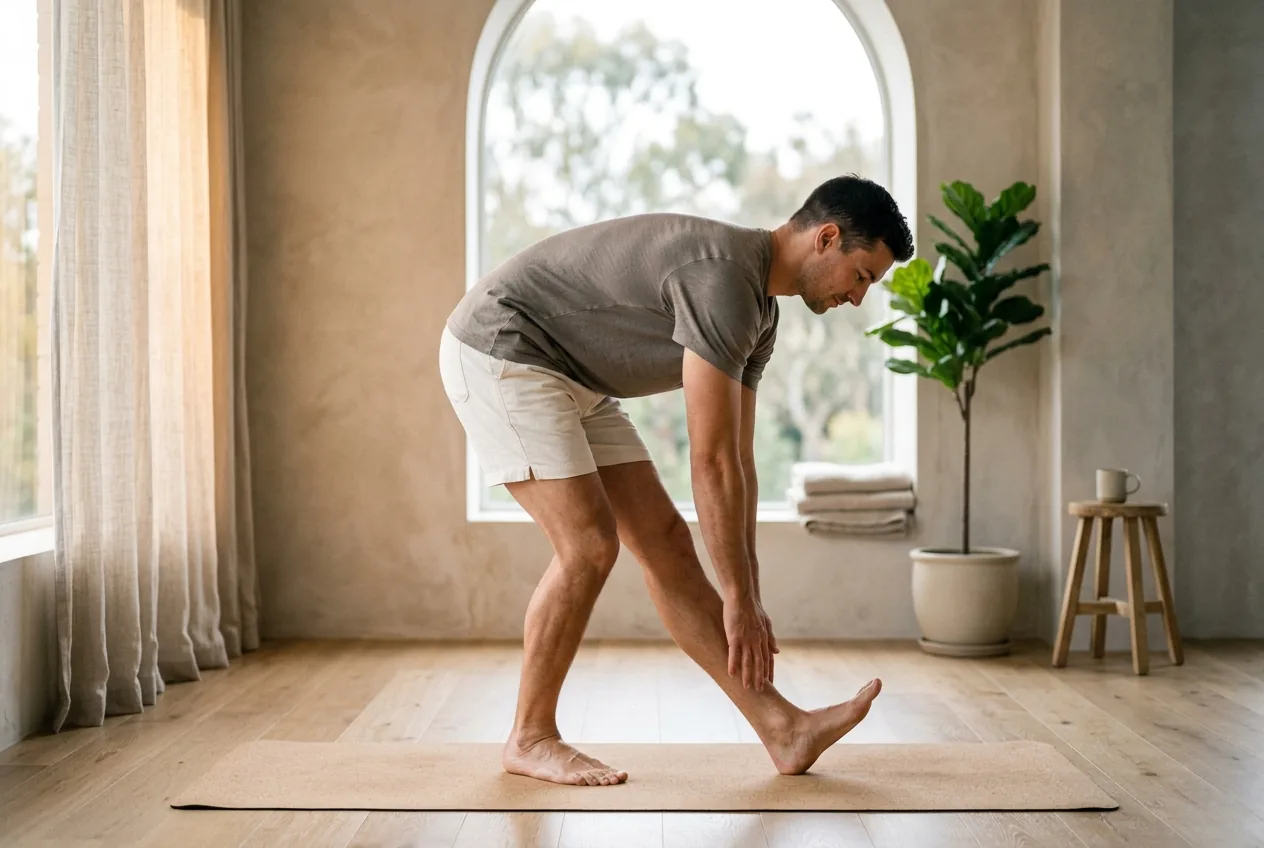
Standing hamstring stretch on a step
A tight hamstring tugs on the pelvis and can pull on the nerve's lower run.
Place one heel on a low step or curb, leg straight but knee soft, toes up. Keep your back flat and hinge forward gently from the hips — not by rounding your back — until you feel a mild stretch up the back of the thigh. Hold 20 to 30 seconds. Keep it mild; bouncing or forcing it can aggravate the nerve.
Standing nerve glide
This gently slides the nerve rather than stretching it hard, which an irritated nerve usually tolerates better.
Stand tall. Straighten the affected leg out in front, heel on the floor, toes pulled up toward you. As you do, look up slightly. Then point the toes and drop your chin toward your chest. Move slowly back and forth between the two, like a slow pump, 8 to 10 times. You're flossing the nerve through its path, not holding a stretch. If it increases symptoms, ease the range.
Standing back extension
For sciatica that comes from the lower back, gently arching backward can take pressure off the nerve.
Stand with feet hip-width, hands on your lower back. Gently arch backward a small amount, looking slightly up, then return. Do it slowly, a few times, only as far as comfortable. If arching back worsens the leg pain, skip this one — it's a sign your pattern prefers forward positions instead.
Standing calf and lower-leg release
Where sciatica reaches the calf, easing the lower leg helps. Step one foot back, heel down, back leg straight, and lean gently into a wall until you feel a calf stretch. Hold 20 to 30 seconds a side.
How to use them
- Little and often beats one big session. A round every hour or two during a flare does more than a single long stretch.
- Stay in the pain-easing range. These should reduce or hold symptoms steady, not sharpen the shooting pain.
- Pair them with moving. A short walk between rounds often helps as much as the stretches. Sitting still is usually what wound it up — see the floor-based companions in sciatica stretches at home.
When to see a doctor
This is posture and self-care education, not medical advice. Sciatica usually settles, but some signs need prompt attention. See a clinician without delay for any loss of bladder or bowel control, numbness in the saddle area between the legs, or weakness in a leg or foot that's getting worse — these are red flags. Also seek care if the pain came after a fall or accident, comes with fever, follows unexplained weight loss, affects both legs, or is severe and steadily worsening despite sensible self-care.
Why a stretch helps for an hour but not for good
Standing stretches are genuinely useful for getting through the day, but they treat the symptom — the irritated nerve — not the reason it's irritated. Sciatica from the lower back usually traces to how the spine and pelvis are loaded: a posture that keeps pressing on the nerve root, a tipped pelvis, a deep muscle clamping down. Stretch all you like; if the pattern that compresses the nerve stays, the pain circles back.
A posture assessment that measures your own deviations shows which way your spine and pelvis are loading the nerve — which is also what decides whether arching back helps you or forward positions do. That's the difference between stretches that get you through the afternoon and a routine that takes the pressure off for good.
Common questions
Can you do sciatica stretches standing up?
Yes. Standing figure-four for the deep buttock, a step hamstring stretch, a standing nerve glide, gentle back extension, and a calf stretch all ease tension on the sciatic nerve without getting on the floor. They're handy at a desk, in a queue, or anywhere you can't lie down, as long as you stay in the pain-easing range.
Which standing stretch is best for sciatica?
It depends on where your sciatica comes from. The standing figure-four helps when a tight deep buttock muscle is involved; gentle back extension helps many people whose sciatica comes from the lower back; the nerve glide suits an irritated nerve that dislikes hard stretching. The right one is whichever eases your symptoms rather than sharpening them.
Why do some sciatica stretches make it worse?
Because an irritated nerve dislikes being pulled hard, and because the position that helps one cause can aggravate another — forward-bending helps some patterns and worsens others, and the reverse for arching back. If a stretch sharpens the shooting leg pain, stop; it's signalling that it's the wrong move for your pattern.
How often should I do standing sciatica stretches?
Little and often works best during a flare — a short round every hour or two, paired with brief walks. Stay gentle and in the range that eases symptoms. These manage the day-to-day pain, but lasting relief comes from addressing why the nerve is being compressed in the first place.