
By about 2pm, the back of your neck feels like it's been set in concrete and the band of muscle across the top of your shoulders has gone hard. You roll your head a few times, shrug, maybe lace your fingers and push your arms overhead. It loosens for a minute. Then you go back to the screen and it tightens right back up.
Upper back and neck stretches are the usual first move for this, and they can genuinely help. But there's a reason yours might not be sticking — and it isn't that you're doing them wrong. It's that stretching the part that hurts often misses what's actually driving the stiffness. Below are the moves that work, why they work, and how to tell which ones are worth your time.
Why your neck and upper back stiffen at a desk
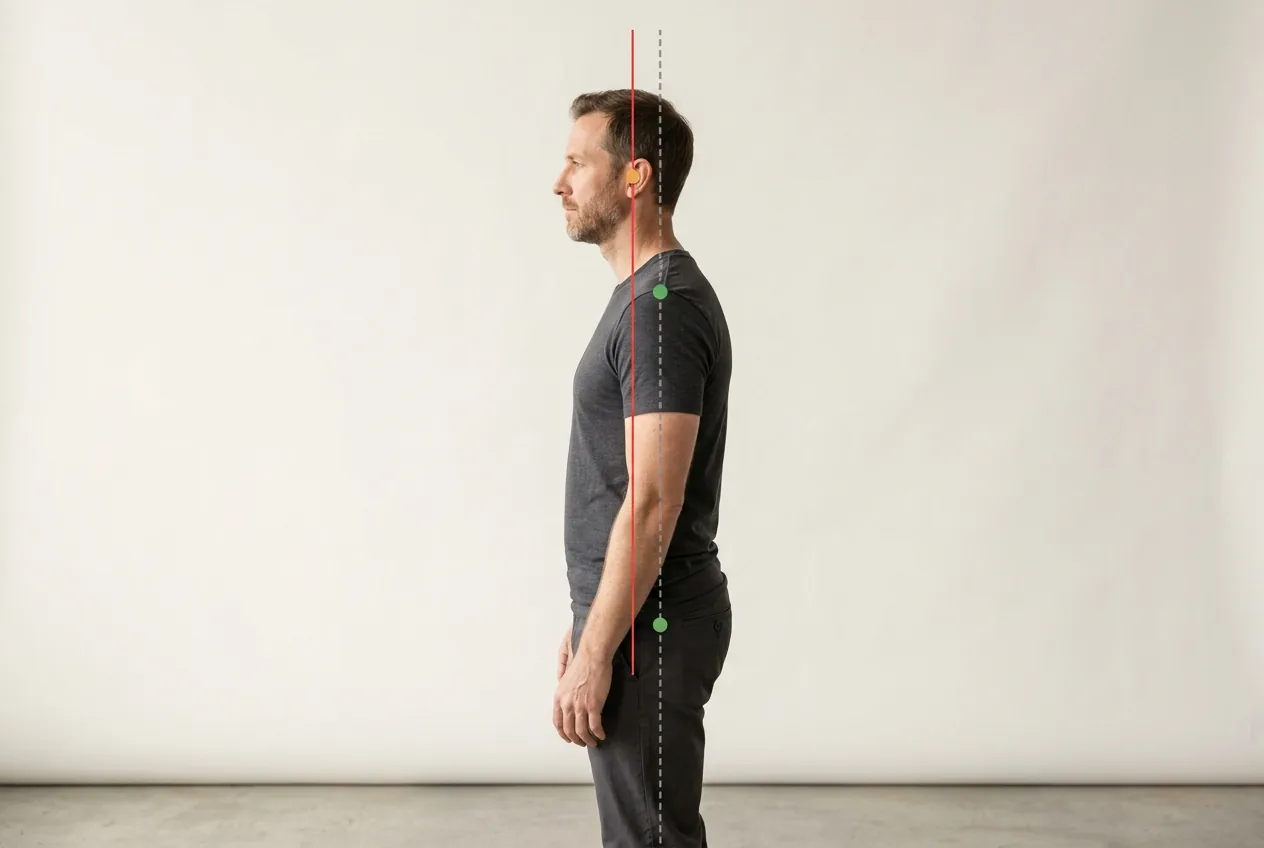
Your head weighs roughly five kilograms, about the weight of a bowling ball. When it sits balanced over your shoulders, the muscles of your neck and upper back barely have to work to hold it up. When it drifts forward toward the screen — which it does, hour after hour — those muscles have to brace against gravity the whole time.
That bracing is the stiffness. The band across the top of your shoulders (the upper trapezius) and the small muscles at the base of your skull stay switched on for hours, and muscles that never get to rest don't stay loose. The mid-back rounds, the chest tightens at the front, and the whole upper body settles into a forward hunch.
So the tightness you feel isn't usually a problem with those muscles. It's those muscles doing overtime to hold up a head that's drifted out of position. Stretch them and you get relief for a few minutes — until the position pulls them tight again. That's the loop most people are stuck in, and it's the same pattern behind the familiar knot between the shoulder blades.
Stretches that target the neck
Start here when the stiffness sits high — the base of the skull, the sides of the neck, the top of the shoulders.
- Upper trapezius stretch. Sit tall. Drop your right ear toward your right shoulder, then place your right hand gently on the left side of your head and let its weight ease you a little further. You should feel a long stretch down the left side of your neck. Hold 20–30 seconds, then switch. Don't pull hard — the weight of the hand is enough.
- Levator scapulae stretch. From the same upright position, turn your head about 45 degrees to the right, as if looking toward your right pocket, then nod down into that angle. Use your right hand for a gentle assist. This catches the muscle that runs from the neck to the shoulder blade, the one that often feels ropey. Hold 20–30 seconds each side.
- Chin tuck. Sit tall, look straight ahead, and draw your head straight back as if making a double chin — not down, back. Hold three to five seconds, do eight to ten reps. This one isn't really a stretch; it retrains your head to sit back over your shoulders, which is the thing that lets the neck muscles rest. It's worth doing more than any single stretch here, and there's a fuller walkthrough in the chin tucks exercise guide.
Stretches that target the upper back
When the tightness sits lower — between the shoulder blades, across the mid-back — these open up the rounding.
- Thoracic extension over a chair. Sit, lace your hands behind your head, and gently arch your upper back over the top edge of the backrest. Breathe out as you ease back. A few slow reps restores the extension that hours of rounding take away.
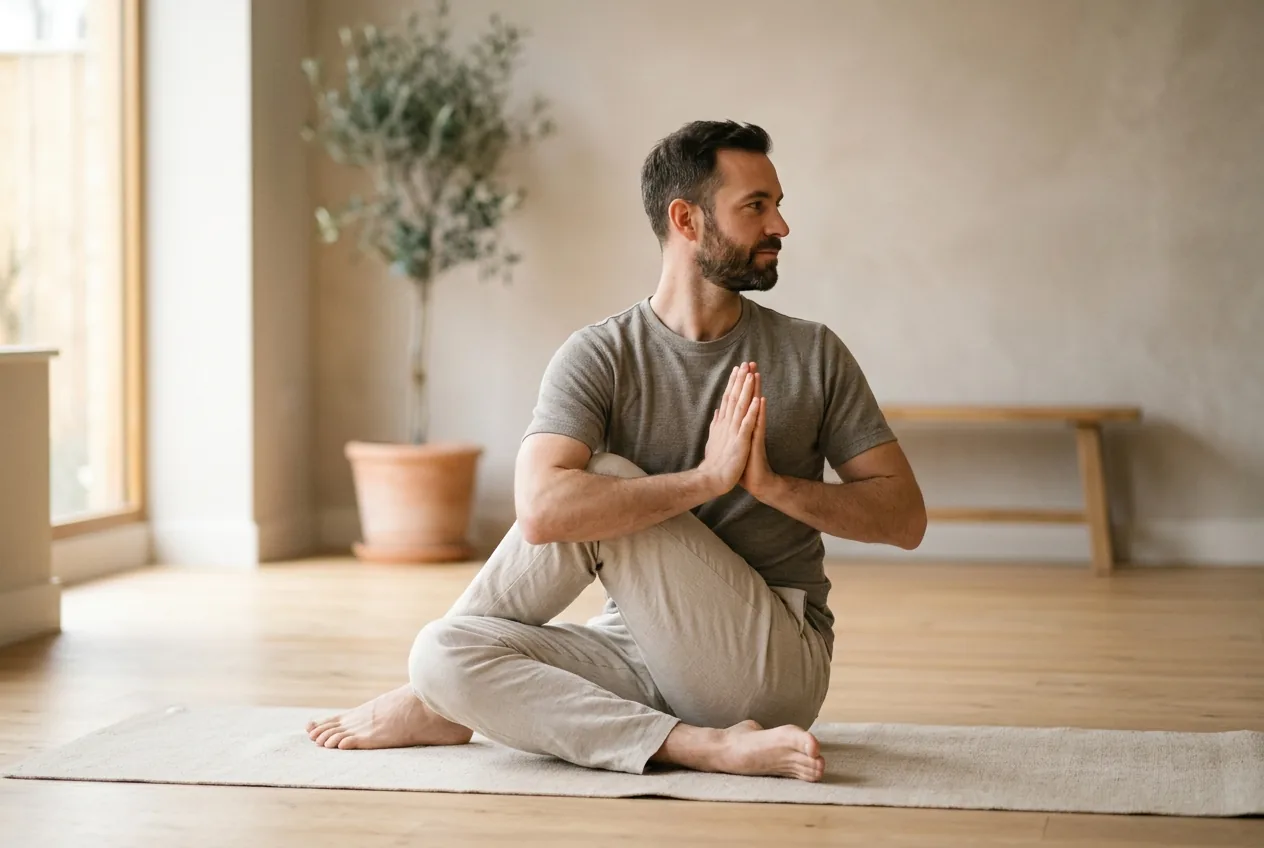
- Thread the needle. On all fours, slide your right arm under your body and across, lowering the right shoulder toward the floor. You'll feel it open between the shoulder blades. Hold 20–30 seconds each side. Good for the part of the back you can never quite reach.
- Doorway chest stretch. Stand in a doorway, forearm on the frame, elbow at shoulder height, and step gently through. This stretches the front of the chest — and a tight chest is what pulls the shoulders forward and keeps the upper back rounded. Loosening the front is often what finally lets the back relax. Hold 20–30 seconds each side.
The muscles that ache are rarely the ones that need the most attention. The tight front pulls the rounded back tight.
What to stop doing
A few habits quietly undo the stretching:
- Cranking your neck for the stretch. More force doesn't mean more benefit. Let gravity and the weight of your hand do the work; a hard pull just makes the muscle guard.
- Stretching once and expecting it to hold. A muscle held tight for eight hours won't stay loose from one 30-second stretch. Short, frequent resets beat one long session.
- Never moving the screen up. If you're looking down at a laptop all day, no amount of stretching outpaces the position. Raise the screen to roughly eye level. A few practical fixes are in the desk stretches at work guide.
When to see a doctor
Stiffness that loosens with movement is usually mechanical. See a clinician promptly if neck or upper-back pain comes with numbness, tingling, or weakness spreading into an arm or hand; if it follows a fall or accident; if it comes with a fever, headache, and a stiff neck you can't bend forward; or if it's severe and steadily worsening rather than easing. Those patterns point beyond simple muscle tightness.
Why the right stretch depends on your posture
Here's the catch with a list like this: the same stretch that frees one person does nothing for another. If your head sits far forward, chin tucks and chest opening matter most. If your shoulders are rounded but your head is fine, the doorway stretch does the heavy lifting. Stretch the wrong link and you spend effort without changing the thing holding you tight.
Generic stretches are a reasonable starting point. Lasting relief comes from knowing which part of your own posture is doing the overworking — and that's what a posture assessment measures. It looks at how far your head sits forward, how rounded your upper back is, and builds the routine around your actual pattern. If the stiffness keeps coming back no matter how much you stretch, that's the signal to stop guessing and see how a posture-based method works from your real alignment.
Loosen the neck, open the chest, retrain the head position — and the 2pm concrete stops setting in the first place.
Common questions
What are the best stretches for upper back and neck stiffness?
The most useful combination is an upper trapezius stretch and a levator scapulae stretch for the neck, plus thoracic extension and a doorway chest stretch for the upper back. Add chin tucks to retrain head position. Hold each stretch 20–30 seconds and repeat through the day rather than once.
How often should I stretch my neck and upper back?
Little and often beats one long session. A muscle held tight for hours won't stay loose from a single stretch, so a brief reset every hour or two at the desk works better than a single block at the end of the day.
Why does my neck stiffness keep coming back after stretching?
Usually because the head position that's overworking the muscles hasn't changed. If your head sits forward toward a screen all day, the muscles tighten right back up after you stretch. Retraining head position and raising the screen address the cause, not just the symptom.
Can stretching make neck pain worse?
It can if you pull hard or push into sharp pain — the muscle guards and tightens. Gentle, slow stretches that you ease into are safe for most people. If a stretch produces tingling, numbness, or pain shooting into the arm, stop and see a clinician.