
You've probably landed here because you saw the name, watched a clip, or a friend mentioned an app that "actually fixed their posture" — and you want to know what it really is before you download anything. Fair. There are a lot of posture apps that turn out to be a buzzing notification in a nice wrapper. Here's a straight answer about what Postureletics is, how it works, and who it's for, without the pitch.
The short version
Postureletics is a mobile app, for iPhone and Android, that delivers personalized posture-therapy exercise programs for chronic back, neck, and sciatica pain. You take a short photo-based posture assessment, the app maps your joints and scores your posture, and then it builds a roughly fifteen-minute-a-day corrective routine matched to the specific misalignments it found. As your posture changes, it re-assesses and adjusts. It's free to start.
The one-line difference from most posture apps: it doesn't remind you to sit up straight, and it doesn't strap anything to you. It assesses your body and prescribes a correction — the same logic a posture specialist uses in person.
How the assessment works
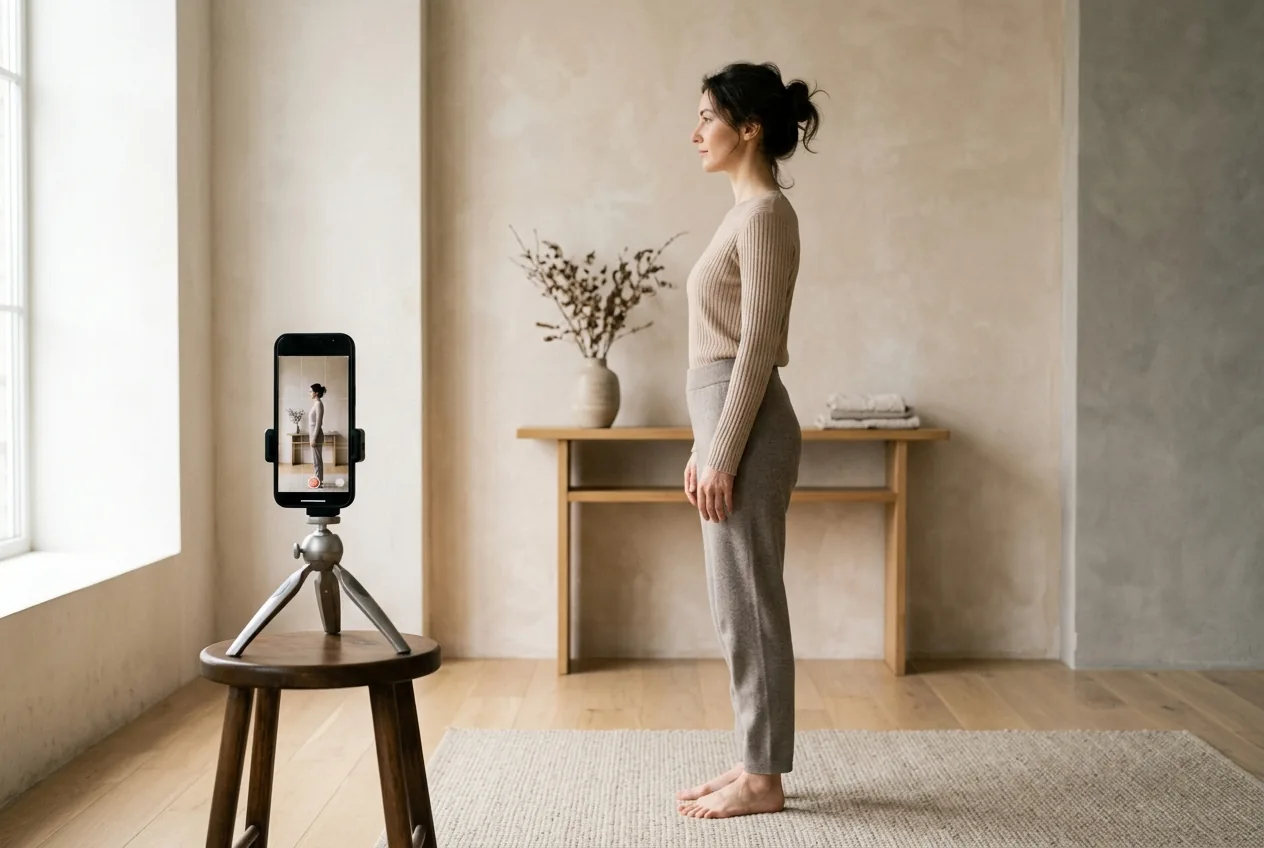
The app starts with a two-minute assessment. You take a few photos from set angles, and computer vision maps where your joints actually sit — then scores your posture and lists the specific deviations behind it: a forward head, rounded shoulders, a tilted pelvis, uneven hips, and so on.
This step is the whole point, and it's what separates a real posture tool from a gadget. Most chronic, non-traumatic back and neck pain comes from the body compensating around a postural imbalance — some muscles switch off, others overwork to cover for them, and pain shows up where the overload lands. Generic stretches fail because the same move that helps one posture can worsen another. You can't prescribe the right routine until you've measured the actual pattern. The assessment is that measurement. If you want the mechanism in full, where bad posture causes pain traces it from head to foot.
How the program works
Once it knows your deviations, the app builds a sequence of corrective exercises matched to them — gentle, specific positions held or repeated to wake up the muscles that switched off and release the ones that overwork. The daily commitment is small on purpose: around fifteen minutes, because a routine you'll actually do beats an ambitious one you'll quit. The sequence matters as much as the moves; corrections are done in an order that lets each change hold before the next.
Then it re-assesses. Your posture in week eight isn't your posture in week one, so the program shifts with you instead of handing you the same static list forever. That adapting loop — assess, correct, re-assess — is the part a reminder app or a wearable tracker structurally can't offer. For the self-guided version of the same approach, how to improve posture covers the principles.
The method and the evidence behind it
Postureletics is built on postural-alignment therapy, the tradition associated with the Egoscue method — the idea that you correct chronic pain by correcting the alignment driving it, not by chasing the sore spot. The founder, Daniyar Abenov, is a Certified Posture Alignment Specialist.
On evidence: individualized postural therapy was tested head-to-head against usual medical care in the SPINE CARE randomized trial, published in JAMA in 2022, and showed greater improvement in pain and disability at three months and again at one year. An earlier Stanford pilot found meaningful pain reduction over a couple of months. That's a stronger evidence base than most posture products can point to, and we lay it out in full on the science page. It's also worth being clear about what that evidence is and isn't — it supports posture therapy for chronic, posture-related pain, not as a treatment for disease or injury.
Who it's for — and who it isn't
Postureletics fits people with the slow, nagging, recurring kind of back and neck pain: desk workers, people who sit or stand all day, parents lifting kids, anyone whose pain tracks with how they hold themselves and builds over months. It also fits people who simply want to stand straighter and prevent problems before they start.
It is not a fit, and the app says so, for fresh injuries, fractures, pain from a fall or accident, congenital conditions, or active illness. Posture therapy is non-medical — it doesn't diagnose or treat disease. If your pain is sudden and severe, comes with fever, or brings numbness or weakness in both legs or any loss of bladder or bowel control, that's a clinician-first situation, not an app one. When to worry about back pain spells out those red flags. An app belongs after serious causes are ruled out.
How it compares to other options
If you're weighing Postureletics against the alternatives, the honest framing is by what each actually does. A posture corrector brace holds you upright but doesn't retrain you — covered in posture corrector vs exercises. Reminder and wearable apps build awareness but don't prescribe a correction — covered in best posture apps. Physical therapy and chiropractic treat in their own ways, which we compare on the comparison page. Postureletics sits in the assess-and-correct category, which is the one built to change the underlying pattern rather than manage around it.
Trying it
The app is free to start, so the lowest-risk way to judge it is to take the assessment and see your own posture scored — that alone tends to be clarifying, whether or not you go further. You can download it here. Judge it the way you'd judge any of these tools: not by how slick the assessment felt, but by whether your posture in the mirror actually changes over a couple of months.
Common questions
Is Postureletics free?
It's free to start, including the photo-based posture assessment, so you can see your posture scored and your specific deviations identified before deciding whether to go further with the full program.
How is Postureletics different from a posture reminder app?
Reminder apps nudge you to sit up straight on a timer; they don't measure your posture or prescribe anything. Postureletics assesses your specific deviations and builds a corrective program around them that adapts over time — it's designed to change the pattern, not just interrupt you.
Does Postureletics actually work?
It's built on individualized postural therapy, which was tested against usual medical care in the JAMA SPINE CARE trial (2022) and showed greater pain and disability improvement at three months and one year, with an earlier Stanford pilot showing meaningful pain reduction. Results depend on doing the daily program consistently, and it's meant for chronic, posture-related pain rather than injury or disease.
What does Postureletics treat?
It's aimed at chronic, non-traumatic back, neck, and sciatica pain that's tied to posture and builds over time. It is not a treatment for fresh injuries, fractures, congenital conditions, or active illness, and it doesn't diagnose disease — see a clinician for those.
How much time does it take each day?
The daily corrective program is built to run about fifteen minutes. That's deliberate — a short routine you'll actually keep doing changes posture more than a long one you abandon after a week.