
The MRI report used a word that stuck with you: "bulging," maybe "herniated," at one of the levels in your neck. And it lined up with what you'd been feeling — a deep ache at the base of the neck that some days runs out into the shoulder, occasionally a pins-and-needles trail down the arm. You read the report and assumed the worst: something is broken in your spine and it's only going to get older and worse.
A bulging disc in the neck sounds more alarming than it usually is. The discs between your neck vertebrae are cushions, and when one pushes out of its normal shape it can press or irritate nearby tissue, which is what you feel. The reassuring part: most disc problems in the neck calm down over weeks to a few months without surgery, and how you hold and move your neck has a lot to do with whether it settles or stays angry. There's an important exception, covered in the red-flag section — read that first if your arm feels weak or numb.
What a bulging or herniated disc in the neck actually is
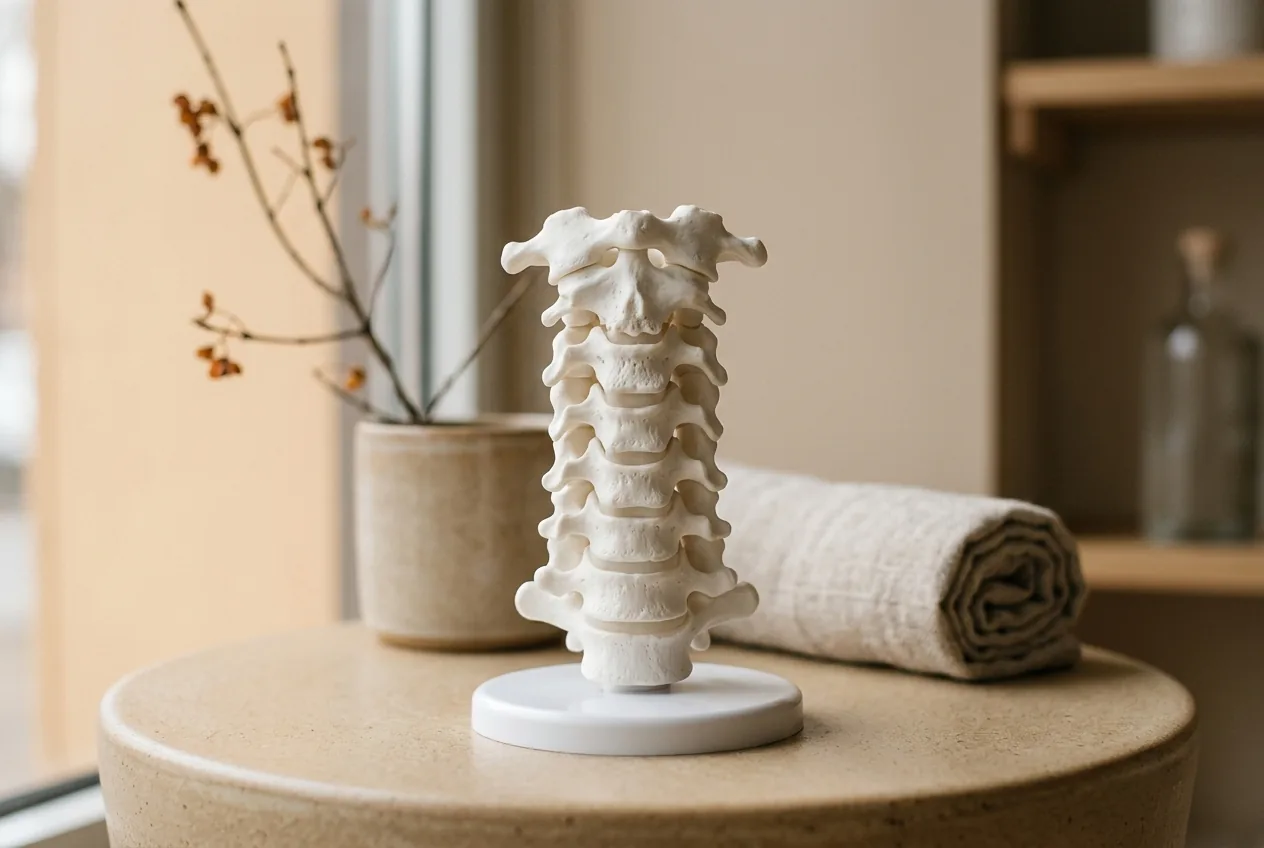
Between each pair of neck vertebrae sits a disc: a tough outer ring with a softer gel center, built to absorb load and let your neck move. A bulging disc is one where the outer ring pushes outward past its normal edge, like a tire wall flexing under weight. A herniated disc (sometimes called a slipped cervical disc) is when the softer center pushes through a tear in that ring.
Either way, the trouble comes when that bulge gets close to a nerve root leaving the spine. The nerve gets irritated, and because that nerve runs down into the shoulder, arm, and hand, you can feel symptoms well away from the neck itself — aching, burning, tingling, sometimes a patch of numbness. This is why a neck problem shows up as an arm problem. It's the same nerve-irritation mechanism behind a pinched nerve in the neck, and the two often overlap.
Worth knowing: plenty of people have disc bulges on MRI and no pain at all. The bulge on the scan isn't automatically the cause of your symptoms, and it doesn't dictate how much it has to hurt.
Red flags — when to see a doctor promptly
Most neck disc symptoms are safe to manage gently. But see a clinician quickly, and treat some of these as urgent, if you have:
- Weakness in the arm or hand — trouble gripping, lifting, or a hand that feels clumsy or gives way.
- Numbness that's spreading rather than a small fixed patch, or numbness in both arms.
- Problems with balance, walking, or fine hand movements like buttoning a shirt.
- Any loss of bladder or bowel control, or numbness around the groin — get emergency care.
- Severe pain after a fall or accident, or pain with fever and feeling generally unwell.
Arm weakness and numbness are the ones not to sit on. A nerve under enough pressure to weaken a muscle needs a proper assessment, not a stretch from an article.
What helps it settle
Once anything serious is ruled out, the aim is to take pressure off the irritated nerve and stop feeding the irritation. Gentle and consistent beats forceful.
Ease the position that pinches the nerve
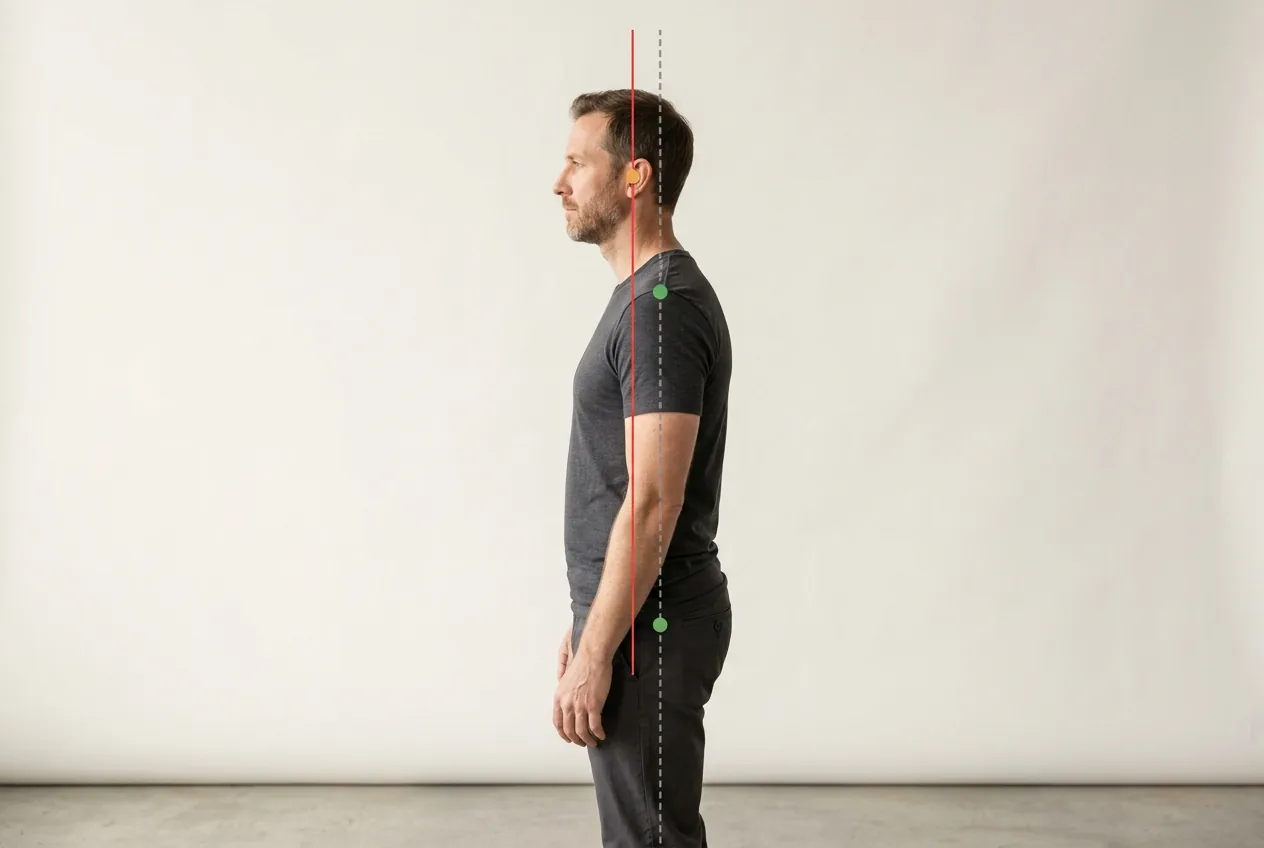
Many people find certain neck positions clearly better or worse. Often, a forward, jutted-chin posture closes down the space where the nerve exits and makes symptoms worse, while bringing the head back over the shoulders opens it up.
- Chin tucks. Sitting tall, draw your head straight back to make a gentle double chin, hold a few seconds, repeat eight to ten times. Done often through the day, this helps unload the irritated level. Stop if it sends pain or tingling down the arm.
- Posture resets at the desk. Raise your screen so you're not looking down for hours. The forward-head desk slump is a common driver, and resetting it through the day takes constant pressure off the neck.
Calm the irritation
- Move within comfort. Gentle range-of-motion — slow turns and tilts to the point of mild stretch, not pain — keeps the neck from stiffening up while it heals.
- Heat for the muscle guarding. The muscles around an irritated disc tend to clamp down. Warmth can ease that protective tension and make movement easier.
- Sleep support. A pillow that keeps your neck level — not propped too high or dropped too low — stops you spending eight hours in a position that aggravates the nerve.
A neck disc usually doesn't need you to fight it. It needs you to stop pinching the nerve all day and give it room to calm down.
Stop doing
- Long stretches looking down at a phone or laptop.
- Cranking the neck into the painful range to "test" it.
- Aggressive self-manipulation or hard cracking of the neck when symptoms are active.
How long it takes
Most cervical disc symptoms improve over several weeks, with the sharp arm symptoms often easing before the last of the neck ache. It's rarely linear — better days and worse days are normal. Surgery is the exception, not the rule, usually reserved for cases with real, persistent weakness or symptoms that don't settle despite good conservative care. The pattern of flaring and calming is much like a bulging disc in the lower back, where the same patience-and-position approach applies.
Why position matters more than the bulge
Here's the part that changes how people manage this: the disc bulge is one thing, but what irritates the nerve day to day is often the position you hold your neck in. A head that sits forward for ten hours keeps the irritated level loaded and the nerve pinched. Reset the head over the shoulders and the same disc can quietly settle.
That position isn't random — it comes from your particular posture, how your head, shoulders, and upper back stack up. The right correction depends on your specific pattern, which is what a posture assessment measures: where your head actually sits, what's tight, what's switched off. Once a clinician has cleared anything serious, it's worth seeing how a posture-based method addresses the alignment behind neck pain rather than treating the bulge as a fixed sentence.
Take the pressure off, give it time, and a neck disc that read like a disaster on paper usually turns out to be something the body can quietly settle.
Common questions
Can a bulging disc in the neck heal on its own?
Often, yes. Most cervical disc bulges and herniations settle over weeks to a few months without surgery as the irritation calms and the disc material is gradually reabsorbed. Gentle movement, good neck position, and avoiding aggravating postures support that process. Persistent weakness is the main reason to consider more.
What's the difference between a bulging and herniated disc in the neck?
A bulging disc is when the disc's tough outer ring pushes outward past its normal edge. A herniated, or slipped, disc is when the softer center pushes through a tear in that ring. Both can irritate a nearby nerve and cause neck, shoulder, or arm symptoms; herniations tend to be more likely to press on a nerve.
Why does a neck disc cause arm pain or tingling?
The nerves that leave the spine in your neck travel down into the shoulder, arm, and hand. When a disc bulge irritates one of those nerve roots, the symptoms show up along the nerve's path — so a neck problem can produce aching, burning, tingling, or numbness in the arm well away from the neck itself.
When should I worry about a herniated disc in my neck?
See a doctor promptly for weakness in the arm or hand, numbness that's spreading or affecting both arms, or problems with balance and walking. Loss of bladder or bowel control, or numbness around the groin, needs emergency care. These suggest more than ordinary nerve irritation.