
You turn your head and there it is — a hot, raw band across the back of your neck, like someone held a match to the skin from the inside. It isn't the dull ache you'd call a stiff neck. It burns. And burning feels alarming in a way a normal ache doesn't, because we associate it with damage.
Most of the time, a burning sensation in the neck isn't a sign that something is breaking. It's a sign that a muscle is overworked to the point of irritation, or that a nerve in the area is getting squeezed or rubbed. Both are common, both are usually mechanical, and both tend to trace back to how your head sits on your shoulders all day.
Why burning feels different from a normal ache
A regular muscle ache is the deep, tired soreness of a muscle that's been working hard. Burning is a step further along. When a muscle stays contracted for hours — holding your head forward over a screen, for example — it runs low on oxygen and starts to accumulate metabolic byproducts. The tissue gets sensitised. Nerve endings that normally report "working" start reporting "irritated," and your brain reads that as heat.
There's a second source. The nerves that supply the skin and muscles of your neck exit between the bones of your cervical spine. When the surrounding tissue is tight or a joint is irritated, those nerves can get mildly compressed or inflamed. Nerve irritation often shows up as burning, tingling, or a pins-and-needles quality rather than a plain ache — and it can radiate, so the burn at the base of your skull might actually be coming from lower down.
The posture link most people miss
Here's the part that surprises people. The muscle that's burning is usually not the muscle causing the problem.
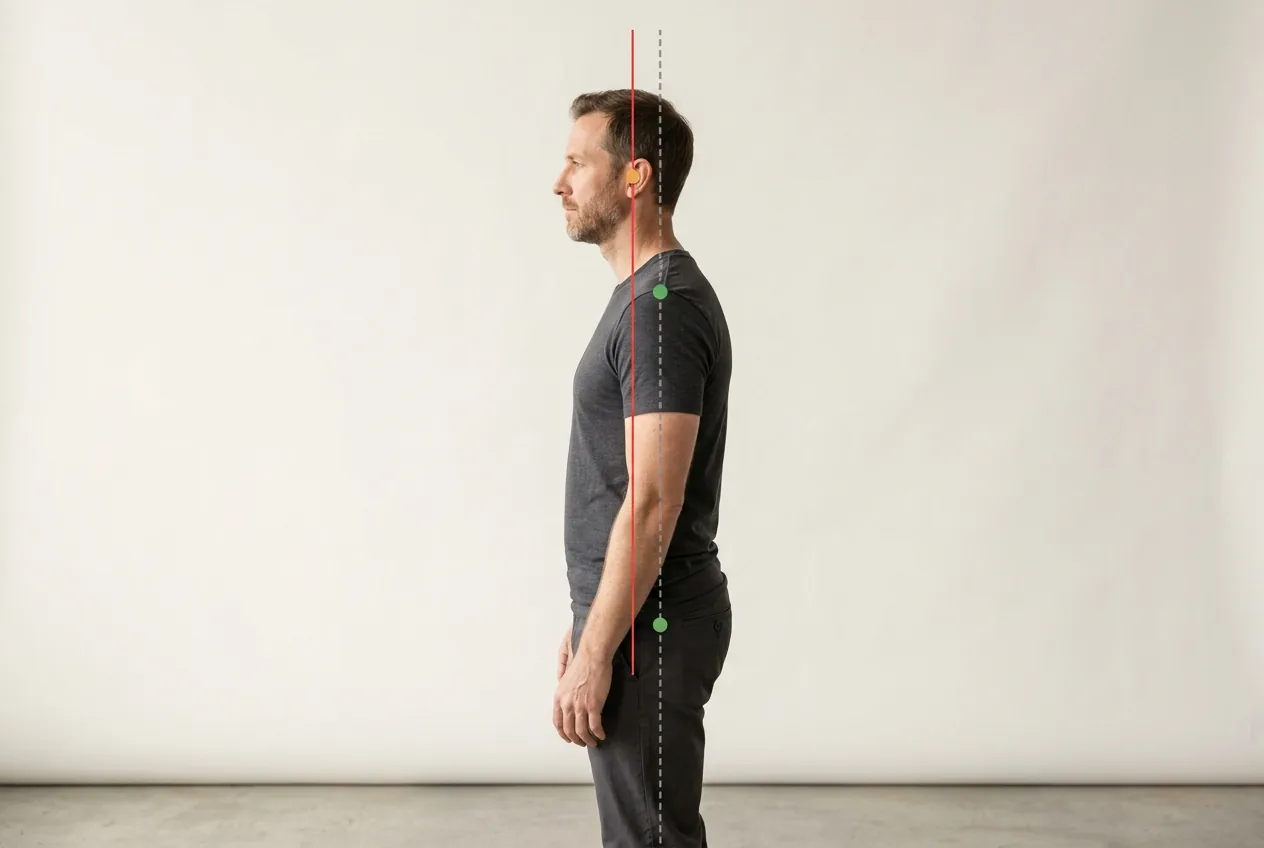
When your head drifts forward — the default position for anyone who spends the day at a desk, on a phone, or driving — the muscles at the back of your neck and across the top of your shoulders have to fight gravity to keep your head from dropping. Your head weighs roughly five kilograms. Held over your chest instead of stacked over your spine, the load on those back-of-neck muscles multiplies. They're not built for that kind of marathon. So they overwork, get sensitised, and eventually burn.
Meanwhile the muscles that should help hold your head upright from the front and the deep stabilisers along the spine have effectively switched off from disuse. That's the compensation pattern behind most chronic neck symptoms: some muscles quit, others cover, and the ones covering are the ones that hurt.
The spot that burns is rarely the spot that's failing. It's the one picking up the slack.
This matters because it explains why generic neck stretches give mixed results. Stretch the burning muscle and you might get twenty minutes of relief — but you've done nothing about the forward-head position that's overloading it, so it's burning again by mid-afternoon.
What tends to set it off
- Long static hours. Screens, driving, reading in bed. Anything that holds your head still and forward for a stretch.
- Stress. People clench their neck and shoulders under pressure without noticing. Held tension turns into burning, which is why neck and shoulder tension that flares with stress so often has a burning edge.
- Sleeping awkwardly. A pillow that's too high or too flat leaves your neck bent for hours.
- A pinched nerve. If the burning travels — into the shoulder, down the arm, into the fingers — a nerve root in the neck may be involved. This is the territory of a pinched nerve in the neck, and the radiating quality is the tell.
What actually settles the burning
Some moves you can do today. None of them are dramatic, and that's the point — gentle and frequent beats hard and occasional with an irritated neck.
- Chin tucks. Sit tall. Without tilting your head, draw your chin straight back, as if making a double chin. Hold for five seconds, release. Do ten. This re-stacks your head over your spine and takes load off the burning back-of-neck muscles. It's the single most useful move for forward-head patterns.
- Upper-trap release. Sit on one hand to anchor the shoulder. Gently tip your head to the opposite side until you feel a stretch along the burning band. Hold thirty seconds. Breathe. Don't pull hard.
- Shoulder-blade sets. Draw your shoulder blades gently down and back, hold five seconds, release. Repeat through the day. This wakes up the muscles that should be sharing the load.
- Heat, then movement. A warm compress for ten minutes relaxes the sensitised tissue, but don't just heat and sit still — follow it with gentle movement so the muscle doesn't lock back up.
What to stop doing matters as much. Stop cranking your head into deep stretches when it's actively burning — that often inflames an already irritated nerve. And stop the long unbroken sitting blocks. A movement break every thirty minutes does more than any single stretch.
When to see a doctor
Most neck burning is mechanical and eases within a couple of weeks of changing the load on your neck. See a clinician promptly if the burning comes with weakness or numbness spreading down an arm, if you lose grip strength or coordination in a hand, if it follows a fall or accident, or if it's accompanied by fever, severe headache, or feeling generally unwell. Burning that steadily worsens despite rest and gentle movement also deserves a professional look. None of this is to frighten you — these are simply the situations where you want eyes on it rather than waiting.
Knowing your own pattern
Chin tucks and trap releases help because they address the most common driver — a head that lives too far forward. But "most common" isn't "yours." The exact mix of which muscles in your neck have switched off and which are overworking varies from person to person, and a stretch that calms one pattern can aggravate another.
That's the case for figuring out your own posture rather than copying a generic routine. A short posture assessment measures where your head and shoulders actually sit and builds a daily routine around your specific deviations — which is usually what turns short-lived relief into something that lasts.
Common questions
Why does my neck burn when I'm stressed?
Stress drives you to clench the muscles across your neck and shoulders, often for hours without noticing. Sustained contraction sensitises the tissue, and sensitised muscle reports as burning rather than a simple ache. Releasing the clench — through breathing, movement breaks, and shoulder-blade resets — usually calms it.
Is a burning neck a sign of a pinched nerve?
It can be, especially if the burning travels into your shoulder, arm, or fingers, or comes with tingling and numbness. Burning that stays local to the neck is more often overworked, irritated muscle. Radiating burning that reaches the hand is the pattern most worth getting checked.
How long does a burning neck usually last?
A muscle-driven burn often eases within a few days to a couple of weeks once you reduce the load — better screen height, movement breaks, and gentle resets. If it's nerve-related it can take longer. Burning that lingers beyond a few weeks or keeps returning is worth investigating for an underlying postural cause.
Can my pillow be causing it?
Yes. A pillow that holds your neck bent up or dropped down for hours leaves those muscles strained all night, and you wake with the burn already lit. Aim for a pillow that keeps your neck roughly level with your spine when you're on your side or back.