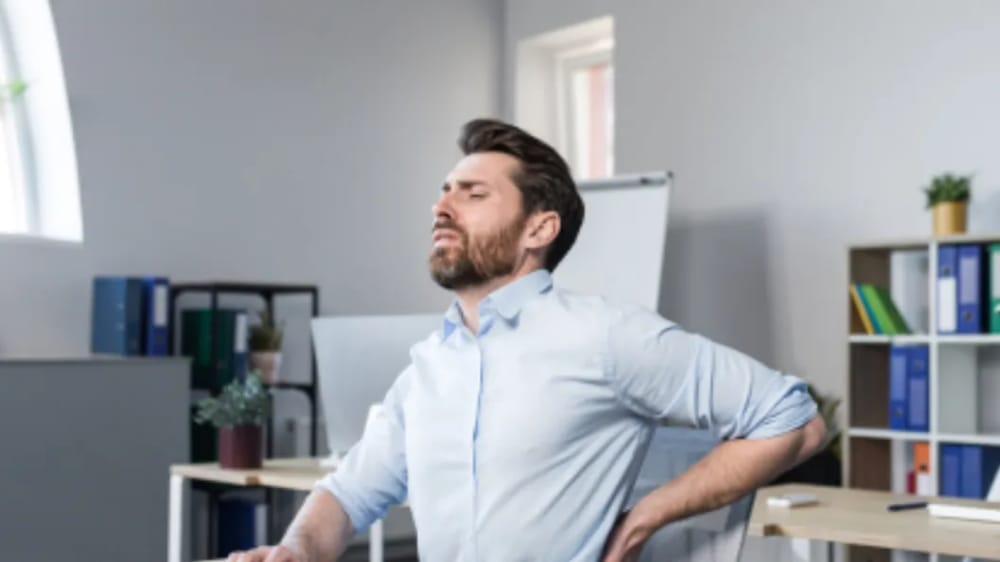
You've iced it, stretched it, taken the anti-inflammatories, maybe had an MRI that found "nothing serious" — and the ache in your back, neck, or hip is still there a year later. Somewhere in that loop a friend or a forum mentioned the Egoscue Method, and you want to know what it actually is before you spend another weekend on a fix that doesn't hold. Here's the straight version.
The Egoscue Method is a posture-therapy approach to chronic musculoskeletal pain. Its central claim is simple and a little provocative: most long-running back, neck, hip, and knee pain isn't a problem with the part that hurts — it's a problem with how your whole body is aligned, and you treat it by correcting the alignment, not by chasing the symptom.
Where the Egoscue Method came from
The method was developed by Pete Egoscue, an anatomical physiologist, who built it after working through his own chronic pain decades ago. Out of that came a system of postural assessment and corrective exercise that's now taught through the Egoscue Institute and its certified Posture Alignment Specialists. It sits in the broader family of postural-alignment therapy — non-medical, movement-based, and focused on function rather than diagnosis.
The core idea: pain is usually a posture problem
Here's the mechanism the method is built on. The human body has a "design" posture — viewed from the side, your ankles, knees, hips, and shoulders should stack in a roughly vertical line. Modern life works against that. We sit for hours, move in one plane, favor one side, and over years the body drifts out of alignment: some muscles switch off from disuse, others overwork to compensate, and joints start loading at angles they weren't built for.
When that happens, the pain often shows up nowhere near the cause. A dropped, rotated hip can surface as knee pain. A collapsed upper back can surface as a headache or a forward head posture that aches at the base of the skull. That's why treating the sore spot so often fails — the sore spot is where the load *landed*, not where the problem *started*. We map that whole chain in where bad posture causes pain, and the underlying question — can bad posture cause back pain — gets a fuller answer there.
This is also why generic stretching disappoints. The same move that helps one posture can worsen another: someone with an anterior pelvic tilt needs almost the opposite emphasis from someone with rounded shoulders or a kyphotic upper back. A routine has to match the specific deviations, or it's a coin flip.
What an Egoscue session actually looks like
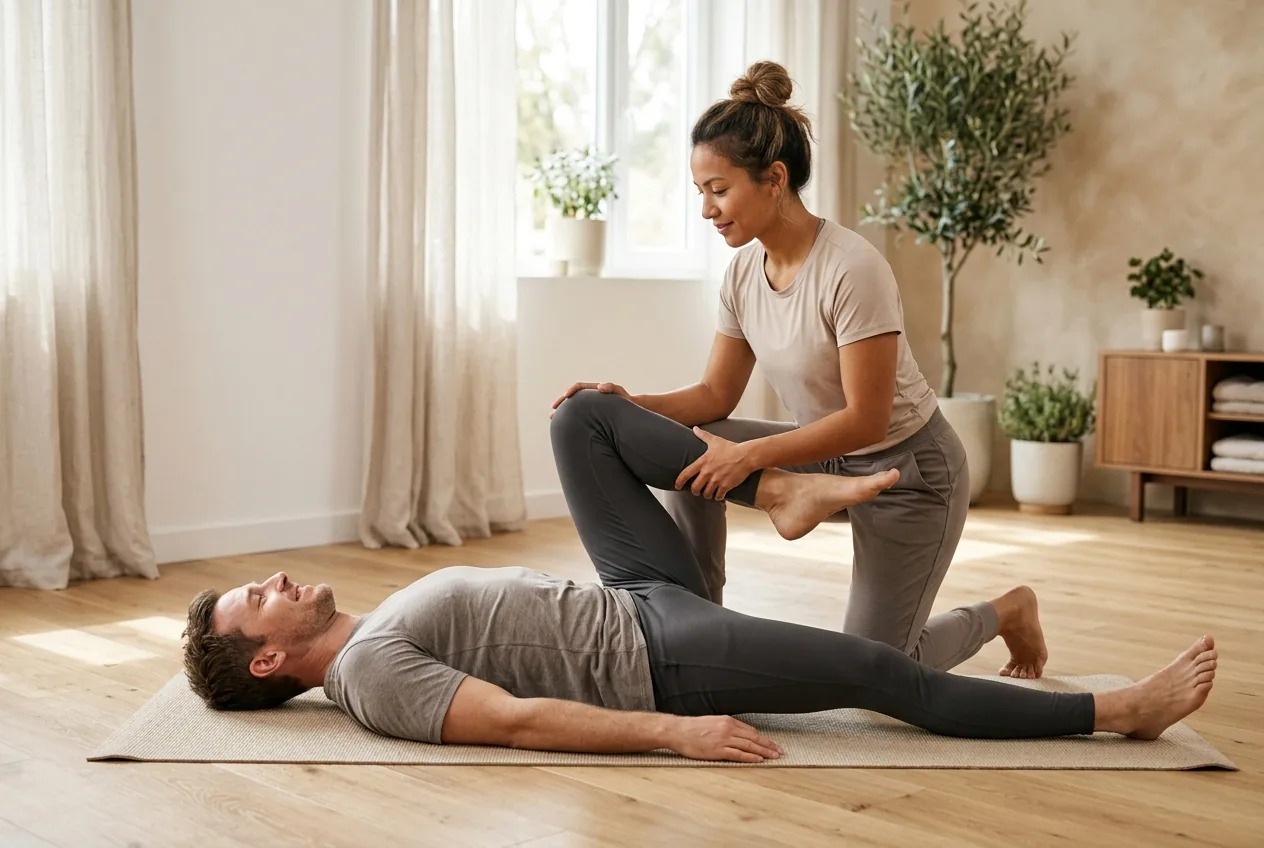
The method starts with a postural assessment — looking at how you stand, where your joints sit, which side is high or rotated, which load joints have drifted. From that reading, a specialist builds a menu: a personalized sequence of gentle exercises, done in a set order. Egoscue calls these exercises "E-cises."
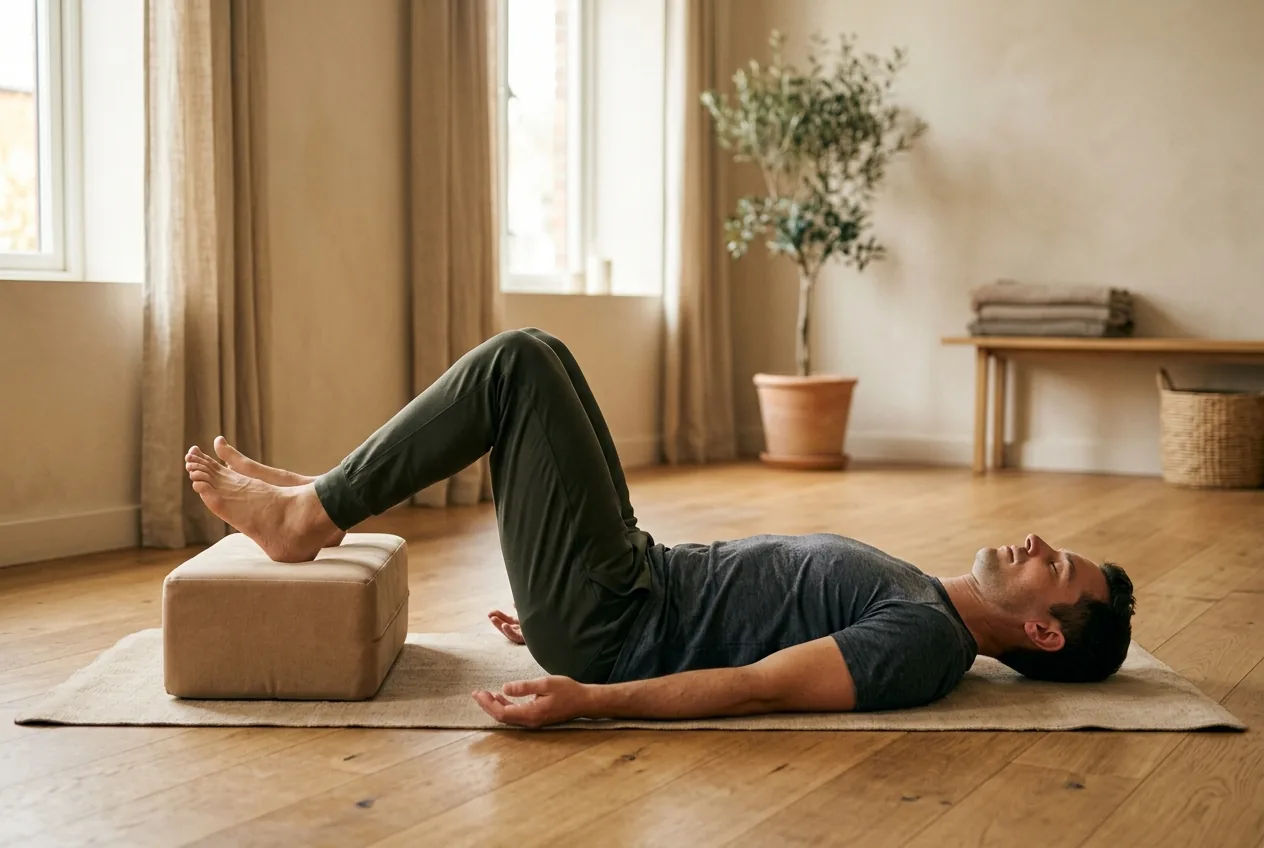
They're not strength training and they're not a sweaty workout. Most are slow, supported positions held for a few minutes — lying with your legs up on a block to let the lower back settle, gentle spinal rounding and arching, a held wall position for the hips and thighs. The point isn't to burn muscle; it's to wake up the muscles that switched off and let the overworking ones release, so your joints can return toward that stacked, neutral line. The *sequence* matters as much as the moves, because each position sets up the next.
The kinds of exercises it uses
If you've done posture work before, several Egoscue-style moves will look familiar, because they overlap with well-known corrective exercises:
- Gentle spinal rounding and arching — close to the cat-cow stretch — to restore mobility through the mid-back.
- Held wall positions like the wall sit to rebuild the hip and thigh support that sitting erodes.
- Head and neck repositioning along the lines of chin tucks to pull a forward head back over the shoulders.
The difference from grabbing those moves off a list is the *matching* and the *order* — which ones, in what sequence, for your specific posture. A self-guided starting point lives in how to improve your posture.
What it helps — and what it doesn't
Posture therapy fits the slow, recurring, movement-related pain that builds over months: the stiff lower back, the nagging neck, the hip that aches by evening, the sciatic-type pain that flares with sitting. It's also why so many people land here after pain that keeps coming back despite everything else.
It is not a treatment for disease or injury, and the method is clear about that. It is not the first move for pain after a fall or accident, a known fracture, pain with fever, numbness or weakness in both legs, or any loss of bladder or bowel control. Those are signals to see a clinician now, not start an exercise menu. If your symptoms fit that list, get them checked first — posture work comes after serious causes are ruled out, not instead of ruling them out.
Does the Egoscue Method work?
Honestly: the everyday results are strong and the formal research is still catching up. Many people get real, lasting relief, and the logic — correct the alignment driving the overload — is sound. The broader approach it belongs to, individualized postural therapy, was tested head-to-head against usual medical care in a randomized trial published in JAMA (the SPINE CARE trial, 2022) and showed greater improvement in pain and disability at three months and again at a year. We lay that evidence out on the science page. That trial studied the category, not a brand — but it supports the core premise that a posture-matched program can outperform standard care for chronic back pain.
The fair caveat: results depend on doing the daily menu consistently, and posture that drifted over years doesn't reset in a week. The good news is the change is real and yours to keep — which is the opposite of a brace. If you've weighed one, posture corrector vs exercises explains why a strap holds you up while corrective work teaches you to hold yourself. And no, the change isn't permanent-by-default in either direction — is bad posture permanent covers what actually sticks.
Doing Egoscue without a clinic
Working one-on-one with a certified specialist is the classic way to do this, and it works — but it's not cheap and not everywhere. The part that's hard to replicate on your own is the assessment and the matching: you can't prescribe the right menu until you've measured your actual deviations.
That's the gap Postureletics is built to close. It was created by an Egoscue-certified Posture Alignment Specialist and applies the same principles in an app: a two-minute photo assessment measures your specific posture deviations, then it builds a roughly fifteen-minute daily corrective program matched to them and re-assesses as you change. It's the method's logic — assess, correct the cause, re-check — without the clinic schedule. You can try the assessment here. Whichever route you take, the test is the same: not how the session felt, but whether your posture in the mirror changes over a couple of months.
Common questions
What is the Egoscue Method?
It's a posture-therapy approach to chronic musculoskeletal pain, developed by Pete Egoscue. It treats pain by correcting the postural misalignments behind it — using a personalized sequence of gentle corrective exercises called E-cises — rather than treating the spot that hurts.
Does the Egoscue Method really work?
Many people get lasting relief, and the broader approach it belongs to (individualized postural therapy) outperformed usual medical care for chronic back pain in a JAMA-published randomized trial in 2022. Results depend on doing the daily exercises consistently, and it's meant for chronic, posture-related pain rather than injury or disease.
What are E-cises?
E-cises are the gentle corrective exercises the Egoscue Method uses — mostly slow, supported positions held for a few minutes to wake up underused muscles and release overworked ones. They're prescribed as a personalized "menu" matched to your specific posture, and the order they're done in matters.
Can I do the Egoscue Method at home?
Yes — the exercises are gentle and home-friendly, and that's the whole format. The hard part to do alone is the assessment and matching the right exercises to your posture. A posture app that assesses you and builds the sequence, or a session with a certified specialist, solves that part.
Is the Egoscue Method the same as physical therapy?
No. Physical therapy usually treats a diagnosed, painful area with a standard protocol — ideal for a specific injury. The Egoscue Method assesses your whole posture and corrects the alignment pattern causing the overload, which is a better fit for chronic pain where the sore spot isn't the real source.
How much does the Egoscue Method cost?
One-on-one sessions with a certified Posture Alignment Specialist are priced like other private therapy and vary by clinic and location. App-based programs built on the same approach are far cheaper and can be free to start, which is the lower-risk way to see whether the method fits you.