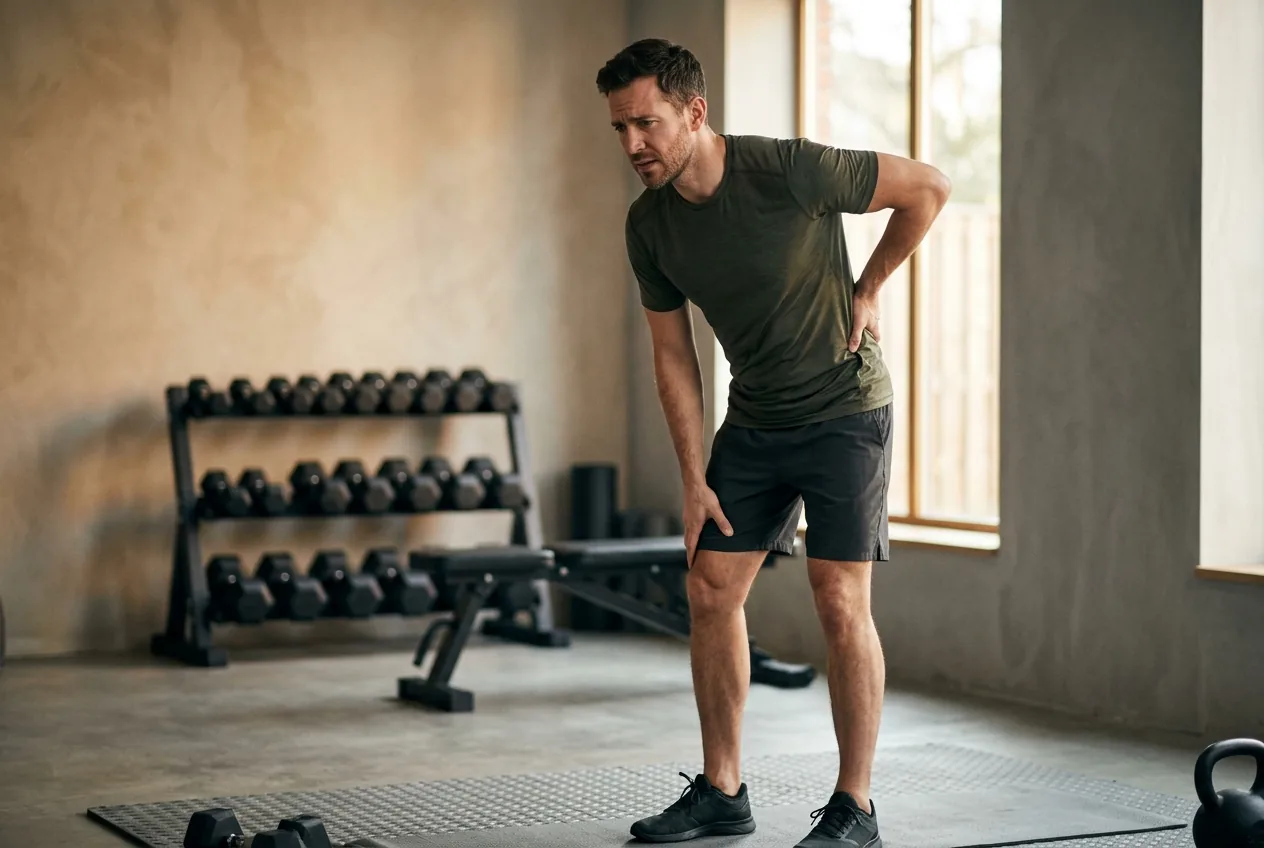
You finish a session feeling fine, and an hour later your lower back is a tight, deep ache that wasn't there before. Or it shows up mid-set — that pinch low in the back when you come up from a squat or a row. Lower back pain after a workout is one of the most common complaints from people who are otherwise doing everything right, and it's usually not a sign you've hurt yourself.
More often it's a sign that your lower back is covering for something else — picking up work that your core, hips, or glutes were supposed to handle.
Two kinds of post-workout back ache
It helps to separate the two.
The first is general muscle soreness — a dull, achy stiffness that comes on a day or two later, eases as you move, and fades within a few days. That's normal training soreness, the same thing you feel in your legs after a hard session. It's not a problem.
The second is the one worth paying attention to: a localized lower back ache or pinch that shows up during or right after lifting, especially on the same lifts every time. That's not random soreness. It's a loading pattern, and it tends to repeat until you change something.
Lower back pain from lifting is usually a form-and-posture signal, not a damage signal. Read it as feedback.
Why lifting lights up the lower back
When you hinge, squat, or press, your spine is meant to stay stable while your hips and legs do the moving. The job of holding the spine steady belongs to your deep core and glutes. When those don't fire well — which is common after years of sitting — your lower back muscles step in to stabilize a load they were never meant to carry. They fatigue and ache.
A few specific culprits:
- Hinging from the back instead of the hips. On deadlifts, rows, kettlebell swings, and even bent-over picking-up, the movement should come from the hips folding back. If it comes from rounding or over-arching the lower back, the back takes the load. Deadlifts are the classic case — the mechanics are broken down in lower back pain after deadlifts.
- Over-arching under load. Pressing weight overhead or doing planks with a sagging middle lets the lower back hyperextend to compensate for a weak core, which compresses and irritates it.
- An already-tipped pelvis. If you start with tight hip flexors and an anterior pelvic tilt, your lower back is over-arched before you even pick up a weight. Loading on top of that concentrates strain right there.
- Skipping the warm-up. Going straight into heavy lifts with cold, sticky hips means your back compensates for hips that won't move yet.
How to train without the flare-up
The fix isn't to stop training. It's to put the load back where it belongs.
Brace before you lift
Before a working set, take a breath into your belly and gently tighten your midsection as if about to be poked — that's a brace. A braced trunk lets your hips move under a stable spine instead of the spine bending under load. Practice it on lighter sets first.
Move from the hips
For any hinge, think about pushing your hips back toward the wall behind you and keeping your spine in one neutral line, then driving the hips forward to stand. Your back should stay still while your hips do the folding. If you can't feel the difference, lighten the weight until you can.
Warm up the right things
A few minutes before lifting: cat-cow to mobilize, a kneeling hip flexor stretch to free the hips, and a set of glute bridges to wake the glutes so they fire during the main lifts. This alone resolves a lot of "lower back sore after working out" complaints.
Build the support
Outside of your main lifts, train the muscles that protect the spine directly. Safe core work that doesn't aggravate the back is covered in ab exercises for lower back pain, and glute work in the glute bridge for back pain.
Right after a session
If your back is sore post-workout, gentle movement beats lying still. A short walk and easy mobility help more than icing and resting flat. Don't pile another heavy back-loading session on top the next day — alternate.
When to see a doctor
Most post-workout back soreness is muscular and settles within a few days. A few signs mean you should stop and get checked rather than train through it.
See a clinician promptly if you have numbness, tingling, or weakness spreading down a leg, any loss of bladder or bowel control, pain that came with a distinct pop or sharp injury under heavy load, pain that's severe or steadily worsening rather than easing, fever with back pain, or pain that doesn't settle over a week or two of easier training. A back you genuinely tweaked under a heavy bar deserves a professional look rather than guesswork.
Why it keeps happening on the same lifts
Here's what most training advice misses. If your lower back lights up on the same movements every time, the issue usually isn't that lift in isolation — it's that you walk into the gym with a posture that already overloads your back, so every loaded hinge or press piles onto a pre-stressed area. Cue yourself all you like; if the underlying alignment makes your back the default stabilizer, it'll keep speaking up.
Lasting relief comes from knowing your own pattern: how your pelvis sits, which stabilizers aren't firing, where the load actually lands. That's the idea behind a posture assessment that measures your real deviations and builds the corrective routine around them, so your back stops being the first muscle to volunteer. If lifting keeps flaring your back no matter how clean your form feels, see how a posture-based method approaches chronic back pain.
Train the hips and core to do their jobs, and your lower back can go back to doing its own.
Common questions
Why does my lower back hurt after a workout?
Usually because your lower back is stabilizing a load your core and glutes should be handling. After years of sitting those muscles often underperform, so the back compensates on hinges, squats, and presses and fatigues. It points to form and posture more than injury.
Is lower back pain after lifting normal?
General achy soreness a day or two later that eases with movement is normal training soreness. A localized lower back pinch during or right after the same lifts is a loading pattern worth fixing with bracing, hip-driven movement, and a proper warm-up — not something to push through.
Should I keep training with a sore lower back?
Gentle movement and easier sessions usually help more than rest. Avoid piling heavy back-loading lifts on consecutive days. Stop and get checked if there's numbness or weakness in a leg, a sharp injury under load, or pain that's severe or steadily worsening.
How do I stop my lower back hurting when I lift?
Brace your midsection before each set, drive movement from the hips rather than the lower back, warm up the hips and glutes first, and train the core and glutes directly so they protect the spine. If it persists on the same lifts, your starting posture is likely overloading the back.