
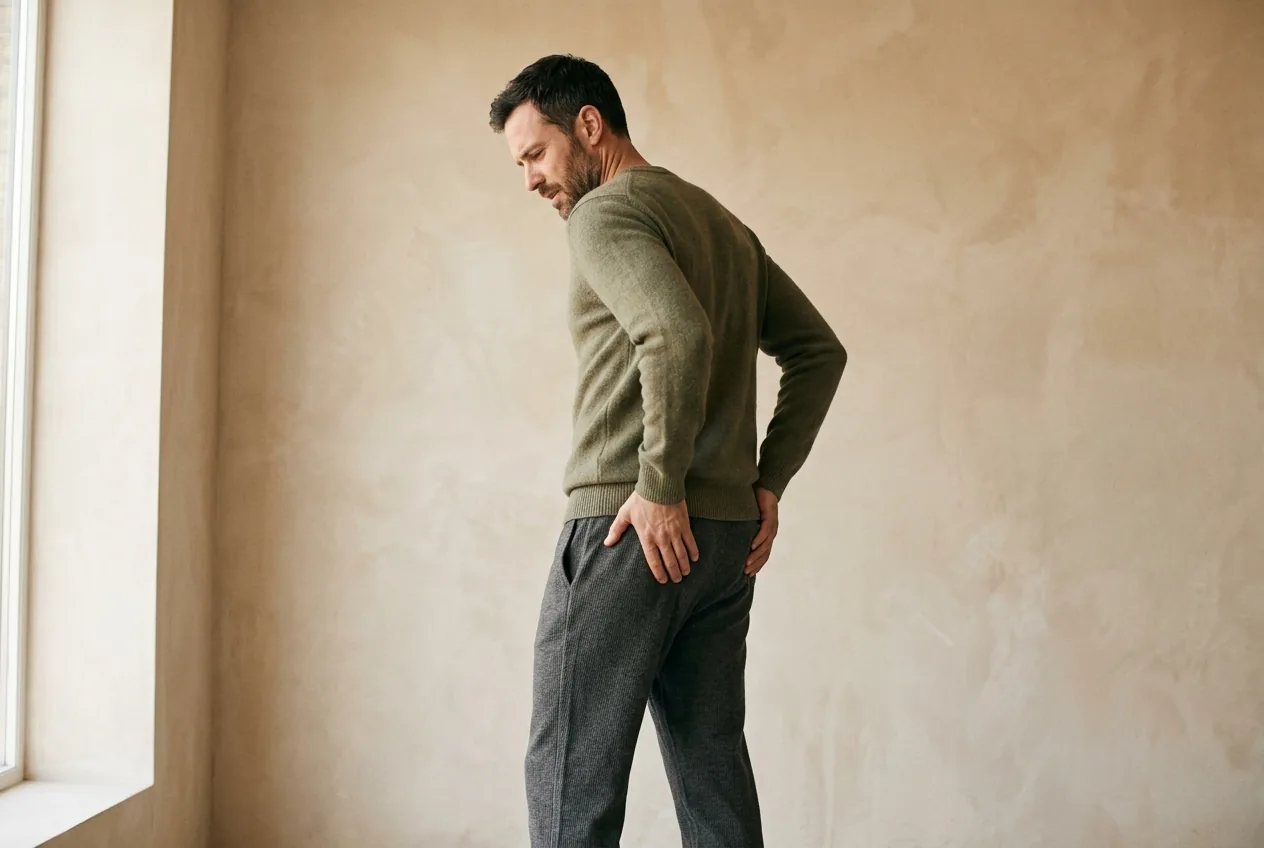
You sit down on a hard chair and there it is — a deep, hot ache parked in one buttock, sometimes sharp enough to make you shift your weight every few minutes. It doesn't shoot down your leg the way sciatica is "supposed" to. It just sits there, in the cheek, and won't quit.
Sciatica pain in the buttock only is a real and common pattern, and the fact that it stops short of the leg is actually useful information. It tells you where the irritation likely sits and points to a slightly different short list of culprits than full-length leg pain. Let's walk through what's going on and what tends to settle it.
Why the pain stops at the buttock
The sciatic nerve is thick, and it runs from the lower spine, through the buttock, and down the back of the leg. Pain anywhere along it can be sciatica. When the irritation is mild or sits high — near where the nerve passes through the buttock rather than down at the disc — the pain can stay local. It aches in the cheek without traveling far.
A few things commonly produce buttock-dominant pain:
- The piriformis muscle. This small, deep muscle in the buttock crosses right over the sciatic nerve. When it's tight or overworked, it can compress and irritate the nerve, producing a deep buttock ache that worsens with sitting. This is close enough to true sciatica that telling them apart matters — the sciatica vs piriformis syndrome breakdown is worth a read.
- A mildly irritated nerve root. A small disc bulge or early nerve irritation can refer pain to the buttock before it ever reaches the leg. Sometimes this is sciatica in an early or milder form.
- The SI joint. The joint where the pelvis meets the spine sits right above the buttock and refers pain into that area. It can mimic sciatica closely. If your pain is more to the side and lower back, the SI joint pain article may fit better.
- Trigger points in the glutes. Tight, knotted glute muscles can ache deeply and even send a vague referral down the leg without involving the nerve much at all.
The pattern — deep ache, worse with sitting, parked in one cheek — is the through-line for most of these.
The sitting connection
Notice when it's loudest. For a lot of people, buttock pain is at its worst after sitting, especially on a hard or narrow seat, or after a long drive. That's not a coincidence. Sitting puts the buttock muscles on stretch over the back of the chair and, if the piriformis is involved, presses the muscle right onto the nerve underneath it. Sit on your wallet and it gets worse still.
There's a posture layer underneath this. If your pelvis tilts or rotates, or one hip sits higher than the other, the glutes and the piriformis on one side end up doing more work to keep you level. Over time, that overworked side gets tight and cranky, and the nerve running beneath it pays the price. It's the familiar pattern of the body compensating around an imbalance, with the strain landing in one spot.
Buttock-only pain is often the nerve telling you the irritation is local and mild — which is good news, if you treat it patiently.
What tends to help
The aim is to take pressure off the buttock and calm the nerve, not to force anything.
- Change how you sit. Get off hard, narrow seats. Use a cushion, sit back into the chair rather than perching, and stand up every twenty to thirty minutes. Empty your back pocket.
- A gentle piriformis stretch. Lying on your back, cross the sore-side ankle over the opposite knee, then gently draw the supporting thigh toward your chest until you feel a stretch deep in the buttock. Hold easy, breathe, stop short of any shooting pain. The piriformis syndrome stretches walk through more options.
- Wake up the glutes. Weak glutes make the piriformis overwork to cover. A simple glute bridge done daily helps the right muscles carry the load.
- Walk, gently and often. Short walks keep the hip moving and the nerve calm. Long stretches of stillness tend to stiffen everything back up.
Skip the deep foam-roller grinding directly on the nerve, hard forced stretches, and anything that reproduces sharp electric pain. With nerve irritation, gentle and frequent beats hard and occasional every time.
When to see a doctor
Most buttock-dominant pain is mechanical and settles with patience. But get checked promptly if the pain spreads down the leg and gets worse, if you develop leg or foot weakness, or if numbness creeps into the saddle area between the legs. Any trouble controlling your bladder or bowel needs same-day care — that's a red flag, not something to wait out.
Also see a clinician if the pain followed a fall or accident, comes with fever or unexplained weight loss, or is severe and steadily climbing rather than easing. This is education, not a diagnosis — a hands-on exam is the way to tell piriformis from a disc from the SI joint with any confidence, and it's worth knowing when to worry about back pain.
Why the cause matters more than the cheek
Here's the catch with buttock pain: you can stretch and rub the sore spot for weeks and it keeps coming back, because the sore spot isn't the cause — it's the symptom of a hip or pelvis that's loaded unevenly. The piriformis stays tight because it's still doing extra work. The nerve stays irritated because nothing changed upstream.
Knowing your own pattern is what breaks that loop. A posture assessment measures how your pelvis and hips are actually sitting, so the routine targets the imbalance feeding the buttock pain rather than just chasing the ache. If your buttock pain keeps returning no matter how much you stretch it, the posture therapy approach is built to find the setup underneath.
Local pain, treated patiently, with the cause addressed — that's the path out of a buttock that won't stop aching.
Common questions
Can sciatica stay only in the buttock and not go down the leg?
Yes. When the irritation is mild or sits high near where the nerve passes through the buttock, the pain can stay local. It's a common and often milder pattern than full-length leg pain.
How do I know if it's piriformis or sciatica?
They overlap a lot, since the piriformis sits right over the sciatic nerve. Piriformis-related pain often centers in the buttock and flares with sitting, while disc-related sciatica tends to travel further down the leg. A proper exam is the reliable way to tell.
Why does my buttock hurt more when I sit?
Sitting compresses the buttock muscles against the chair and, if the piriformis is tight, presses it onto the nerve underneath. Hard or narrow seats and sitting on a wallet make it worse.
What stretch helps buttock sciatica?
A gentle figure-four piriformis stretch — lying on your back, ankle crossed over the opposite knee, drawing the thigh toward your chest — is a common starting point. Stop short of any shooting pain and keep it easy.