
You woke up, went to turn your head to check the clock, and your neck refused. Now it's locked to one side, sore on the slightest turn, and you're moving your whole torso instead of your head to look at things. A stiff neck from sleeping has a way of hijacking the entire morning.
The good news: most of these settle within a couple of days, and there's plenty you can do to speed it up. The better news: once you understand why it happened, you can usually stop it happening again.
Why you wake up with it
A stiff neck after sleep almost always comes down to one thing — your head spent several hours at an angle your neck didn't like, and the muscles on one side stayed shortened and tense the whole time. Sleep on your stomach with your head cranked to one side, or on your side with a pillow too flat or too thick, and the small muscles of the neck spend the night in a held, awkward position. By morning they've stiffened and protest when you ask them to move.
It feels dramatic, like something tore. Usually nothing did. The muscles are guarding — clamping down to protect a joint that got irritated by hours in a bad position. That guarding is what limits your range of motion.
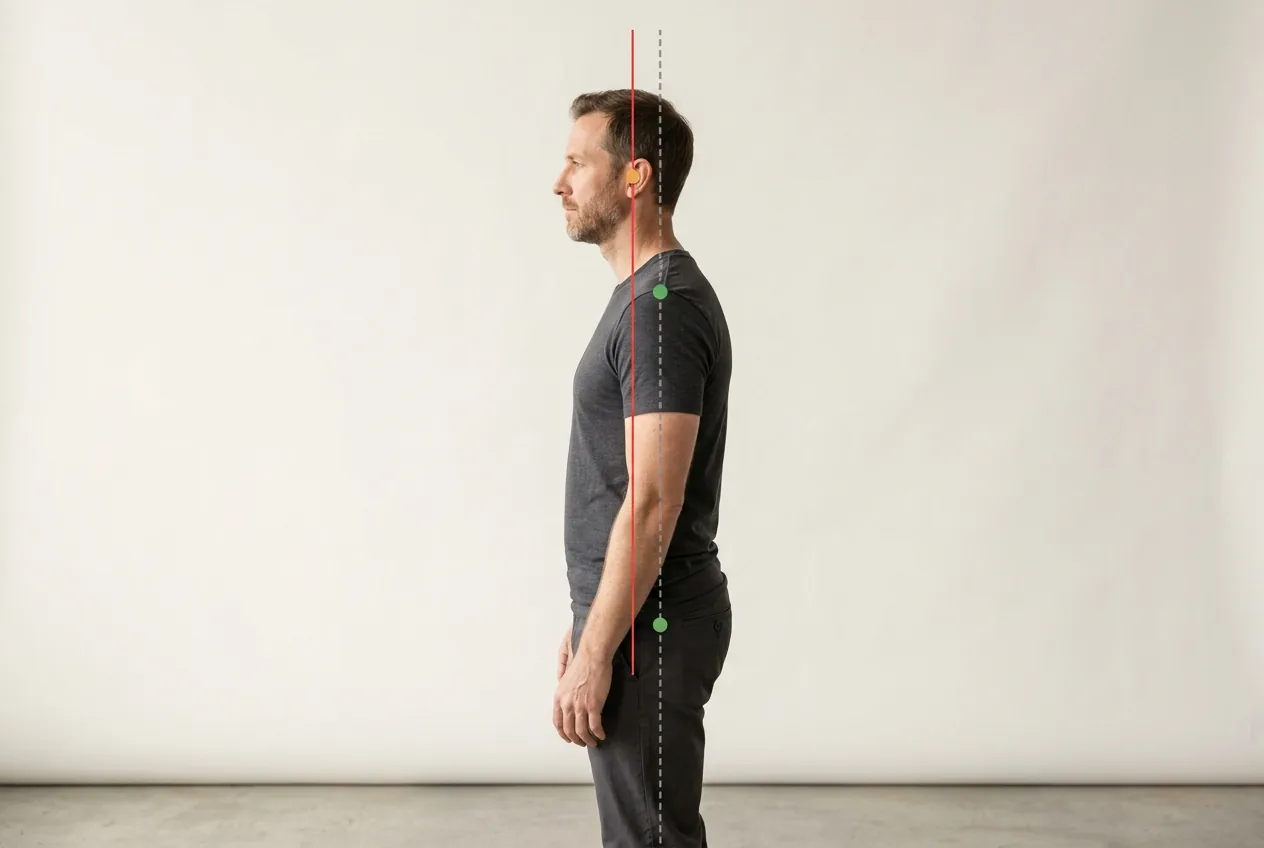
People who already carry their head forward during the day are more prone to it, because the neck starts the night already loaded and stiff. If your daytime posture leans that way, the forward head posture pattern is worth understanding, because it's often the quiet setup behind a neck that seizes overnight.
Your neck didn't break in your sleep. It got stuck holding a position for hours, and now it's bracing.
How to fix it fast today
The aim in the first day is to calm the guarding, restore a little movement, and not make it worse by forcing it.
Gentle range first, never force
Don't crank your neck to "stretch it out." That feeds the guarding. Instead, move within the range that doesn't hurt.
- Sitting tall, slowly turn your head toward the painful side only as far as comfortable. Hold two seconds, return.
- Tilt your ear gently toward the easy-side shoulder. Hold, return.
- Repeat each a few times, every hour or two. You're coaxing movement back, not chasing a deep stretch.
The principle here is that pain-free range tells the nervous system the joint is safe, which lets the guarding relax. Pushing into sharp pain tells it the opposite, and the muscles clamp down harder. So the rule is simple: go to the first hint of resistance, not past it, and come back. Each round you'll usually find you can turn a few degrees further than the last.
Warmth to loosen the guarding
Heat helps a guarded muscle let go. A warm shower aimed at your neck and upper shoulders, or a heat pack for 15 minutes, often unlocks more range than any stretch in the first day or two.
Keep it moving through the day
A stiff neck hates stillness. The worst thing you can do is hold it rigid for hours out of fear. Gentle, frequent movement settles it faster than rest. Chin tucks are a good, safe way to reintroduce controlled motion once the sharpest pain eases — the chin tucks exercise guide shows the right technique so you don't aggravate it.
Don't reach for the rigid collar
A soft collar feels reassuring, but holding the neck dead still for days actually slows recovery — the muscles stiffen further and the guarding deepens. If you instinctively want to brace the neck and barely move it, that's the urge to push back on. Support it for sleep with a good pillow, then keep it gently mobile while you're awake.
How to stop it coming back
Fixing today's stiff neck is half the job. The other half is the sleep setup that caused it.
- Match your pillow to your sleep position. Side sleepers need a pillow thick enough to keep the head level with the spine — not tilted up or sagging down. Back sleepers need something thinner that supports the natural curve without shoving the head forward.
- Stop sleeping on your stomach. It forces your head to one side all night and is the single most common cause of a morning-stiff neck. If you can't break the habit, a thinner pillow reduces the strain.
- Don't fall asleep on the couch with your head propped on the armrest. That's a guaranteed bad angle for hours.
If neck pain and morning stiffness are becoming a regular thing rather than a one-off, the daytime pattern usually matters more than the pillow. Pain that keeps returning at the base of the skull, for instance, often points back to how the head sits all day — the neck pain at the base of your skull piece covers that mechanism.
What to stop doing
- Stop the aggressive neck cracks and forced stretches. They feel productive and slow recovery.
- Stop holding your neck dead still all day. Movement is medicine here.
- Stop ignoring a pillow that's clearly wrong. One bad night is bad luck; the same crick every week is a setup problem.
When to see a doctor
Posture work is education, not medical care. Most stiff necks from sleeping ease within a few days. But see a clinician promptly if the stiffness comes with a fever, if a severe headache arrives suddenly, if you have numbness, tingling, or weakness spreading into an arm or hand, or if the neck pain followed a fall or accident. Pain that's severe, steadily worsening, or refuses to improve over several days also deserves a proper look.
The piece most people skip
Warmth, gentle movement, and a better pillow handle most morning stiff necks. But if you keep waking up with one, the question isn't really the pillow — it's why your neck is already tense and forward-loaded before you even lie down. That's a daytime posture pattern, and it's specific to you.
A proper posture assessment measures how your head and shoulders actually sit and builds a daily routine around it. Settle the daytime pattern and the morning crick tends to stop showing up.
Fix the night you're having. Then fix the days that keep setting it up.
Common questions
How long does a stiff neck from sleeping usually last?
Most ease within a few days, often sooner if you keep it gently moving rather than holding it still. If it's dragging past a week or getting worse, it's worth a proper look.
Should I use heat or ice on it?
Warmth tends to suit a stiff, tense neck better, since it relaxes the muscles and helps you move. A warm shower aimed at the neck, or a heat pad for ten minutes, is a good first move. Ice is more for a fresh, sharp injury.
Is it better to rest my neck or keep moving it?
Keep moving it, within a comfortable range. Holding it dead still all day stiffens it further. Slow, easy turns and gentle nods through the day are part of the recovery.
What pillow height stops me waking up stiff?
It depends on how you sleep. Side sleepers need a thicker pillow to keep the head level with the spine; back sleepers need a thinner one that supports the curve without pushing the head forward. The right height keeps your neck neutral, not tilted.